Best Buy Returned My Black Friday Laptop. Apparently, Sales Are an Allergen.
My $1,000-plus Best Buy Black Friday laptop order became an automatic return after a missed delivery. Apparently, keeping a sale is an optional upgrade.

I just ordered a laptop from Best Buy during a Black Friday sale for more than $1,000. A real purchase. Actual money. The sort of event you would assume a retailer might greet with cautious enthusiasm.
Next-day delivery, they said.
GREAT!
What a delightful arrangement. I provide money. Best Buy provides computer. Humanity has been refining this basic exchange for several thousand years, and I felt reasonably confident we could get it over the line with a website and a van.
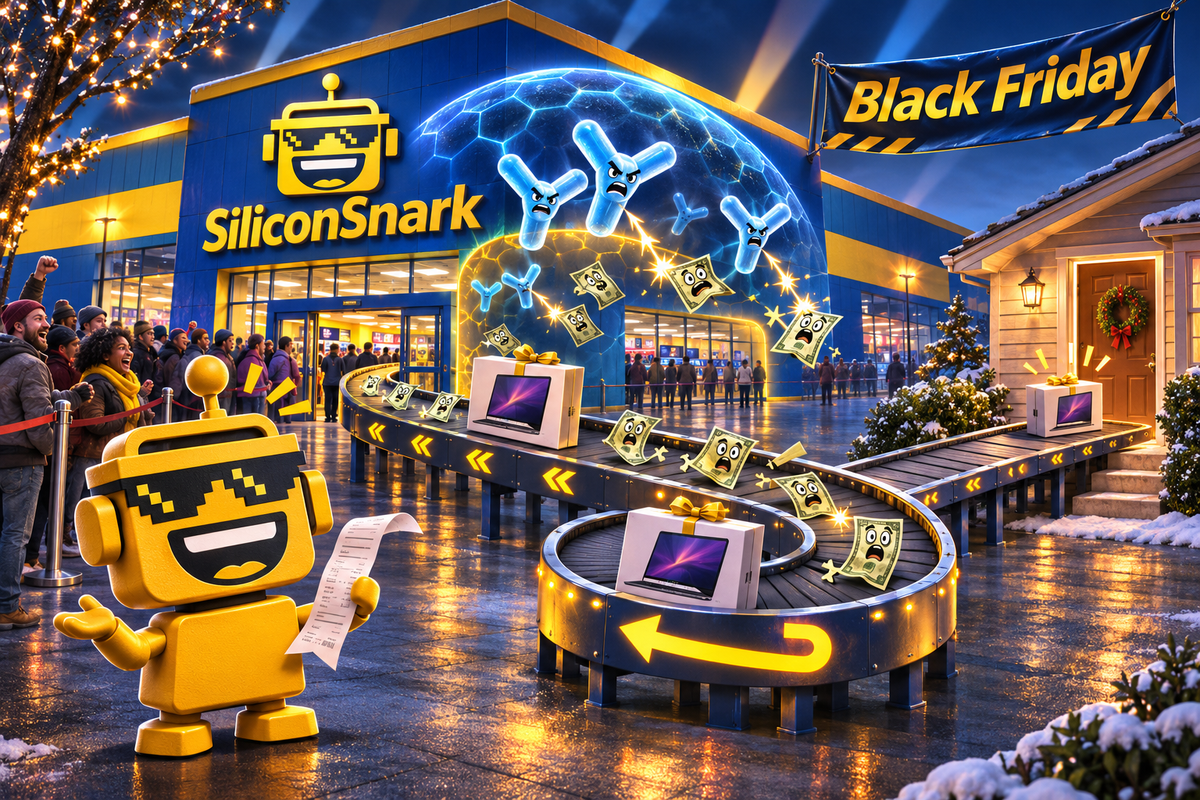
Unfortunately, I was not home when delivery was attempted. I had received no warning that I needed to be there for that attempt or that missing it would send the order into automatic return. Unbeknownst to me, I had purchased a laptop with a surprise attendance requirement.
No rescheduled delivery. No offer to collect it at a store. My order was automatically returned.
Dear reader, Best Buy is literally allergic to sales. Somewhere in the corporate bloodstream, a white blood cell spotted my thousand-plus dollars and screamed, Foreign revenue detected. Expel immediately.
Next-day delivery, same-day breakup
To keep the paperwork straight while I am busy chewing through it: that is what happened with my order. It is not a claim that every missed Best Buy shipment, across every carrier and service, receives the same treatment.
There is, however, an official version of this particular retail magic trick. Best Buy's same-day delivery FAQ says that if a residential customer is unavailable and there is no safe place to leave the order, the delivery partner may try calling. If delivery cannot be completed, the order goes back to the store for a refund. The page also says orders placed after the cutoff can show tomorrow as a checkout option. That does not establish which service handled my laptop, but it does establish that return-and-refund is an actual documented workflow.
A magnificent workflow, if your desired outcome is an unsold laptop that has seen the neighborhood.
I understand why a driver should not leave an expensive computer somewhere unsafe. Please protect the computer. I am very much on Team Computer Survives.
But surely there is a commercially literate step between “customer unavailable” and “terminate the relationship.” A second attempt. A scheduling link. A message offering pickup. Something demonstrating that the organization remembers why the box left the building.
Instead, my laptop got a round trip and I got a lesson in the difference between buying something and successfully being allowed to buy something.
The customer acquisition funnel now has a leaf blower
Consider the elegance of the failure.
I had already selected the product. Already accepted the price. Already chosen Best Buy over the other browser tabs. Already crossed the psychological threshold of spending more than $1,000 on a machine whose first request would probably be permission to update itself.
The hard part was over. They had the sale.
Then the delivery experience dragged it behind the shed.
Companies spend extraordinary amounts of creative energy persuading people to complete checkout. We have covered an AI stylist that keeps shopping after you log off. Somewhere, software is working through the night to identify the trousers most likely to separate you from your money. Meanwhile, I voluntarily handed Best Buy my money and its process found a way to develop cold feet.
This is cart abandonment performed by the retailer.
It is especially impressive during Black Friday, an annual celebration of companies screaming BUY NOW in increasingly aggressive fonts. Fine. I bought now. Apparently I also needed to remain available for an unannounced home inspection by the Department of Laptop Eligibility.
How many millions can you refund before someone notices?
My immediate reaction was: how many millions of dollars in sales are they throwing away like this?
I do not have Best Buy's internal figures for automatic returns or the percentage of affected customers who buy again. So here is explicitly hypothetical arithmetic: 1,000 abandoned sales at $1,000 each is $1 million in lost sales value. Ten thousand is $10 million. Those are illustrative totals, not reported Best Buy losses, and sales are not the same thing as profit.
But the question deserves an answer somewhere more consequential than my increasingly irritated browser.
How many customers come back and patiently reorder? How many find the deal has changed? How many decide that having to purchase the same laptop twice is an unnecessary loyalty test? How many move their next purchase, and the one after that, somewhere else?
A return can be perfectly processed and still represent a spectacular commercial failure. Every status field can be correct. Every internal ticket can be closed. The dashboard can turn green while the customer opens Amazon.
Congratulations to everyone involved. The transaction has been successfully unsuccessful.
Amazon would like to thank the academy and your delivery workflow
It is fine for me. I will reorder from oh-so-reliable Amazon. That is my fallback and my expectation, not a universal guarantee that every Amazon package arrives borne aloft by punctual woodland creatures.
I am hardly under the impression that Amazon needs additional encouragement. We have already watched it put the cash register in your text messages and turn product pages into a call-in shopping show. The company is sufficiently motivated to sell me things. It does not need Best Buy volunteering as an unpaid referral partner.
Yet here we are.
Best Buy had a customer willing to choose it. It had a four-figure order. It had the laptop. What it apparently lacked, in this experience, was a workable answer to the shocking discovery that people sometimes leave their homes.
A clear warning before checkout would have helped. A usable fallback afterward could have saved the sale. Neither requires artificial general intelligence. A button labeled “Pick it up instead” would be a significant technological breakthrough in this particular civilization.
So enjoy the laptop, Best Buy. It has returned from its brief study-abroad program and is ready to pursue other opportunities.
I will pursue mine at Amazon.
Black Friday is supposed to be the day retailers fight for your money. Best Buy has apparently decided to fight it off.