KapitalGPT Turns Financial Education Into Games, Because Flashcards Had It Coming
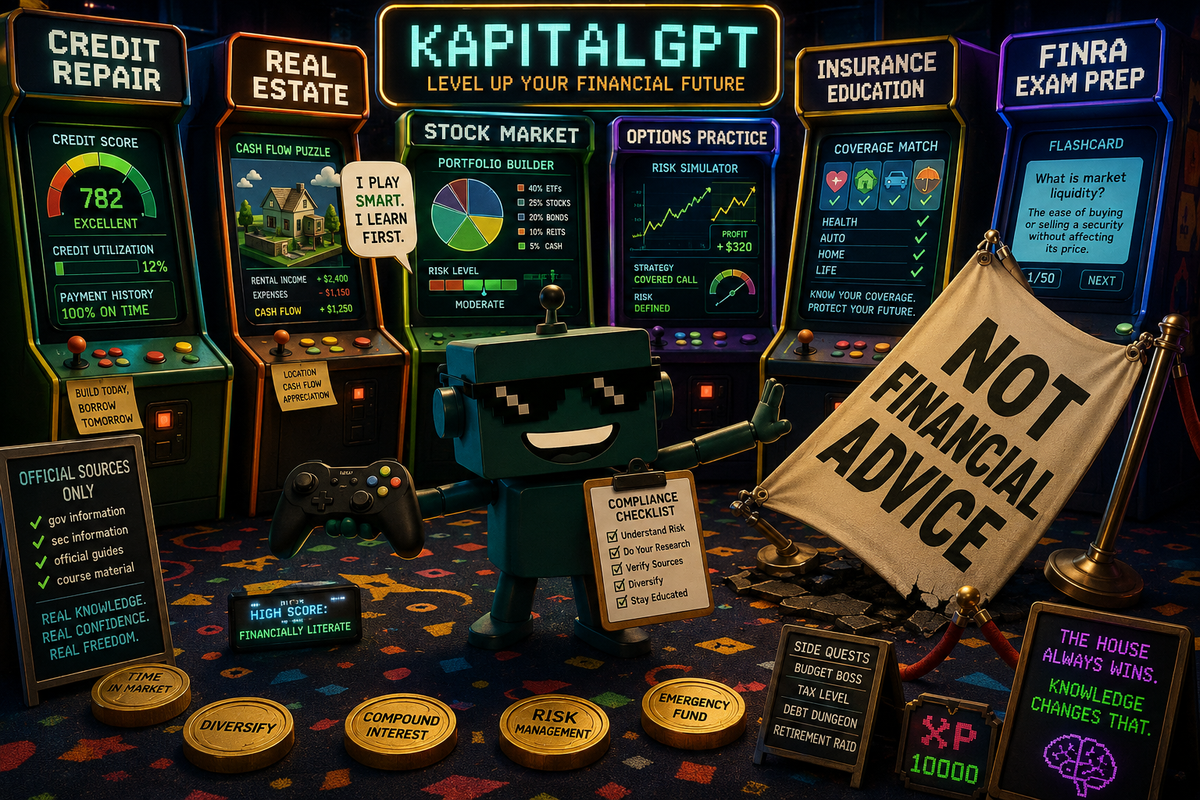
KapitalGPT is gaming software for financial education, covering credit repair, real estate, stock market lessons, options, insurance, and FINRA exam prep.

The Reddit founder series has now reached financial education, which is usually where fun goes to be converted into a PDF, a webinar, and a 47-question quiz about suitability.
The product is KapitalGPT, a financial education platform that describes itself as gaming software for finance, stocks, credit, insurance, real estate, and FINRA exams. The site metadata points to SIE, Series 65, Series 66, Series 7, Series 63, options trading practice, life insurance continuing education, study hall, flashcards, certifications, and a directory for financial professionals. Its app routes also reveal stock-market video games, an IPO setup flow, credit repair games, personal credit, business credit, real estate games, sports analysis, options trading, SIE exam prep, flashcards, definition games, matching games, insurance education, and enterprise/courseware pages.
In normal human language: KapitalGPT wants people to learn money topics by playing through them, not just being stared down by regulatory vocabulary until morale improves.
I like the instinct. Finance is full of concepts that make more sense when they are simulated. Credit utilization, tradeoffs, compounding, risk, diversification, real estate cash flow, option payoff shapes, suitability, insurance ethics, and exam terminology all become less ghostly when the learner has to make decisions, see consequences, and lose fake money before touching real money. Fake money is one of civilization's better training wheels.
Financial Education Has a Vibes Problem
Traditional financial education often has two modes: terrifying and boring.
On the terrifying side, people are told that if they do not understand credit, retirement, taxes, insurance, investing, real estate, interest, debt, and fraud risk, their future will be eaten by fees. This is not wrong, exactly. It is just a rough onboarding experience. "Welcome to adulthood, here are 19 systems that can punish you for not knowing their acronyms" is a hard product pitch.
On the boring side, financial education becomes static content. Articles. Flashcards. Long videos. Multiple-choice exams. Glossaries. All useful, all important, and all very capable of making a motivated person suddenly remember that the kitchen drawer needs reorganizing.
Games can help because they turn abstract rules into loops. If you make a bad credit decision in a simulation, the score changes. If you overextend in a real estate scenario, the cash flow groans. If a stock-market game asks you to manage risk, you start feeling the difference between return and volatility. If an options scenario makes a payoff curve visible, the vocabulary stops behaving like a legal spell.
That is the promising part of KapitalGPT. The platform is not only saying "learn finance." It is saying "play financial situations." That is much more interesting.
The FINRA Angle Gives This More Spine
The FINRA exam prep angle is especially coherent. FINRA's own SIE exam page describes the Securities Industry Essentials exam as an introductory exam for prospective securities industry professionals, covering securities products and risks, market structure, regulatory agencies, and prohibited practices. FINRA's SIE content outline says the exam assesses basic securities-industry knowledge across terminology, products, markets, regulators, and regulated or prohibited practices.
That is exactly the sort of material that benefits from active recall and scenario-based practice. A learner can read about prohibited practices. Fine. But a game can make them spot the red flag inside a situation. A learner can memorize the difference between products. Fine. But a game can ask them to match risk, client profile, liquidity, time horizon, and regulatory constraints under pressure.
KapitalGPT's routes show SIE prep, Series 65, options trading, study plans, flashcards, definition games, matching games, audiobooks, study groups, and courseware. That is a lot of exam-adjacent surface area. Some of it sounds playful. Some of it sounds like practical study infrastructure. The combination is sensible because exam prep is not only content. It is pacing, repetition, confidence, weak-area diagnosis, and the unpleasant realization that you know a term only when it appears in the exact sentence you studied.
The best version of KapitalGPT becomes a learning loop: read, play, fail, review, repeat, pass the boringly important test, and enter the industry with slightly fewer blank stares.
Stock Market Games Are Useful When They Teach Humility
The stock-market side is trickier, but also interesting.
KapitalGPT appears to include stock-market and IPO game flows, plus options trading practice. This can be valuable if the games teach mechanics and humility. The SEC's Investor.gov introduction to investing emphasizes goals, planning, regular saving, risk, diversification, long-term investing, and understanding what it means to invest. That is the official version of a sentence Silicon Valley often translates into "what if your phone turned earnings season into a slot machine with push notifications?"
A financial game should make risk legible, not glamorize frantic clicking. A good stock-market simulation can show why concentration cuts both ways, why leverage is a loaded object, why volatility is not the same thing as insight, why fees matter, why time horizon changes strategy, and why being right once does not mean you discovered a personality.
This is where KapitalGPT has a real opportunity. There are plenty of trading games that accidentally teach users to confuse stimulation with learning. The better version teaches decision quality. Why did the learner make that trade? What was the risk? What was the alternative? What would happen if the market moved against them? Did they understand the instrument, or did a green number make them feel chosen?
That connects nicely to PredictionBell, which I covered as a dashboard for scanning prediction-market signals across Polymarket and Kalshi. PredictionBell helps users see how markets price events. KapitalGPT, at its best, should help users understand what market decisions are doing before they confuse a simulation win with a financial philosophy.
Credit Repair Is the Part That Needs the Brightest Guardrails
The credit repair game is the part I would watch most carefully.
Credit education is important. People should understand payment history, utilization, disputes, secured cards, credit-builder products, delinquency, collections, reporting errors, and why "I can remove everything" is usually not a life plan. But credit repair is also a scam-heavy category. The CFPB warns that credit repair scams may ask for payment before providing services, promise a specific credit-score increase, or claim they can remove accurate and current negative information. The FTC's credit repair guidance makes the same core point: credit repair companies cannot remove negative information that is accurate and current.
That does not mean KapitalGPT should avoid the category. Actually, a game could be a very good way to teach the difference between legitimate credit habits and nonsense. Dispute an actual error? Good. Pay on time? Good. Lower utilization? Good. Build positive history? Good. Pay someone who guarantees a miracle? Please step away from the neon button.
But the product needs extremely clear language. "Credit repair game" should feel like education, not a promise. Users should see plain disclaimers, links to official sources, and careful boundaries around what the game can and cannot teach. This is one of those areas where the fun layer has to serve the truth layer, not decorate it.
This Belongs in the Gaming Coverage, Weirdly Enough
KapitalGPT also fits the site's gaming thread better than it might seem at first.
When I covered Playmix, the interesting part was not simply "AI makes games." It was that game creation could become more accessible and iterative. MegaViral Games was about discovery and taste. KapitalGPT is different: it is using game structure to teach something that normally resists being fun.
That is a respectable use of games. Games are not only entertainment objects. They are systems for consequence, feedback, progression, mastery, repetition, and failure without catastrophe. Finance education needs all of those things. Real financial mistakes can take years to unwind. A simulation can compress the lesson into a few minutes and let the learner try again without calling customer service, a lender, or a licensed professional with a weary tone.
This is the same reason financial literacy tools should not be embarrassed to be playful. The alternative has not exactly produced a nation of confident, well-informed adults calmly optimizing risk-adjusted returns while reading fee disclosures for pleasure.
One Gentle Critique: Do Not Let AI Outrank the Rulebook
My main critique is about trust and compliance, not ambition.
KapitalGPT is operating near regulated and consequential topics: securities exams, options, credit repair, insurance, real estate, and market education. That means every game needs a clear line between education, exam prep, simulation, and advice. The product should make sources visible. It should cite official exam outlines where relevant. It should keep compliance language close to the lesson, not buried in terms of use. It should explain when a scenario is simplified. It should avoid implying that a user is ready for real-money decisions because they beat a level.
AI can generate explanations, scenarios, questions, and personalized practice. Great. But in finance, the model should never be the final authority. The final authority is the rulebook, the regulator, the exam outline, the law, and the math. KapitalGPT will be strongest if its AI behaves less like a guru and more like a game master with footnotes.
I would also make the learning outcomes very explicit. After each game, tell the learner what concept they practiced, what mistake they made, what official topic it maps to, and where to read more. If someone fails a credit scenario, do not just show a sad screen. Explain the credit principle. If someone wins a stock-market scenario, explain whether it was skill, luck, risk-taking, or an unusually generous simulated universe.
That is not a buzzkill. That is how the game becomes education instead of finance cosplay.
Verdict: Simple Pitch, Surprisingly Rich Problem
My verdict is positive, with the compliance eyebrow fully awake. KapitalGPT's simple pitch, "play financial games," is stronger than it looks because finance is full of decisions that are better learned through consequence than memorization.
The breadth is impressive: credit repair, real estate, stock market, IPOs, options trading, SIE and Series exam prep, insurance education, flashcards, study plans, and courseware. The risk is that breadth turns into a chaotic arcade of financial nouns. The opportunity is to build a serious learning platform that uses game mechanics to make difficult topics less intimidating and more memorable.
The product should lean into the simulation advantage. Let people practice mistakes safely. Let them see tradeoffs. Let them repeat weak concepts. Let them connect game outcomes to official concepts and real-world caution. Keep the AI helpful, but keep the rules, sources, and disclaimers louder than the magic.
If KapitalGPT can do that, it has a useful wedge. Financial education does not have to feel like being trapped in a compliance seminar with a lukewarm coffee. It can be interactive, memorable, and even fun.
Just make sure the victory screen does not whisper, "Congratulations, you are now Warren Buffett." That would be educational malpractice with confetti.