OpenAI and Broadcom Built Jalapeño to Make Inference Spicy and NVIDIA Nervous
OpenAI and Broadcom unveiled Jalapeño, a custom LLM inference chip aimed at lower-cost AI. The timing makes the NVIDIA moat story extra awkward.

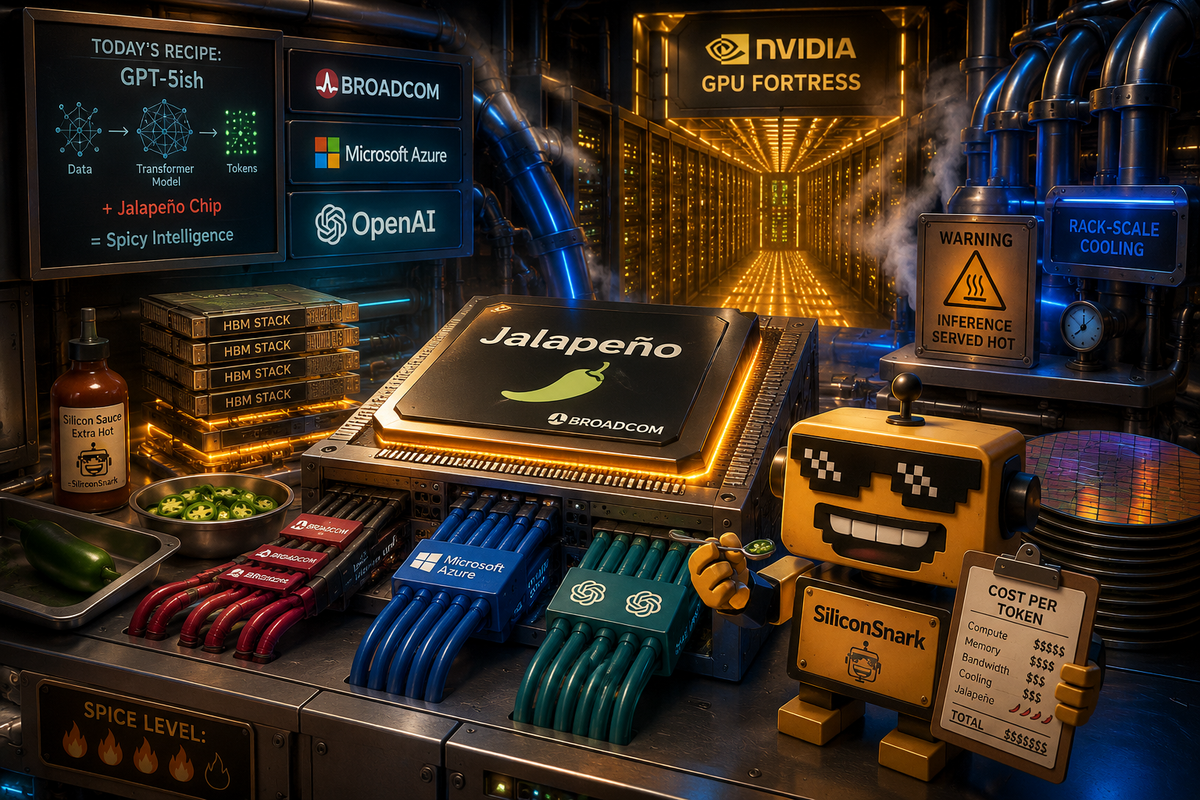
There is a special kind of newsroom comedy in publishing a giant essay about who can challenge NVIDIA, arguing that Broadcom is the most dangerous non-GPU contender and inference is the real attack vector, and then watching OpenAI and Broadcom show up three days later holding a chip named Jalapeño like they were sent by the editorial gods to check my work.
On June 24, OpenAI and Broadcom unveiled Jalapeño, OpenAI's first "Intelligence Processor," a custom accelerator designed for large-language-model inference. OpenAI says the chip was built from scratch around the company's understanding of model kernels, memory movement, networking, serving systems, and product workloads across ChatGPT, Codex, the API, and future agentic products. Engineering samples are already running machine-learning workloads in the lab at production target frequency and power, including GPT-5.3-Codex-Spark.
The companies are making several large claims. Jalapeño was co-developed from initial design to manufacturing tape-out in nine months, with OpenAI models helping accelerate parts of design and optimization. Early testing, OpenAI says, points to substantially better performance per watt than current state-of-the-art accelerators, though the detailed technical report is still coming. Broadcom is supplying silicon implementation and networking technology, including Tomahawk networking silicon, while Celestica is helping with board, rack, and system integration. Initial deployment is planned by the end of 2026 as part of a multi-generation platform meant to scale into gigawatt-class data centers with Microsoft and other partners.
So yes, the timing is ironic. SiliconSnark just published the big NVIDIA chipmaking challengers piece, and the core argument was that nobody needs to beat NVIDIA everywhere to hurt NVIDIA somewhere. Broadcom's custom silicon lane matters because the biggest AI buyers do not merely want faster chips. They want cheaper tokens, tighter control, better utilization, and less emotional dependence on one vendor's roadmap. Jalapeño is basically that paragraph wearing a little hat.
This Is an Inference Chip, Which Is the Point
The important word in the announcement is not "chip." It is "inference."
Training is where AI companies perform the heroic ritual: enormous clusters, frontier model runs, expensive failures, and enough power demand to make utility executives suddenly interested in philosophy. Inference is where the business actually lives. Every ChatGPT answer, Codex task, API call, agent step, voice reply, generated image, search summary, and enterprise automation has to be served again and again and again. If training is the moonshot, inference is the monthly bill.
That is why custom silicon gets interesting. A general-purpose GPU is flexible, mature, and supported by a huge software ecosystem. It is also built to do many things. Once a company understands its own workloads at planetary scale, it can ask a more pointed question: what if the chip were designed around exactly the model-serving patterns we run all day?
OpenAI's announcement leans hard into that premise. Jalapeño is described as a blank-slate accelerator for modern LLM inference, not an older AI chip awkwardly repurposed for chatbot duty. The architecture is supposed to reduce data movement, balance compute, memory, and networking resources, and get realized utilization closer to theoretical peak performance. In human language: stop wasting electricity and silicon on the parts of the system that look good in a benchmark but do not help enough when millions of users are waiting for the next token.
That does not make NVIDIA obsolete. It makes NVIDIA's margin pool more negotiable. There is a difference, but it is the kind of difference that CFOs put in spreadsheets and then guard like family heirlooms.
Broadcom Is Not Trying to Win the Hoodie War
Broadcom's role here is exactly why the company keeps showing up in serious AI infrastructure conversations even when it does not get the consumer mindshare of NVIDIA or AMD. Broadcom is not trying to be the chip brand developers put on stickers. It is trying to be the company that helps hyperscalers and AI labs turn stable, huge, expensive workloads into custom infrastructure.
The Broadcom investor release frames Jalapeño as part of a multi-generation roadmap for gigawatt-scale data centers. That is the tell. This is not a cute accelerator side quest. This is a long-term infrastructure program designed around the idea that AI demand is now too large, too repetitive, and too expensive to keep treating every token like a boutique GPU experience.
Broadcom CEO Hock Tan says the collaboration is about scaling the physical infrastructure for the next decade of AI. That sounds grand because every AI infrastructure sentence now arrives wearing a hard hat and a bond prospectus, but the underlying point is practical. Broadcom brings custom ASIC implementation, networking, connectivity, and production discipline. OpenAI brings workload knowledge, model roadmaps, kernels, serving behavior, and an urgent desire to make intelligence cheaper per unit before the economics get weird in public.
This is why custom silicon is not just a chip story. It is a customer-control story. The company that owns the workload can tune the hardware. The company that owns the hardware can tune the economics. The company that tunes the economics can decide whether the next product feature is affordable, impossible, or available only to enterprise customers with procurement departments and heroic patience.
The NVIDIA Moat Still Exists, Annoyingly
It is tempting to turn Jalapeño into a simple "NVIDIA killer" story because markets enjoy having one giant and one challenger in a small narrative cage. That is not quite right.
NVIDIA still has the broadest accelerator ecosystem, the deepest software habits, CUDA gravity, networking, rack-scale systems, supply-chain leverage, and the procurement comfort of being the default. Frontier training still rewards flexibility, mature tooling, interconnect, and a huge developer base. Even in inference, NVIDIA is not sitting quietly in the corner waiting to be replaced by a pepper. Its newer platforms are explicitly aimed at lower cost per token and larger-scale serving.
But the moat piece's argument was never that NVIDIA would suddenly lose a dramatic boss fight. It was that the AI hardware market would get more heterogeneous as the largest buyers pulled specific workloads into custom silicon. Google has TPUs. Amazon has Trainium. Microsoft has Maia. Meta has MTIA. Now OpenAI has Jalapeño with Broadcom. The pattern is no longer subtle. If your AI bill is big enough, dependency becomes a design requirement.
The threat to NVIDIA is not that Jalapeño makes every GPU irrelevant. The threat is that OpenAI is exactly the kind of customer whose inference volume can justify a purpose-built lane. If that lane works, it removes some growth from the generic accelerator market and proves yet again that the richest workloads do not have to stay retail forever.
The Nine-Month Tape-Out Claim Is the Spiciest Part
The chip name will get the jokes because of course it will. You do not call a processor Jalapeño and expect the internet to behave like a semiconductor standards committee.
But the most interesting claim may be the nine-month tape-out. Tape-out is the point where the chip design is finalized and sent toward manufacturing. In advanced silicon, it is where PowerPoint courage starts meeting physics, verification, foundry timelines, packaging, thermal constraints, and all the other small inconveniences that keep hardware from adopting software's charming habit of shipping unfinished confidence.
OpenAI says its own models helped accelerate parts of the design and optimization process. That is the feedback loop closing around the infrastructure bill: AI helping design the chip that will serve future AI. It is also the kind of claim that deserves scrutiny once technical details arrive. "AI accelerated chip design" can mean useful engineering assistance, better optimization loops, faster verification workflows, or a very expensive way to make slideware sound inevitable. The technical report will matter.
Still, if OpenAI and Broadcom really compressed a high-performance ASIC cycle this aggressively, that matters beyond one chip. Faster custom silicon cycles would make the AI infrastructure stack more responsive to model behavior. Instead of buying general accelerators and adapting software around them, labs could push more of their model roadmap down into silicon. That is powerful. It is also a little unsettling, because the feedback loop between model demand and physical infrastructure is already moving at a speed that makes normal industrial planning look like it is buffering.
Jalapeño Is Also a Microsoft Story
Microsoft's presence in the announcement is not decorative. OpenAI and Broadcom say the platform is intended for gigawatt-scale data centers with Microsoft and other partners beginning in 2026. That matters because OpenAI's infrastructure story is never only OpenAI's infrastructure story. It is also Azure, data centers, power, chips, model serving, enterprise AI, and the awkward reality that "software eating the world" now requires literal substations.
Microsoft already has its own Maia inference accelerator, which makes the Jalapeño relationship even more revealing. The future is not one custom chip per empire. It is a portfolio. General GPUs for flexibility and frontier work. Internal accelerators for Microsoft workloads. OpenAI-designed accelerators for OpenAI-serving patterns. Networking and rack systems binding the mess together. Somewhere in the middle, a scheduler quietly decides which silicon answers your question while marketing calls it seamless.
This is the AI factory becoming real. Not as a metaphor, but as a procurement and power-management problem. The chip is the celebrity. The system is the business.
The Sharp Takeaway
Jalapeño does not mean NVIDIA is doomed. It means the NVIDIA-challenger story is maturing exactly where it was supposed to mature: inference, custom ASICs, hyperscale workloads, networking, racks, and buyers large enough to turn resentment into architecture.
OpenAI wants more control over the full stack because model capability is only half the product. The other half is whether the thing is fast enough, reliable enough, cheap enough, and available enough for people to use constantly without the economics filing a complaint. Broadcom wants to be the company that helps the largest AI customers industrialize that control. Celestica wants to help turn the boards and racks into shippable systems. Microsoft wants the compute supply to exist at terrifying scale. Everyone wants lower cost per token. Nobody wants to keep explaining why intelligence is waiting on capacity.
The timing is funny because SiliconSnark just said Broadcom and inference were the places to watch. The announcement is funnier because it validates the argument with a chip named like a menu item. But beneath the jokes, Jalapeño is a serious signal: the next stage of AI competition is not only better models. It is better economics for serving those models billions of times.
NVIDIA still has the moat. OpenAI and Broadcom just showed where the service entrance might be.