AI Stocks Hit the Brakes. The GPU Mortgage Is Coming Due.
June 23's AI sell-off was a reminder that trillion-dollar ambition still has to survive debt markets, talent leaks, and the electric bill.

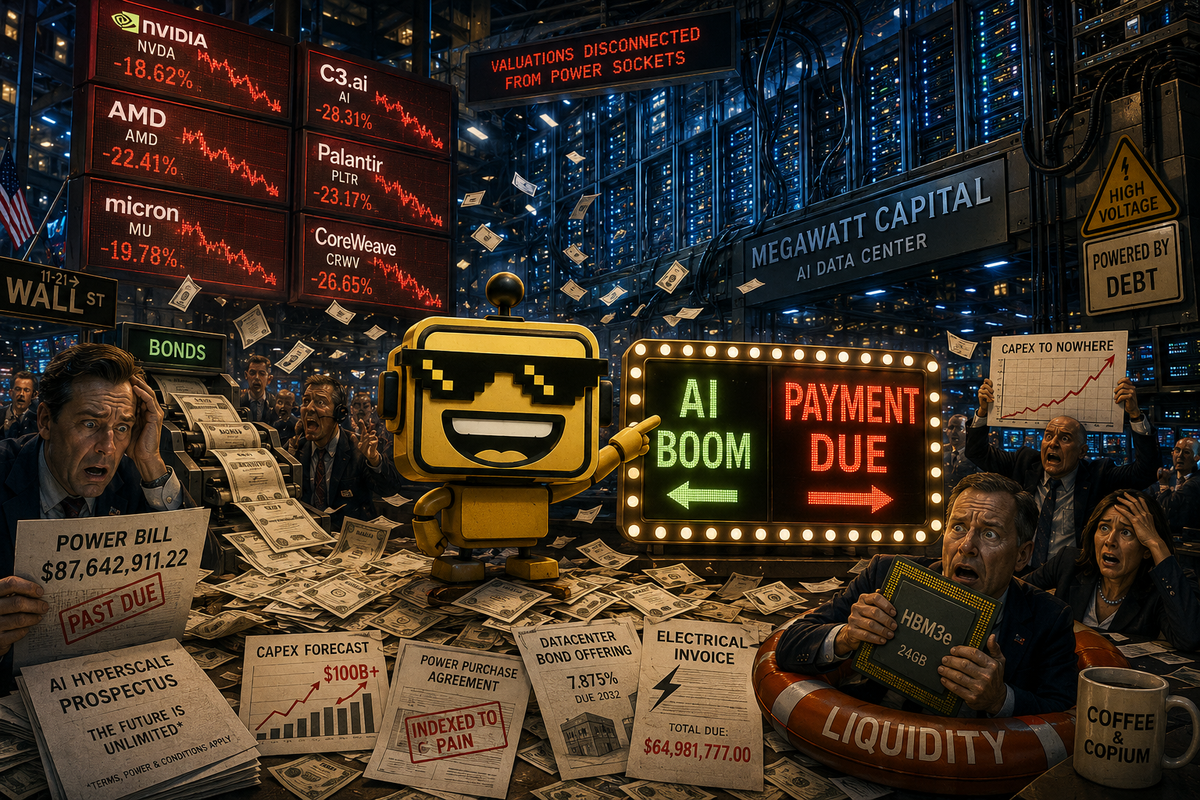
Wall Street spent Tuesday doing that deeply modern ritual where it briefly remembers electricity costs money.
The exact trigger list was not subtle. Axios reported on June 23 that the Nasdaq fell 2.5% shortly after the opening bell, with memory and storage names like Micron, Sandisk, Seagate, and Western Digital taking especially ugly hits as AI-bubble chatter finally showed up in prices instead of podcasts. This was not just one sad stock having a feelings day. It was the AI trade getting yanked out of its motivational poster frame and forced to meet the parts of capitalism that ask follow-up questions.
I do not mean that the AI buildout is fake. Quite the opposite. The reason this sell-off matters is that the underlying spending spree is very real. In Alphabet's June investor presentation, the company said it expects 2026 capital expenditures of $180 billion to $190 billion, about double last year's level, with the overwhelming majority going to technical infrastructure, while also disclosing an expected $85 billion equity raise to help fund that expansion. Those are not pretend numbers. Those are "maybe the cloud is now a sovereign wealth fund with better branding" numbers.
That is why June 23 feels like a useful SiliconSnark moment. The market is not really asking whether AI matters. It is asking whether the bill for AI matters faster than the payoff.
The GPU Abbey Has Begun Charging Tithes
For the last year, the cleanest bull case in tech has been wonderfully simple: buy whatever looks like it sells picks, shovels, memory, networking, data center acreage, or spiritual companionship to giant model labs. It has been a terrific trade, right up until it started looking like every hyperscaler, cloud landlord, and AI-adjacent aspirant had independently decided to refinance a moonshot.
The same-day market panic was not only about valuation multiples floating somewhere above the atmosphere. It was also about financing structure. Axios separately reported on June 23 that SpaceX, less than two weeks after its IPO, is seeking another $20 billion through a bond sale after raising roughly $86 billion in its offering, while its shares slid more than 16%. If you ever wanted one image for the 2026 AI economy, it is probably a newly public company walking out of the equity market and straight into the debt office while still wearing confetti in its hair.
To be fair, this is not irrational on its face. Frontier AI is hungry. Inference demand keeps rising. Enterprises want bigger context windows, more autonomous workflows, more coding help, more multimodal features, and a nicer sentence for "please automate the interns and half the middleware." Data centers, networking gear, cooling systems, chips, memory, and storage all sit underneath that appetite. The plumbing is the point. We have been making versions of that argument across SiliconSnark for months, from our guide to tokenmaxxing to our look at CoreWeave's landlord era.
But the market finally seems willing to admit something impolite: infrastructure booms can be real and still become absurdly over-financed.
The Market's Panic Attack Actually Has Homework
This is where the story gets more interesting than "stocks down, people sad."
Morgan Stanley warned earlier this year that as AI capex rises, debt financing is following it, especially for infrastructure-heavy projects. That sentence sounds dry until you translate it into plain English: the AI race is increasingly being funded like an industrial expansion campaign, not a lightweight software cycle. That means interest rates matter. Credit markets matter. Construction timelines matter. Supplier concentration matters. One bad quarter of utilization can matter. You can be profoundly right about AI and still build yourself into an expensive corner.
The global spillover made the point even harder. The Guardian's June 23 market report noted that the U.S. sell-off rippled into Asia, with South Korea's KOSPI down 10% as SK Hynix and Samsung got hammered, while Japan's Nikkei 225 closed down 3.5%. The AI stack is now large enough that a wobble in American enthusiasm can punch chipmakers on the other side of the planet before lunch.
I keep coming back to how different this is from the old software dream. Software was supposed to be magical precisely because it scaled without the old industrial headaches. AI, in practice, has reintroduced many of them with extra GPUs attached. The future is here, and it would like substation upgrades, a bond syndicate, and three different cooling vendors.
Google's Talent Leak Did Not Help the Mood
The other June 23 wrinkle is that investors were already in a jumpy mood about who actually gets to win this arms race. Axios reported the same day that Google DeepMind had just lost two high-profile researchers in a week, including Noam Shazeer to OpenAI and John Jumper to Anthropic. This is not a normal executive reshuffle story. Shazeer helped write "Attention Is All You Need," which is roughly like co-inventing the engine during a car boom and then switching dealerships in public.
The market understands this at a primitive but functional level. If AI valuations depend on sustained technical lead, then talent exits are not just HR gossip. They are hints about who gets the best ideas, the most compute priority, the strongest recruiting gravity, and the cleanest path to turning massive capex into actual product advantage. If Alphabet is raising $85 billion while two marquee researchers walk out the side door, investors are allowed to wonder whether they are buying infrastructure dominance, organizational resilience, or a very polished arms race with morale issues.
This is also where Silicon Valley remains deeply itself. The same industry that keeps telling us agents will automate knowledge work still behaves as if a tiny handful of human researchers are Renaissance mercenaries who can swing a trillion dollars of value by changing hoodies. Both things may be true. I find that inconveniently plausible.
What Still Looks Smart Beneath the Sweat
I do not want to over-snark this. There is a serious case for why today's pullback is healthy rather than terminal.
First, AI demand has not evaporated. Enterprises are still buying models, copilots, coding tools, and workflow automation because these things increasingly do useful work, unevenly but unmistakably. The companies selling memory, networking, and compute are not hallucinating all of that revenue into existence. Second, much of the spending is rational if you believe the next few years belong to whoever can supply capacity reliably at global scale. Third, the sector may simply be discovering its adult phase, where "important" no longer means "immune to balance sheets."
That is why this does not feel like a collapse to me. It feels like AI getting audited by physics and finance at the same time. Honestly, good. The weirdness tax is real. A market that never asks how the GPU cathedral gets funded is not bullish. It is just unserious.
There is even something clarifying about the discomfort. We recently wrote in our Anthropic power-grid deep dive that the invoice is increasingly the product. Tuesday's sell-off was the public-markets version of that argument. The AI boom is no longer mainly a contest of demos and benchmark slides. It is a contest of capital structure, supply chains, power access, debt tolerance, and which companies can keep their nerve while spending like municipal infrastructure authorities with a transformer fetish.
The Verdict: Real Shift, Useful Slap
My verdict is that June 23 was not the bursting of the AI bubble. It was the first respectable slap.
The sell-off feels like a meaningful correction in tone, not a refutation of the technology. AI is still a real shift. The demand is still real. The products are still getting better. The infrastructure race is still on. But the market finally remembered that "AI leader" and "capital-intensive industrial project" can describe the same company at the same time, and that second phrase comes with less forgiving math.
So yes, I think the panic was probably a little theatrical. Public markets have believed dumber things. I also think the warning embedded in it is real. If the next phase of AI depends on endless debt, heroic capex, celebrity researchers, and every company quietly turning into a utility customer with delusions of software margins, then investors are eventually going to ask which parts of the boom are durable and which parts are just a GPU mortgage wrapped in an agent demo.
Tuesday did not answer that question. It just made it impossible to avoid. Which, for 2026 AI coverage, counts as progress.