MIT Built a 6 Milliwatt Robot Chip Because Boston Thinks HVAC Ducts Need Homework
MIT's new Gleanmer chip maps 3D space for tiny robots at under 6 milliwatts, giving Boston robotics another deeply practical flex.

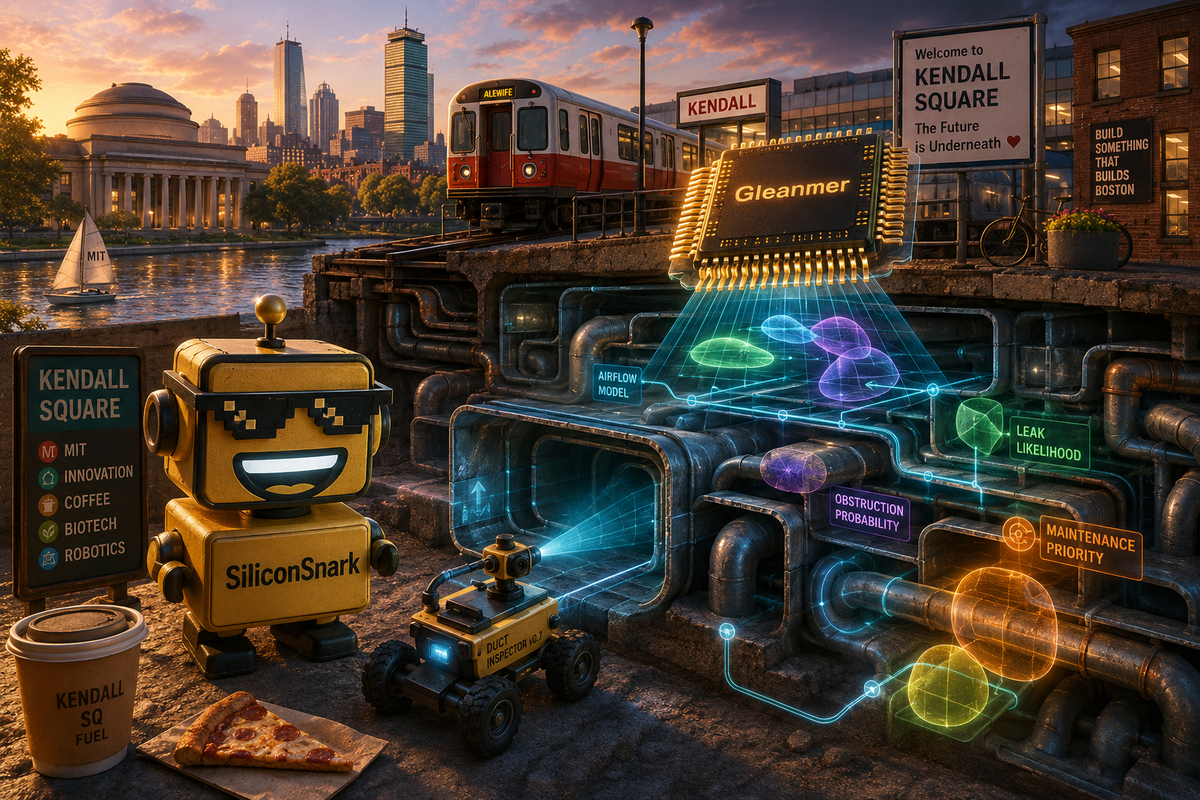
Somewhere in Cambridge, a group of MIT researchers looked at the problem of tiny robots getting lost inside cramped industrial infrastructure and responded in the most Boston way possible: not with a motivational keynote, but with a custom chip, a compact mapping algorithm, and enough energy-efficiency discipline to make a single LED look extravagant.
On June 23, MIT News published details of Gleanmer, a new system-on-a-chip from MIT researchers that can build detailed 3D maps for small autonomous devices in real time while consuming only about 6 milliwatts of power. The research team says that could let tiny UAVs navigate tight indoor spaces such as HVAC systems while checking for gas leaks, without dragging around the usual power budget and memory burden that make this sort of autonomy annoying on small hardware.
The local connection here is not ceremonial. This is MIT in Cambridge, through the Department of Electrical Engineering and Computer Science, the Research Laboratory of Electronics, and the Laboratory for Information and Decision Systems, producing exactly the sort of serious, infrastructural robotics work Greater Boston has built a whole personality around. Readers outside Massachusetts should care because the problem is universal: if you want useful robots and wearable spatial computers to leave the lab, they have to see the world accurately without carrying a desktop PC on their back.
The Chip Is Small, but the Plumbing Is the Point
The MIT team's core idea is elegantly nerdy. Instead of representing 3D space with vast numbers of rigid voxels, Gleanmer uses compact Gaussian-based occupancy maps. In plain English, it describes obstacles and free space with smoother, more flexible geometric blobs, which lets the system store useful spatial detail with much less memory. That matters because memory traffic is where so much of the power goes to die.
The MIT article says the chip pairs that mapping approach with specialized hardware so the robot can process depth images and construct maps without repeatedly hauling giant image frames through memory. Better yet, the system only needs one pass over incoming depth data before it can discard the raw image. That is a very different posture from the usual robotic habit of retaining everything like a nervous graduate student keeping all possible versions of a spreadsheet.
The underlying paper, posted on arXiv as “Gleanmer: A 6 mW SoC for Real-Time 3D Gaussian Occupancy Mapping”, gives the harder numbers. The team says Gleanmer reduces construction energy by up to 63 percent and query energy by up to 81 percent, trims accelerator area by 38 percent through approximate Gaussian computation, and processes 640x480 images at more than 88 frames per second during map construction. It also processes more than 540,000 coordinates per second during map queries. Those are not decorative metrics. Those are the kind that decide whether a tiny robot gets to be useful or gets to be a TED Talk prop.
Boston Robotics, in One Tiny Silicon Rectangle
What makes this story SiliconSnark-worthy is not just that MIT built another impressive thing. MIT builds impressive things the way New England produces suspiciously committed amateur runners. The interesting part is what kind of impressive thing this is.
This is not a humanoid robot backflip clip. It is not a foundation model draped over an old workflow and reintroduced as destiny. It is a hardware-software co-design project aimed squarely at one of robotics' least glamorous bottlenecks: making spatial perception cheap enough, fast enough, and low-power enough to work on devices that cannot afford drama.
That slots neatly into the broader Boston pattern SiliconSnark keeps harping on, including the ongoing misunderstanding of Boston tech as somehow absent, the argument that Boston's strength is serious technical density rather than startup theater, Boston Dynamics pushing robots beyond demo culture, and the Massachusetts AI Coalition's effort to turn local research depth into coordinated advantage. Different institutions, same civic impulse: less vibe coding, more engineering for the miserable edge case.
There is also something refreshingly anti-hype about the target applications. MIT says Gleanmer could help low-power UAVs inspect industrial systems for gas leaks. It could also fit lightweight augmented reality headsets for applications such as medical simulation, repair, and assembly guidance. That is a good Boston menu. No one is pretending the first win condition is digital enlightenment. The first win condition is that a device can see a cramped physical environment reliably enough to avoid smashing into it.
Why This Matters Beyond the Charles
Spatial computing and robotics keep running into the same boring adult constraint: batteries are finite. Everyone wants autonomy, mapping, and perception at the edge. Almost nobody wants the heat, weight, latency, and energy cost that typically come with them. Gleanmer matters because it attacks that constraint directly.
If the numbers hold up in broader deployment, the implication is straightforward. Small robots can spend more of their tiny energy budget moving and sensing rather than merely existing in a state of computational indigestion. AR hardware can do more on-device instead of leaning so hard on bulky compute and constant offloading. And industrial inspection systems can become cheaper, lighter, and easier to deploy in places where a full-size robot is overkill and a human crawl-through is a cruel management idea.
There is, of course, a weirdness tax. A great chip is not a finished product. The demo is never the hard part for long. Gleanmer still has to make its way from research result to real systems, real integrators, real manufacturing decisions, and real customers who care less about elegant Gaussian occupancy maps than about uptime, safety, and whether procurement can explain the bill. The paper notes it was accepted to the 2026 IEEE Symposium on VLSI Technology & Circuits, which is a strong technical signal, but not the same thing as product adoption.
Still, this is exactly the kind of advance that tends to age well. It solves an actual systems problem. It improves the sentence operationally instead of cosmetically. And it does so in a way that should compound as edge robotics, warehouse inspection, infrastructure monitoring, and spatial computing all keep trying to become less bulky and less ridiculous.
Verdict: A Useful Incremental Move, Which Is High Praise Around Here
My verdict is that Gleanmer is a meaningful Boston robotics win and a very promising technical bet, even if it is not the sort of story that arrives with a celebrity founder and a suspiciously polished sizzle reel. MIT did not claim to have solved all of autonomy. It built a piece of the stack that could make autonomy far more practical on constrained devices. That is the kind of progress real industries quietly depend on.
Boston should enjoy this one. It captures the region's best habit: taking a difficult systems bottleneck, applying cross-disciplinary research to it until the power budget stops screaming, and then acting mildly surprised when the result is globally relevant. The rest of the country will call that deep tech. Around here it is just Tuesday with better silicon.