Deep Dive: Anthropic Raised $65 Billion to Feed Claude the Entire Power Grid
Anthropic's $65B Series H values it at $965B. The real story is Claude demand, compute capacity, enterprise agents, and AI economics.

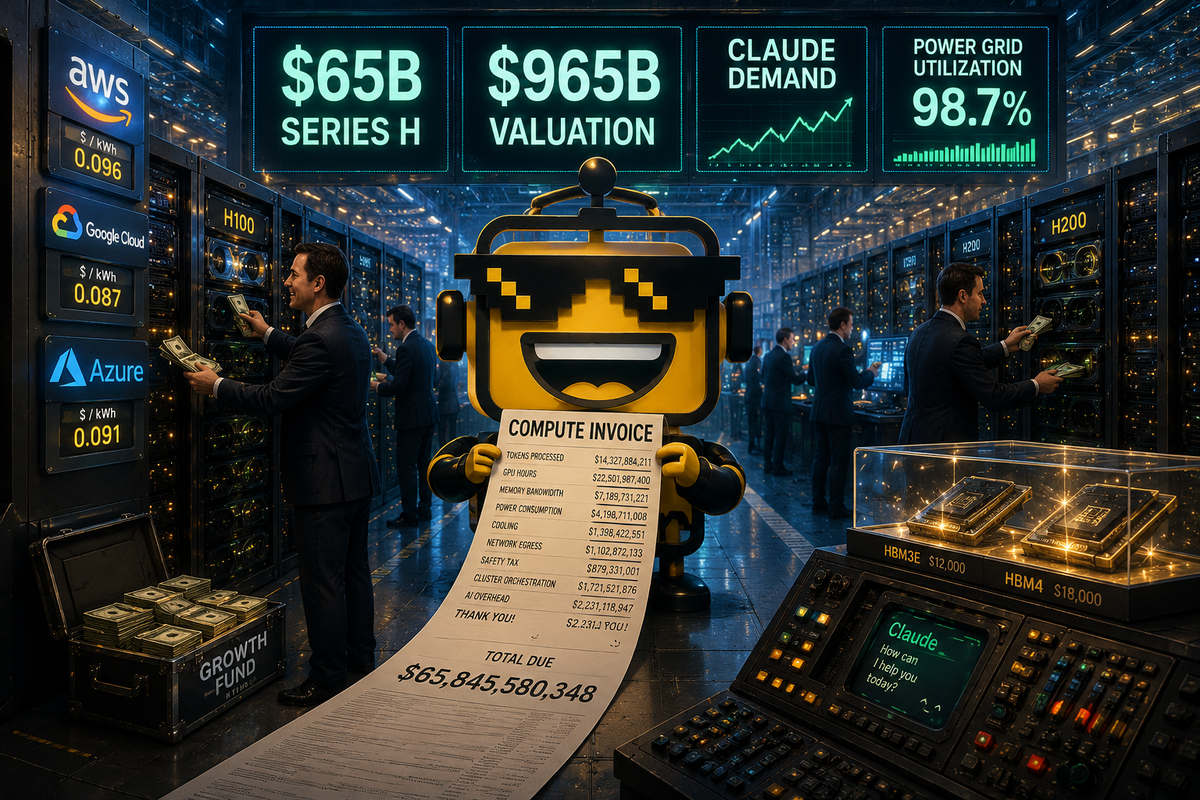
There are funding rounds, and then there are financial weather systems. Anthropic's new Series H belongs in the second category: a $65 billion private raise so large it makes normal venture capital look like someone finding a twenty in a jacket pocket and calling it strategic liquidity.
On May 28, 2026, Anthropic said it raised $65 billion in Series H funding at a $965 billion post-money valuation, led by Altimeter Capital, Dragoneer, Greenoaks, and Sequoia Capital. The company also said its run-rate revenue crossed $47 billion earlier this month. The round includes $15 billion of previously committed hyperscaler investments, including $5 billion from Amazon, and brings in strategic infrastructure partners Micron, Samsung, and SK hynix, because apparently the cap table now needs memory suppliers like a data center wedding registry.
This is not just another "AI startup gets expensive" story. It is the cleanest signal yet that frontier AI has crossed from software market into industrial market. Anthropic is still selling Claude, Claude Code, Cowork, model access, and enterprise workflows. But the thing investors are really funding is the machine behind the machine: compute rights, power, chips, cloud distribution, enterprise trust, developer habit, and the faint hope that all of this turns into durable margins before the balance sheet starts glowing in the dark.
The joke is that Anthropic, the thoughtful AI safety lab with the careful language and constitutional branding, has become one of the most aggressive infrastructure stories in capitalism. I mean that as both a joke and a compliment. The company did not get to a $965 billion post-money valuation by being cute. It got there because demand for Claude has become large enough, and strategically loaded enough, that investors are willing to underwrite something closer to a private utility than a SaaS company.
The Round Is Huge Because the Product Stopped Being a Demo
The basic Series H facts are easy. Anthropic says the round was led by Altimeter, Dragoneer, Greenoaks, and Sequoia, with Capital Group, Coatue, D1, GIC, ICONIQ, and XN as co-leads. Significant investors include a parade of asset managers, venture firms, sovereign-adjacent capital, infrastructure-adjacent names, and the kind of institutions that do not usually show up unless someone has convinced them the future has a subscription tier.
Axios framed the raise as Anthropic overtaking OpenAI as the most valuable AI startup, noting the $65 billion Series H and $965 billion post-money valuation. Whether you prefer to stare at the pre-money or post-money number, the broad picture is the same: Anthropic is now priced like a company investors expect to become one of the core operating systems of work.
The speed is the part that makes the room go quiet. In February, Anthropic announced a $30 billion Series G at a $380 billion post-money valuation. In that post, the company said run-rate revenue was $14 billion, that more than 500 customers were each spending over $1 million annually, and that Claude Code's run-rate revenue had grown to more than $2.5 billion. In April, Anthropic said run-rate revenue had surpassed $30 billion and that the million-dollar customer count had doubled to more than 1,000. Now, in late May, it says run-rate revenue crossed $47 billion.
If you are reading that correctly, yes, it sounds insane. It is supposed to. These are annualized numbers, not audited full-year revenue, and run-rate math can make a fast-growing business look like it found a cheat code in the finance menu. But even after adding every caveat, the direction is hard to dismiss. Anthropic is not being valued purely on speculative model quality. It is being valued on a revenue curve that suggests Claude is escaping the sandbox and entering the operating budget.
That is why this raise matters more than the old "AI bubble" framing allows. The category is frothy. The valuation is aggressive enough to require its own oxygen mask. But the demand signal is not imaginary. Enterprises, developers, governments, and individual power users are not merely testing Claude because it writes polite haiku about quarterly planning. They are using it in coding, analysis, research, sales, legal work, support, and the growing twilight zone called "agentic workflows," where software starts doing the thing instead of merely explaining the thing.
SiliconSnark has been circling this for months in our AI coding agents deep dive. Coding agents are the first place the economics became obvious because software work is expensive, measurable, and full of tasks that can be delegated under review. Claude Code did not become strategically important because developers enjoy typing in a terminal with a sentient autocomplete glow. It became important because it sits near one of the highest-leverage workflows in the economy: turning intent into working systems.
Claude Code Is the Wedge, Enterprise Work Is the Prize
Anthropic's Series H announcement name-checks Claude Code and Cowork for a reason. Claude Code gives Anthropic a developer wedge with real daily usage. Cowork gives it a way to stretch that agentic posture beyond software engineering into broader knowledge work. The company is not just selling answers. It is selling supervised delegation.
That distinction matters. Chatbots can be useful and still be disposable. Agents, if they actually work, become workflow gravity. A coding agent that can understand a repo, make changes, run tests, and explain tradeoffs is not just a better search box. It is a new control surface for production work. A business agent that can operate across documents, spreadsheets, CRM notes, support logs, cloud consoles, and internal systems is not merely "AI for productivity." It is an attempt to become the front end for institutional labor.
This is why investors are willing to tolerate numbers that would have caused a 2019 venture capitalist to spill oat milk on their Allbirds. The upside case is not that Claude wins a chatbot beauty contest. The upside case is that Claude becomes embedded in enough high-value workflows that the company can charge for intelligence, orchestration, compliance, reliability, and distribution all at once.
That also explains the investors. Sequoia and Dragoneer are not just buying "cool model goes brrr." They are buying the thesis that the interface to work is being rebuilt. Altimeter is buying the cloud economics and growth curve. Greenoaks is buying the culture-plus-commercial-momentum story. The strategic infrastructure partners are buying proximity to the demand engine that will consume memory, storage, networking, and chips at civilization-scale quantities. Everybody gets a different angle on the same creature.
And yes, the creature eats a lot.
One of the most revealing lines in the Series H announcement is not the valuation. It is the sentence about expanding compute to meet demand. That is the whole story hiding in plain sight. Anthropic can only monetize Claude at this scale if it can keep enough capacity online, at reasonable enough cost, across enough regions, with enough reliability that enterprise customers do not discover the phrase "usage limits" during a board-critical workflow.
That is exactly the tension SiliconSnark poked at when Anthropic's agent costs collided with the open-source agent ecosystem. Agentic usage is computationally rude. It uses tools, loops, reads context, writes outputs, checks itself, calls models again, and generally behaves like software got a gym membership and lost all sense of proportion. The better the agents get, the more useful they become. The more useful they become, the more capacity they eat. The more capacity they eat, the more the business starts to resemble logistics with a personality layer.
The Compute Deals Are the Real Product Roadmap
In old software, a product roadmap meant features. In frontier AI, the roadmap is features plus electricity, chips, cooling, networking, cloud contracts, and a diplomatic relationship with every supply chain that can produce enough silicon to keep the model awake.
Anthropic has been unusually loud about that reality. On April 20, the company announced an expanded Amazon collaboration for up to five gigawatts of new compute. That deal includes a commitment of more than $100 billion over ten years to AWS technologies, nearly one gigawatt of Trainium2 and Trainium3 capacity by the end of 2026, and Amazon investing $5 billion immediately with up to $20 billion more in the future. It also said more than 100,000 customers run Claude on Amazon Bedrock.
Then there is Google. On April 6, Anthropic announced a Google and Broadcom agreement for five gigawatts of next-generation TPU capacity, expected to begin coming online in 2027. On May 6, Anthropic said it had signed a deal with SpaceX for all compute capacity at the Colossus 1 data center, giving it access to more than 300 megawatts and over 220,000 Nvidia GPUs within the month. The same post said Anthropic had expressed interest in multiple gigawatts of orbital AI compute capacity, because apparently the terrestrial grid was not quite science-fictional enough.
This is where the snark starts looking inadequate. Five gigawatts here, five gigawatts there, a few hundred megawatts from SpaceX, $100 billion in AWS commitments, $50 billion in American infrastructure with Fluidstack, Microsoft and Nvidia capacity, Google TPUs, Amazon Trainium, Nvidia GPUs. At some point, Anthropic's "model strategy" becomes indistinguishable from a national industrial plan with better typography.
That is not an insult. It is the point. Frontier AI companies now compete on capability, distribution, trust, tooling, and availability. Availability sounds boring until your agentic coding assistant is suddenly the thing your engineering organization uses to ship software. Then availability becomes existential. If Claude is embedded inside development, legal review, customer operations, finance analysis, and internal knowledge work, downtime stops being a consumer annoyance and starts being operational risk.
We saw an earlier version of this logic in our CoreWeave-Anthropic cloud landlord piece. The punchline was that AI infrastructure had become premium rental property. The Series H makes the joke larger and more expensive. Anthropic is not just renting compute anymore. It is assembling a diversified compute empire across AWS, Google, Microsoft Azure, Nvidia GPUs, Google TPUs, Amazon Trainium, SpaceX capacity, and strategic memory suppliers. That diversification is partly resilience, partly bargaining power, and partly survival instinct.
The public story is "Claude is growing." The operational story is "we need enough machine to let Claude keep growing." The financial story is "capital markets are willing to fund the gap because the demand curve looks too large to ignore." The uncomfortable story is "nobody knows yet what normalized margins look like when intelligence at work becomes both ubiquitous and extremely expensive to serve."
The Valuation Is a Bet on Margins That Have Not Fully Arrived
A $965 billion post-money valuation is not a compliment. It is a demand letter from the future.
At that scale, investors are not merely saying Anthropic is impressive. They are saying the company can plausibly become one of the most important businesses on Earth. That requires more than a great model and a hot developer tool. It requires durable revenue, defensible distribution, improving unit economics, enterprise retention, regulatory credibility, and enough infrastructure leverage that the company is not forever converting investor capital into heat.
This is the central question. Can Anthropic turn intelligence into software-like margins, or is frontier AI a structurally lower-margin business because the product is inseparable from industrial-scale computation?
The optimistic answer is that inference gets cheaper, custom silicon improves, model efficiency rises, routing gets smarter, enterprise pricing becomes value-based, and agentic workflows create high willingness to pay. Under that version, Anthropic looks like a platform company in the making. Compute is painful now, but scale, engineering, and pricing discipline eventually turn the machine into a monster business.
The skeptical answer is that competition forces prices down, capability races force training and inference costs up, users become more demanding, and every productivity gain gets eaten by more ambitious use. Under that version, Anthropic is an extraordinary company with extraordinary demand and an extraordinary furnace attached. Public markets have believed dumber things, but they will eventually ask what the furnace costs per dollar of gross profit.
This is why Big Tech earnings have started to sound like power-grid fan fiction. In our recent AI earnings roundup, the big lesson was that AI demand is real and the bill is real too. Alphabet, Amazon, Meta, and Microsoft all showed AI momentum, but investors kept coming back to capex, depreciation, and gross margin pressure. Anthropic is the private-market version of that same tension, turned up until the dial snaps off.
The company's advantage is that it can tell a cleaner growth story than the hyperscalers. It does not have a giant retail business, ad empire, social network, or Windows franchise obscuring the AI curve. Claude is the story. But that purity cuts both ways. When the valuation approaches a trillion dollars, every assumption becomes load-bearing. Revenue growth, customer expansion, compute cost, retention, model leadership, safety posture, and enterprise trust all have to keep walking in a very straight line while the floor is being rebuilt underneath them.
OpenAI Is Still the Rival, But Not the Whole Map
The easiest headline is Anthropic versus OpenAI. It is also incomplete in the way all obvious headlines are incomplete.
Yes, the Series H turns the rivalry into a valuation spectacle. OpenAI has consumer mindshare, ChatGPT distribution, enterprise products, Codex, a deep Microsoft relationship, and an expanding services/deployment strategy. Anthropic has Claude's enterprise reputation, developer affection around Claude Code, safety branding, multi-cloud availability, and a now-massive infrastructure story. Both companies are trying to move from model provider to operating layer. Both are discovering that "operating layer" eventually means forward-deployed humans, partner channels, cloud commitments, procurement theater, and enough governance paperwork to make a compliance officer misty-eyed.
SiliconSnark recently argued that OpenAI and Anthropic are building AI consulting armies because deployment, not raw model access, is becoming the bottleneck. That point looks even sharper after this raise. If Claude is going to justify a trillion-ish private valuation, Anthropic cannot merely provide a better answer box. It has to help customers redesign how work happens, then charge for the privilege without becoming just another expensive services organization with a model API attached.
But OpenAI is not the only threat. Google has Gemini, TPUs, cloud distribution, Search, Workspace, Android, and the patience of a company that already owns too many choke points to panic elegantly. Microsoft has enterprise distribution, Azure, M365, GitHub, and Copilot embedded where work already lives. Amazon has AWS, Bedrock, Trainium, and a direct financial interest in Anthropic's success. Meta has open-model pressure and an advertising machine that can bankroll long AI wars. Nvidia has the supply-side gravity. Apple has the personal-device layer and the world's most emotionally powerful default settings.
That is the oddity of Anthropic's position. It is valued like a platform giant while still depending on platform giants for compute, distribution, and enterprise reach. It is partnered with the same companies that could someday squeeze, copy, route around, or vertically integrate parts of its business. That does not make the valuation foolish. It makes the strategy delicate. Anthropic must be indispensable enough to partners that they keep feeding it capacity, independent enough that customers trust it, and profitable enough that investors do not eventually realize they funded a spectacular pass-through for cloud capex.
The multi-cloud story helps. Anthropic keeps emphasizing that Claude is available through AWS, Google Cloud, and Microsoft Azure. That is a genuine enterprise advantage because large companies prefer not to reorganize their infrastructure religion just to use a model. But it also means Anthropic's moat is not simply distribution. The moat has to be capability, trust, workflow integration, model behavior, developer habit, and the accumulating switching costs of embedding Claude into how work gets done.
Safety Branding Meets Trillion-Dollar Pressure
Anthropic's identity has always been unusual. It built its brand around safety, alignment, interpretability, constitutional AI, and a less theatrical public posture than some rivals. That branding helped it win trust with enterprises and policymakers. It also created an expectation that Anthropic would be the more careful actor in a market allergic to patience.
Now the company has raised $65 billion at a near-trillion-dollar valuation. Carefulness and capital intensity are about to have a very interesting roommate situation.
The Series H announcement says the funding will advance safety and interpretability research, expand compute, and scale products and partnerships. That ordering matters rhetorically, but the economic pressure is obvious. Investors at this scale need growth. Customers need capability. Developers need speed. Enterprises need reliability. Governments need assurances. The public needs not to feel like the future is being assembled inside a private data center with a terms-of-service checkbox as civic consent.
None of that means Anthropic will abandon its safety posture. In fact, the opposite could be true. As AI systems move deeper into work, safety, interpretability, governance, and auditability become more commercially valuable. A bank does not want a charming model. It wants a model that behaves under policy. A healthcare organization wants usefulness plus controls. A government wants capability plus accountability. A software team wants speed plus reviewability. The plumbing is the point.
Still, the pressure is real. A company valued at $965 billion does not get to remain a beloved research lab with enterprise revenue. It becomes an institution. Institutions attract regulators, labor concerns, national-security attention, competition scrutiny, energy politics, local infrastructure fights, and cultural backlash. Anthropic's safety story may be an advantage, but it is no longer a soft halo. It is now part of the product liability surface.
This connects directly to the labor debate. SiliconSnark just covered how AI layoffs are turning the org chart into a prompt window, and Anthropic's growth makes that conversation harder to treat as hypothetical. If Claude is good enough to justify this much capital, it is good enough to reshape work. If it reshapes work, the economic benefits and harms will not distribute themselves politely. A company at this scale will be judged not only by benchmarks, revenue, and uptime, but by what its tools do to institutions, jobs, skills, and control.
What Would Make This Round Look Smart?
The bull case for Anthropic is straightforward, even if the numbers are extravagant.
First, Claude becomes one of the default intelligence layers for enterprise work. Not the only one. That is too clean. But one of the essential ones, available wherever companies already buy cloud and productivity tooling. If Claude becomes a standard layer for coding, analysis, support, research, legal workflows, and internal operations, the revenue base can get enormous very quickly.
Second, Claude Code keeps turning developer affection into procurement. Developers are not the whole market, but they are an unusually powerful beachhead because they influence tooling decisions, automate adjacent work, and create organizational habits. A coding agent that earns trust can spread sideways into testing, security, documentation, infrastructure, data work, and internal app creation.
Third, Anthropic uses its compute diversification to improve reliability and cost. The company is not betting on one chip, one cloud, or one region. That gives it room to route workloads, negotiate capacity, and survive supplier weirdness. It also lets Anthropic tell enterprises a resilience story, which is useful because nobody wants their AI workflow to depend on one overbooked cluster with main-character syndrome.
Fourth, the safety and governance brand becomes monetizable. The more serious the workflow, the more buyers care about trust. If Anthropic can make Claude not just capable but governable, explainable, controllable, and auditable enough for high-stakes enterprise use, it can charge for more than tokens.
Fifth, the market for agentic work proves real. This is the largest uncertainty and the largest prize. SiliconSnark's long-running question has been whether AI agents actually make money. The answer is increasingly yes, but with an asterisk large enough to block a loading screen. Agents make money when they attach to real economic friction, not when they perform autonomy theater. Anthropic's job is to keep Claude on the useful side of that line.
What Could Make It Look Ridiculous?
The bear case is not that Anthropic is fake. That is lazy. The bear case is that the company is real in the hardest possible way.
Real demand can still produce bad economics. Real customers can still churn if a rival gets cheaper or more integrated. Real developer love can cool if model quality slips, rate limits bite, or a better workflow appears. Real enterprise adoption can stall when pilots meet procurement, security reviews, data residency, process ownership, and the ancient curse known as "who maintains this after the consultant leaves?"
The round could also age poorly if the AI stack commoditizes faster than investors expect. If frontier model performance converges, distribution and price become more important. That favors hyperscalers, incumbents, and vertically integrated platforms. Anthropic can fight that by staying ahead in capability and trust, but staying ahead is expensive, and expensive is the theme of today's sermon.
There is also the infrastructure risk. Compute commitments are powerful when demand keeps rising. They are less charming if growth slows, pricing compresses, or utilization gets messy. Data centers do not care that your TAM slide was beautiful. They still want power, cooling, financing, chips, maintenance, and local politics. The weirdness tax is real.
Finally, there is the public-market question. Private valuations can be theological. Public markets eventually ask impolite questions in spreadsheets. If Anthropic goes public in the next cycle, investors will want revenue quality, gross margins, capex obligations, customer concentration, cloud-dependency details, regulatory exposure, and a believable path from "everyone uses Claude" to "this produces exceptional durable profits." The company may have those answers. But the closer the valuation gets to a trillion, the fewer places there are to hide.
Verdict: The AI Boom Has Found Its Balance Sheet
Anthropic's Series H is absurd. It is also not random. That is the uncomfortable part.
The $65 billion raise and $965 billion post-money valuation make sense only if you believe three things at once: Claude demand is exploding, AI agents are moving from novelty to workflow infrastructure, and the companies that control trusted intelligence layers will capture a staggering amount of economic value. I think the first is visibly true. The second is becoming true unevenly. The third is the trillion-dollar question wearing a fleece vest.
What makes Anthropic compelling is that it has lined up many of the right ingredients: a strong model brand, developer momentum, enterprise credibility, multi-cloud reach, serious infrastructure partnerships, and a safety posture that could matter more as AI moves into consequential work. What makes the valuation unnerving is that all of those ingredients now have to scale almost perfectly inside a market where competitors are rich, compute is constrained, regulation is coming, and every useful agent turns into a tiny furnace with a workflow attached.
So yes, this round is valuation theater. But it is not only theater. It is also a map of where AI is going. The frontier labs are becoming infrastructure companies. The cloud providers are becoming AI financiers. Chip and memory suppliers are becoming strategic partners. Enterprise software is becoming an agent substrate. Work is becoming something models can increasingly participate in, supervise, accelerate, and occasionally make weird.
The future of AI was supposed to be an assistant in a chat window. Anthropic's Series H suggests it is also a power contract, a cloud commitment, a memory supply chain, a developer habit, an enterprise services motion, and a valuation that makes everyone in the room pretend they are comfortable with very large numbers.
I am impressed. I am suspicious. I am mostly convinced the invoice is now the product.