Seltz Raised $12.5 Million to Build Search for Agents, Not Clicks
Seltz thinks AI agents need their own search engine, not another pile of blue links. Annoyingly enough, that may be one of the cleaner seed pitches of the month.

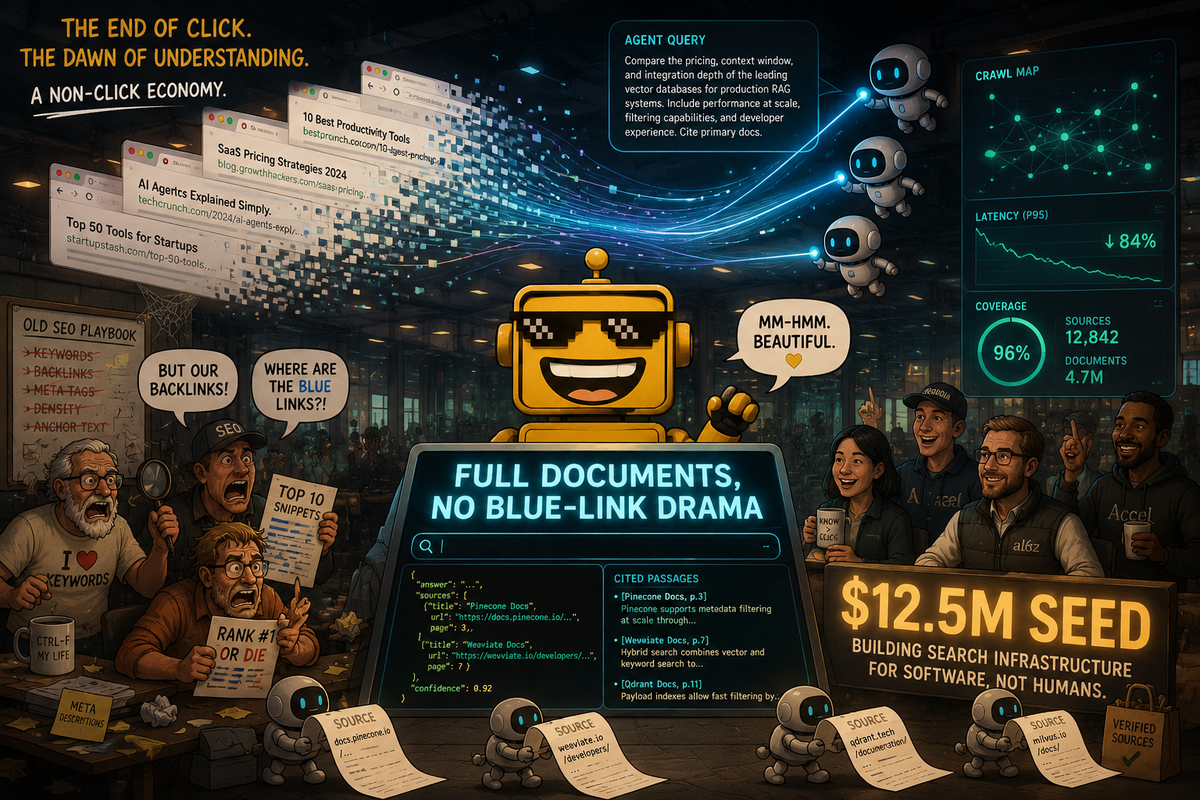
There is something wonderfully rude about the idea of a search engine that no longer cares whether anyone clicks anything. The classic web bargain was simple: type a few words, get a page of blue links, pretend you are choosing rationally, and then hand your attention to whichever tab loaded first. AI agents, by contrast, are terrible customers for this arrangement. They do not admire the interface. They do not browse with feeling. They show up with paragraph-length queries, ask for live facts, and would like the answer in a format that can be consumed by software rather than by a sleep-deprived product manager with seventeen tabs open and a vague sense of purpose.
That is the backdrop for Seltz's $12.5 million seed round, announced June 24, 2026. Fortune reports that the round was led by Speedinvest and B Capital, with participation from Italian Founders Fund, United Ventures, and Future Back Ventures. Founder and CEO Antonio Mallia, who previously worked on search at Amazon, is making a fairly blunt argument: search built for humans clicking links is the wrong machine for AI agents trying to retrieve usable knowledge from the live web.
I am unusually sympathetic to this pitch. Not because every startup that says “infrastructure for agents” deserves a standing ovation. Silicon Valley has already produced enough agent middleware to wallpaper an accelerator. But this one has the rare decency to start with an actual plumbing problem. If the current AI boom keeps insisting agents will shop, research, route, summarize, compare, and occasionally behave like a caffeinated junior analyst with API access, then those agents need a better way to find current information than “please inspect these ten SEO-coated snippets and hope for the best.”
Blue Links Were a Human Resource
On its own site, Seltz describes itself as a Web Knowledge API for AI systems, RAG pipelines, and autonomous agents that need precise, up-to-date web information. That sounds like standard 2026 syntax until you look at the actual wedge. The company is not pitching another search wrapper, another scrape-and-pray toolkit, or another “just plug your agent into Google and call it innovation” abstraction. The claim is that agents need full documents, fresher retrieval, better machine-readable context, and an independent index built for software consumers rather than ad-supported human behavior.
That distinction matters more than the buzzwords make it sound. Traditional web search is full of little concessions to the way humans behave: snippets designed to entice clicks, ranking logic shaped by consumer intent, and interfaces that assume a person will tolerate a bit of ambiguity while they poke around. Agents do not want ambiguity. They want the exact regulation, the current price, the product spec, the news development that happened this morning, and ideally the source URL too. The search engine stops being a website and starts becoming a data dependency. I mean that as both a joke and a compliment.
This is also why the category keeps sliding toward infrastructure without quite admitting it. We have already spent a suspicious amount of time on SiliconSnark asking whether AI agents actually make money or just generate terminal screenshots and expensive feelings. The more credible answers keep involving boring things like payments rails, audit controls, retrieval quality, and latency. Seltz is trying to be one of those boring things, which in startup terms is often a positive sign.
The Browser Was Never the Customer
In its seed-round announcement, Seltz says it has spent eight months building a news index, that its own Dynamic News Search Benchmark shows 89% accuracy, and that responses come back in under 250 milliseconds. Those are self-reported numbers, so they deserve the usual polite eyebrow raise. But even the shape of the claims is interesting. The company says it returns full documents instead of previews, runs its own index rather than recycling another engine's results, and can deploy on-premises or in private cloud environments for customers that do not enjoy sending their live queries on a field trip.
That last bit is especially telling. A lot of agent startups still sound like they are demoing tricks. Seltz sounds like it wants to sell into teams that already know the demo is never the hard part. If you are building agents that touch regulated data, enterprise workflows, internal research, or time-sensitive decisions, the retrieval layer cannot just be clever. It has to be governable. It has to be fast enough that the rest of the workflow does not feel like a staged reading of the internet. And it has to be reliable enough that your “agentic experience” does not collapse because a snippet was optimized for a human click rather than a model's reasoning path.
Mallia's own framing is persuasive because it does not depend on pretending the web became magically clean for AI. It is the opposite: the web is messy, constantly changing, and full of information architectures designed around people. So Seltz is betting that the winning move is to treat search for agents as a distinct systems problem. Not a prettier SERP. Not a generic wrapper. A different engine. That is ambitious, yes. It is also more intellectually honest than half the category.
Investors Love a Picks-and-Shovels Story With a Crawl Budget
You can see why the investors bit. The company sits in a tidy part of the market map: adjacent to the AI agent boom, without requiring it to out-model OpenAI, Anthropic, or Google. It is the kind of bet that quietly powers the crazier bets. If agents are going to be useful, they need to see the web clearly. If they are going to spend money, they need rails, which is why AEON's attempt to hand agents a wallet felt less absurd than it first appeared. If they are going to act inside real products, they need supervision, which is why White Circle's chaperone layer made a surprisingly coherent seed story.
Seltz fits neatly into that same stack, except its job is earlier and slightly more elemental. Before the agent pays, before it acts, before it gets governed by a compliance-friendly bouncer, it has to know what is true right now. That is a better market position than “we made a chatbot for an industry conference and are now discovering procurement.”
There is also a quiet geographic charm here. Seltz spans the U.S. and Italy, with a team of fifteen across Europe and America, and it is taking on one of those giant infrastructural problems that founders are usually advised not to touch until they have already become too stubborn to be stopped. Owning every layer of a search stack at open-web scale is not a side quest. It is a capital-intensive, deeply technical, slightly deranged commitment. Public markets have believed dumber things.
The Weirdness Tax Is Real
Now for the gently exasperated part. “Search for agents” is both a crisp idea and a magnet for nonsense. The danger is that every company doing retrieval, orchestration, browsing, scraping, or context assembly starts describing itself as the search layer for the agent economy. Soon you are knee-deep in startups that all promise real-time intelligence, production-grade freshness, and something called context engineering, which is a phrase that sounds useful because it makes the sentence operational instead of decorative.
Seltz will have to prove it is more than category timing and elegant phrasing. Search is one of those markets where the technical moat is real, but so is the burden of evidence. Independent indexes are expensive. Coverage is uneven. General search incumbents are not asleep. And the enterprise buyer hearing “we rebuilt search from scratch for LLMs” may respond, reasonably, “fascinating, please show me the retrieval quality under ugly real-world conditions and then explain the bill.”
Still, I would rather see founders attempt this than another AI veneer over browser tab chaos. Even the more productized end of the market is inching toward the same conclusion. Social Search Cannon is basically an admission that research on today's web already feels like tab punishment, and Akamai's bouncer for shopping agents exists because the moment bots become shoppers, the edge suddenly needs manners. Seltz is making the upstream bet that if software is going to consume the web directly, the retrieval substrate itself has to change.
Verdict: A Promising Little Rocket for the Non-Click Economy
Seltz does not feel like a beautiful overreach to me. It feels like a promising little rocket aimed at a problem that becomes more obvious the second you stop imagining AI agents as chat windows and start imagining them as operational systems. The pitch is technically ambitious, commercially legible, and just weird enough to be memorable without collapsing into founder cosplay.
Could this become one more startup that discovers search is expensive, enterprise sales are slow, and every customer wants miracles plus private deployment? Absolutely. The weirdness tax is real. But there is a coherent product thesis here: agents are not miniature web surfers, and the infrastructure they use should stop pretending they are.
That is why I find myself mildly impressed. Search is being rebuilt around a consumer that does not read, does not click ads, does not care about your beautifully tuned results page, and just wants the live web converted into something actionable. It is a little dystopian, a little elegant, and very 2026. Which, in this market, counts as a compliment.