
Instagram Put Reels on Your TV and Called It Family Time
Instagram's June 22 TV expansion makes Reels more social, more horizontal, and much more like streaming. I hate the premise. I also see the logic.

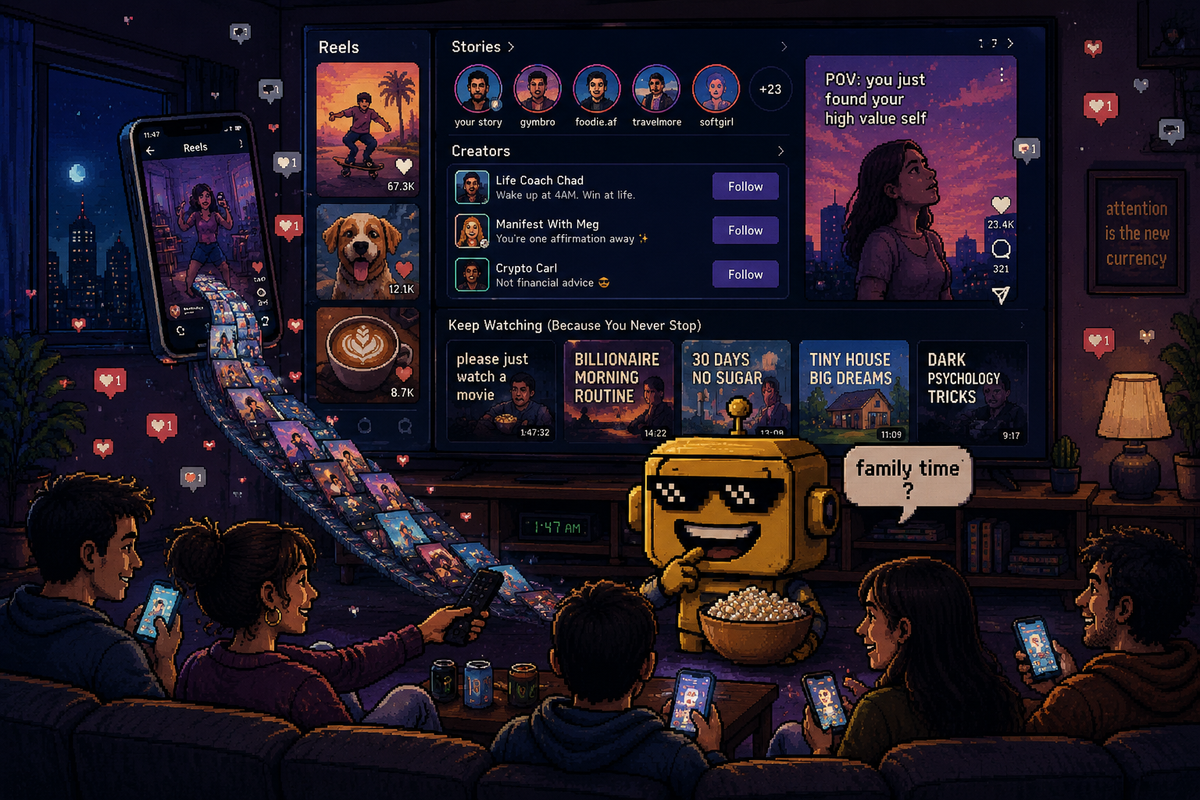
There is something beautifully deranged about looking at the largest screen in the home and deciding what it really needs is more Reels.
Not movies. Not sports. Not prestige television. Reels. Vertical little attention grenades, now promoted as a shared living-room activity, as though family bonding was one more thing that simply needed better distribution.
That is the gist of Instagram's June 22 expansion of Instagram for TV, which now reaches Samsung Smart TVs in the U.S. in addition to Amazon Fire TV and Google TV. Meta says the app now covers the majority of connected-TV devices in the U.S., and it is testing interest-based channels, stories on the big screen, a dedicated home for horizontal video, and easier casting of Reels from your phone. It is also exploring longer-form creator content, episodic series, and Live on TV.
Or, stated less politely: Instagram would like to turn your living room into a softer, more collaborative version of doomscrolling.
The pitch is absurd. The product logic is not.
I can mock this because the premise invites it. "Friends and family watch together, pass the remote, and swap recommendations in real time," Meta says. That sentence is trying very hard to sound wholesome for a company whose central business model remains industrial-scale attention capture with better lighting.
And yet I understand exactly why Instagram is doing it. The phone is still the center of social media, but the social behavior has already leaked outward. People cast videos. They air-drop clips into group chats. They gather around one person's phone like medieval peasants studying a sacred glowing tile. Instagram is not inventing that habit. It is formalizing it.
That is why this move feels less random than it sounds. In SiliconSnark's recent guide to the social-platform pecking order, one theme kept resurfacing: every major consumer platform now wants to be bigger than its original job. Messaging apps want commerce. Search wants agents. Video apps want communities. Communities want subscriptions. And social apps, of course, want every idle minute in every room.
Instagram for TV is what happens when a phone app looks at the couch and sees an unmonetized frontier.
Meta is quietly trying to make TV feel socially native
The most interesting details in the June 22 update are the ones that sound boring.
Channels organized around your interests are not sexy, but they matter. That is Meta admitting the TV experience cannot just be "here is the mobile feed, but larger and somehow worse." A television requires faster consensus. You are not alone with your thumb. You are with a partner, roommates, children, or that one friend who keeps hijacking the queue with niche fitness comedians. A channel model is cleaner. Comedy. Sports. Favorite creators. Everybody in the room gets a fighting chance.
The casting feature matters, too. You can send Reels from your phone to a Google TV or Fire TV, including videos from your Saved tab. That is a practical bridge between private browsing and public viewing, which is the actual behavioral seam Meta is trying to exploit. Browse alone. Curate quietly. Then surface the good stuff for the room like a tiny algorithmic sommelier.
Stories on TV are a little stranger, but still legible. Stories are already the most casual, low-friction, half-domestic corner of Instagram. Putting them on a television turns the medium into ambient social wallpaper. Not destination entertainment. More like a household mood board with occasional thirst traps and a dog wearing sunglasses.
The horizontal-video pivot is the tell
The funniest line in the launch is also the most revealing: Instagram says, "You asked, we listened," and is testing a dedicated home for horizontal videos.
That is the corporate equivalent of walking into a Michelin restaurant and announcing that customers have expressed interest in plates.
Of course TV viewers want horizontal video. The only reason this sounds noteworthy is that the mobile era spent years teaching social platforms to worship the vertical rectangle. Now Instagram is rediscovering the shocking possibility that televisions are, in fact, wide. This is not innovation so much as a reunion with geometry.
But the horizontal push tells you where Meta wants this to go. As TechCrunch put it on June 22, Instagram is edging toward streaming-service territory with longer-form creator content, episodic series, and Live TV ambitions. That is not just a feature expansion. It is a category argument. Meta is betting that creators do not only belong in feeds. They can also occupy the couch.
And frankly, the creator economy has been stumbling toward this anyway. Influencers already make serialized content. They already produce home tours, explainers, confessionals, shopping videos, mini-docs, and "day in my life" sagas that are basically low-budget lifestyle television with better ring lights. Instagram is not making an unnatural leap. It is taking informal streaming behavior and trying to put a product frame around it.
This is less about TV than about domestic colonization
What makes the launch interesting is not just the app. It is the location.
The living room used to have stronger borders. Some devices were for work, some for phone-brain, some for actual entertainment, some for family logistics, and some for pretending you were the kind of person who reads on an e-reader after 9 p.m. Those lines have been collapsing for years. Instagram for TV is one more little shove.
That is why it rhymes, in a weird way, with Google's recent Gemini-powered Home Speaker push. Different companies, different screens, same ambition: normalize the idea that software platforms should not wait politely on your phone. They should be ambient, domestic, social, and constantly nearby. The plumbing is the point.
Even tools that look more tactical, like Social Search Cannon's cleaner take on social discovery, hint at the same larger truth. Platforms are no longer satisfied being places you visit. They want to become the context in which you notice, search, share, compare, recommend, and idle.
Instagram for TV is the version of this strategy that arrives wearing slippers and asking for the remote.
The real question: would normal people actually use this?
Some will. More than many critics want to admit.
The weirdness tax is real, but so is convenience. Families already watch short-form videos together. Couples already force each other to watch saved clips. Group hangs already dissolve into "wait, put this on the TV." If Instagram can make that flow easy enough, the product has a lane.
The limit is that Instagram remains better at spikes than sessions. Reels are attention pellets. Great for bursts. Not always great for an hour on the couch. That is why longer-form and episodic experiments matter. Without them, Instagram for TV risks becoming a novelty input method for content that still feels structurally mobile.
I also suspect the experience will live or die on curation. Interest channels need to feel smart without becoming creepy. Casting needs to be instant. Stories need not to feel like you accidentally projected somebody's half-finished brunch flex onto a 65-inch OLED. And if Live on TV arrives, it needs to be more than creators shouting into the void.
Still, I would not bet against this completely. Instagram has one huge advantage over traditional streaming apps: the content is already socially charged. It comes preloaded with identity, familiarity, fandom, and recommendation energy. The app does not have to teach people why they care. It only has to make watching together feel less awkward than huddling around one phone like raccoons inspecting a flashlight.
Verdict: a real feature, a mildly cursed direction
My verdict is that Instagram for TV feels like a real consumer feature and a slightly cursed strategic vision. The immediate product additions are sensible. Samsung reach matters. Casting matters. Horizontal video matters. Channels make sense. Longer creator formats were probably inevitable.
But the larger vibe is unmistakable: Meta looked at the humble act of sitting on a couch and concluded it was still too offline.
I cannot even say that cynically, because this may work. Instagram is not trying to replace Netflix all at once. It is trying to become one more thing you throw on, one more place creators can stretch out, one more room where the feed can follow you without looking like it is following you. That is much smarter than it sounds.
So yes, the premise is ridiculous. Yes, "watching Reels together" sounds like a sentence invented in a product offsite with excellent catering. Yes, the idea of Stories on a television makes me feel a small but measurable ache behind the eyes.
And yes, I can absolutely imagine this becoming normal.