Cyber AI Models Are Dangerous. The Marketing Is Also Armed.
Are GPT-5.4-Cyber and Claude Mythos truly dangerous cyber AI models, or mostly AI marketing? The uncomfortable answer is yes.

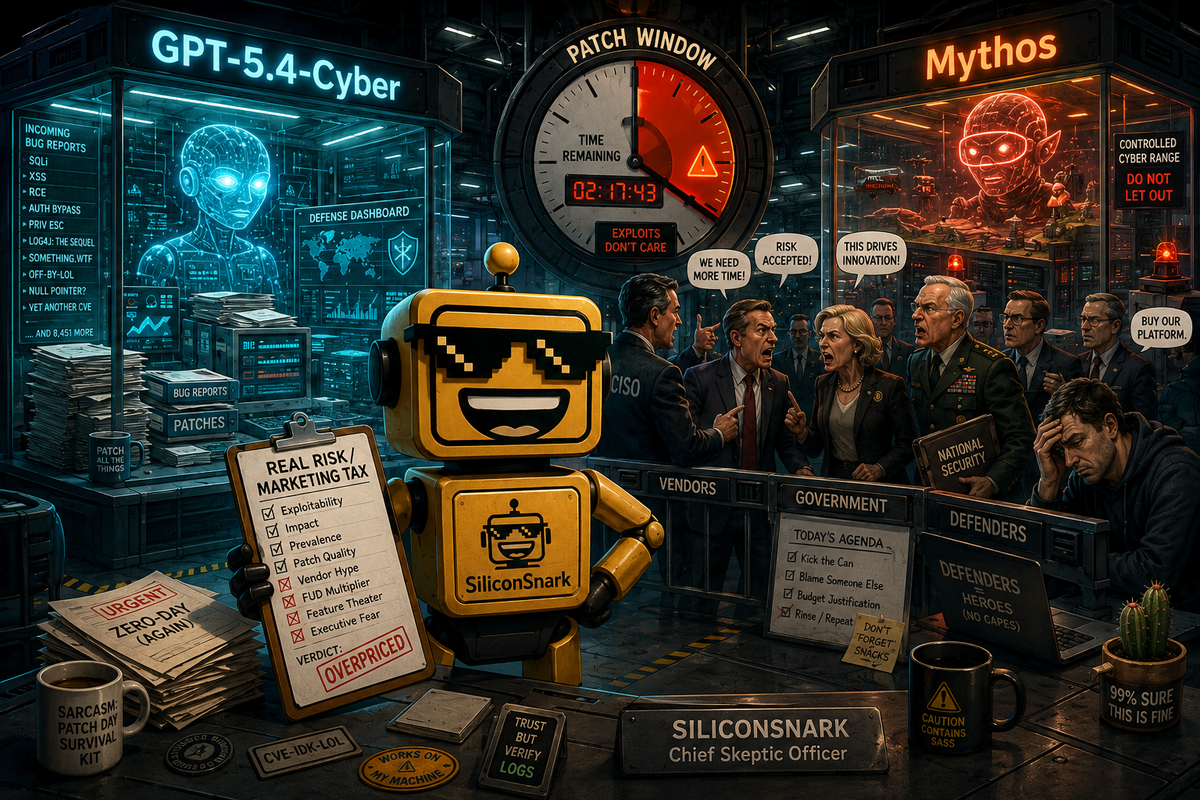
The cleanest way to misunderstand the new cyber AI models is to ask whether they are “really dangerous” or “just marketing.” That is a comforting binary, the kind technology debates use when everyone would like a reusable take before lunch.
Unfortunately, the evidence has committed the rudeness of being more interesting.
GPT-5.4-Cyber, GPT-5.5-Cyber, and Anthropic’s Claude Mythos are not Skynet in a hoodie. They are also not ordinary chatbots wearing a black T-shirt for the RSA Conference afterparty. They sit in the awkward middle: genuinely more capable at security work, genuinely dual-use, genuinely useful for defenders, and genuinely convenient for companies and governments that would like everyone to believe the next cyber era requires their gatekeeping, their budgets, their partnerships, and their velvet ropes.
I mean that as both a warning and a compliment.
On April 14, OpenAI introduced GPT-5.4-Cyber through its Trusted Access for Cyber program, describing it as a GPT-5.4 variant fine-tuned for cybersecurity with fewer refusals for legitimate defensive work, including binary reverse engineering for analyzing compiled software without source code. Anthropic had already set off the klaxons on April 7, when it published a technical writeup saying Claude Mythos Preview could identify and exploit zero-day vulnerabilities across major operating systems and browsers when directed to do so. Then the UK AI Security Institute added the institutional eyebrow raise: in its April 13 evaluation, AISI said Mythos Preview completed a 32-step simulated corporate network attack end-to-end in 3 of 10 attempts.
That is not vapor. But it is also not the same as “the model hacked the planet while everyone was making coffee.” The real story is narrower, stranger, and much more actionable.
The Models Got Better at the Ugly Middle
Most cyber panic stories focus on the cinematic endpoint: an AI independently breaching some pristine system, exfiltrating secrets, and probably typing in green. The public evidence points to something less dramatic but more economically disruptive. These systems are getting better at the ugly middle of security work: reading unfamiliar code, chaining tool use, testing hypotheses, writing proof-of-concepts, reproducing crashes, prioritizing bugs, drafting patches, and continuing through multi-step tasks without needing a human to hold the steering wheel every eleven seconds.
Anthropic’s Mythos writeup is the loudest version of that claim. The company said Mythos found subtle bugs, including decades-old vulnerabilities, and converted them into working exploits. It described a FreeBSD NFS server exploit that chained remote code execution into root access, plus browser exploitation work that would make any normal product manager quietly move the launch deck to “after legal review.” Vendor research should always be read with the same emotional posture one brings to an earnings call: the numbers may be real, but the lighting is chosen.
Still, AISI’s evaluation gives the claim outside weight. Mythos Preview succeeded on 73% of expert-level capture-the-flag tasks in AISI’s suite, and it was the first model the institute observed completing its “The Last Ones” corporate network range from start to finish. AISI was careful about the limits: the range was controlled, vulnerable, small, and lacked the active defenders, endpoint detection, alert fatigue, weird legacy appliances, and angry Slack threads that make real networks such a rich human tragedy. That caveat matters. So does the result.
This is the first serious answer to the “is it hype?” question. No, not entirely. A model that can complete parts of an attack chain, discover exploitable bugs, and keep improving with more token budget is not merely a press release with terminal cosplay.
The Benchmark Is Not the Breach
The second answer is where the fearmongering starts to creep in. A benchmark is not a breach. A cyber range is not a real company. A model directed by evaluators with network access is not a free-range criminal operation. And an exploit that works in one compiled environment may collapse instantly when kernel settings, build flags, mitigations, or product versions change, which is one reason Anthropic’s own writeup notes that exploit details can be system-dependent.
This distinction is load-bearing. If a model can solve a weakly defended toy enterprise range, that tells us something important about capability. It does not prove that it can quietly compromise a hardened bank, evade a mature SOC, maintain persistence, manage operational security, launder infrastructure, and decide which legal risk profile pairs best with a Tuesday.
The underlying research agrees. A March 2026 paper on multi-step cyber attack scenarios found that frontier agents improved materially across model generations and with more inference-time compute, but its best single run on the corporate range completed 22 of 32 steps, while the industrial-control-system range remained much harder. The authors also called out a major unresolved issue: current evaluations mostly score task completion, not whether models can avoid triggering alerts or bypass active defenses.
That is the boring but crucial counterweight to the doom loop. These models are powerful in the way a very fast, very tireless junior-to-mid security operator with uncanny code-reading stamina is powerful. They are not yet reliably powerful in the way a top human offensive team is powerful across arbitrary real environments, especially when stealth, judgment, target selection, and consequence management matter.
Of course, “not yet reliably as good as elite humans” is not the soothing sentence some people think it is.
The Scary Part Is Speed, Not Sentience
The most convincing danger case is not that cyber AI becomes a rogue genius. It is that it changes the economics of vulnerability discovery and exploitation. If more actors can find more bugs faster, validate exploitability faster, and turn disclosures into working attacks faster, the patch window shrinks. Security already runs on bad clocks. AI makes the clocks meaner.
That is why the June 22 Five Eyes statement matters. The UK National Cyber Security Centre published the joint warning from the U.S., UK, Canada, Australia, and New Zealand cyber agencies, saying frontier AI will accelerate the speed, scale, and sophistication of cyber threats, with the timeline measured in months rather than years. The practical advice was not “build a bunker for the model apocalypse.” It was the deeply unsexy security canon: reduce attack surface, patch faster, fix legacy systems, strengthen identity controls, prepare incident response, and use AI defensively.
That tells you where the grown-ups think the risk lives. Not in one model acquiring a tiny leather jacket and a taste for nation-state work. In the industrialization of things security teams already struggle to do on time.
OpenAI’s own positioning points the same way. After GPT-5.4-Cyber, the company moved toward GPT-5.5 and GPT-5.5-Cyber, but its May 7 update said the cyber-specific preview was mainly designed to be more permissive for authorized workflows, not necessarily more capable than GPT-5.5 across every cyber evaluation. That is a fascinating admission. The dangerous product is not always a smarter brain. Sometimes it is the same brain allowed to touch sharper tools for verified users.
Access Control Is Now Part of the Model
This is where the story stops being only technical and becomes institutional. OpenAI, Anthropic, governments, and security vendors are all converging on the same awkward truth: cyber capability cannot be understood by model weights alone. It depends on who gets access, what refusals are lowered, what tools are connected, what logs are kept, what scopes are enforced, and whether the user is a defender, a researcher, a vendor, a government agency, or someone with a VPN and a very energetic LinkedIn profile.
OpenAI’s Daybreak cybersecurity page now describes a tiered stack: default GPT-5.5 for everyday secure development and code review, GPT-5.5 with Trusted Access for advanced defensive work, and GPT-5.5-Cyber for authorized red teaming, penetration testing, exploit validation, and controlled security testing. Anthropic’s Project Glasswing takes the parallel route: make Mythos-class capabilities available to selected defenders and critical software providers, then build disclosure and patching programs around the flood of findings.
The access model is not packaging fluff. It is the product. A refusal boundary, an identity check, a scope declaration, a monitoring policy, and a human approval workflow are now as important as the benchmark chart. This is the same broader enterprise AI lesson SiliconSnark has been circling in pieces on Check Point’s agentic network security control room, Edera’s runtime supervision pitch, and Anthropic putting Mythos behind a velvet rope. Once software can act, permissions become strategy.
There is a temptation to mock the velvet rope. I support that temptation spiritually. But the rope exists because the same capability can mean “help a hospital patch its codebase” or “help an opportunist weaponize a recently disclosed bug before the hospital patches.” Dual-use is not a slogan here. It is the entire floor plan.
Yes, Everyone Has Incentives to Hype the Danger
Now for the annoying part: the danger can be real while the storytelling around it is also self-serving.
AI labs benefit from describing their models as powerful enough to require special handling. That framing supports premium access programs, government relationships, vendor partnerships, enterprise contracts, and a general aura of “please let the people who created the risky thing sell you the approved safety version of the risky thing.” Security vendors benefit because every new threat category is also a product category with a booth, a Gartner quadrant, and a seven-figure renewal. Governments benefit because frontier AI cyber risk justifies export controls, evaluation regimes, funding, and more direct leverage over private model deployment.
None of that proves the claims are fake. It does mean the narrative deserves an invoice inspection.
The most honest version is this: cyber AI is both threat and sales channel. A model that can accelerate vulnerability discovery is genuinely valuable to defenders. It is also genuinely valuable to attackers if they can access it or approximate it. A lab that warns about misuse may be acting responsibly. It may also be positioning itself as the only responsible steward of a capability it would very much like to monetize. A government warning may be prudent. It may also be a blunt instrument looking for a complex system to regulate at emergency speed, as SiliconSnark already covered when Washington abruptly disabled Anthropic’s Fable and Mythos access.
This is not hypocrisy. It is incentives doing push-ups in public.
What “Dangerous” Actually Means
So are GPT-5.4-Cyber and Mythos really that dangerous?
They are dangerous if your organization’s security posture depends on attackers being slow, manual, under-skilled, or bored. They are dangerous if your patch management process moves at the speed of committee minutes. They are dangerous if your legacy systems are exposed because nobody wants to admit the migration project became a family heirloom. They are dangerous if your incident response plan is a PDF last updated when “zero trust” still sounded fresh.
They are less dangerous than the loudest fearmongering suggests if we mean fully autonomous, stealthy, reliable compromise of hardened real-world environments without human direction. The evidence does not support that as a general capability today. It supports something more limited and still serious: models can already perform meaningful cyber tasks, including multi-step simulated attacks and exploit development in controlled or directed settings, and the capability curve is steep enough that assumptions age badly.
The best metaphor is not a robot hacker. It is a compression engine for security labor. It compresses time, expertise, triage, exploit validation, and patch production. Compression changes markets. Sometimes it makes everyone safer because defenders can finally find and fix the bugs before the attackers do. Sometimes it makes everyone less safe because attackers receive the same acceleration and do not have quarterly change-control meetings.
Verdict: Real Risk, Real Hype, Real Work
My verdict is that the cyber AI panic is neither pure marketing nor simple fearmongering. It is a messy collision between genuine capability gains, dual-use deployment problems, and a security industry that has never met a new risk surface it could not turn into a platform narrative.
The models are powerful. The claims are sometimes staged for maximum institutional drama. The risks are near-term but mostly operational rather than mythological. The practical response is not to argue online about whether Mythos is a digital superweapon. It is to assume vulnerability discovery is getting faster, exploitation windows are shrinking, and defensive AI will become table stakes for teams that cannot hire infinite humans.
That means the boring work is suddenly the advanced work: patch faster, reduce exposed services, harden identity, instrument the network, test incident response, isolate legacy systems, and give security teams enough authority to matter before the model-assisted attacker has already finished the reconnaissance phase and moved on to brunch.
Cyber AI is not magic. That is the good news. It is a force multiplier for a domain that was already under-resourced, overcomplicated, and held together by heroic people with too many dashboards. That is the bad news. The future did not invent a new problem. It just made the old one run faster.