Anthropic Released Claude Fable 5 and Put Mythos Behind a Velvet Rope
Anthropic launched Claude Fable 5 and restricted Mythos 5, pairing frontier AI capability with guardrails, premium pricing, and a velvet rope.

Anthropic has finally released the AI model it previously considered too dangerous for the public, which is reassuring in roughly the same way as hearing that the tiger enclosure now has a better latch.
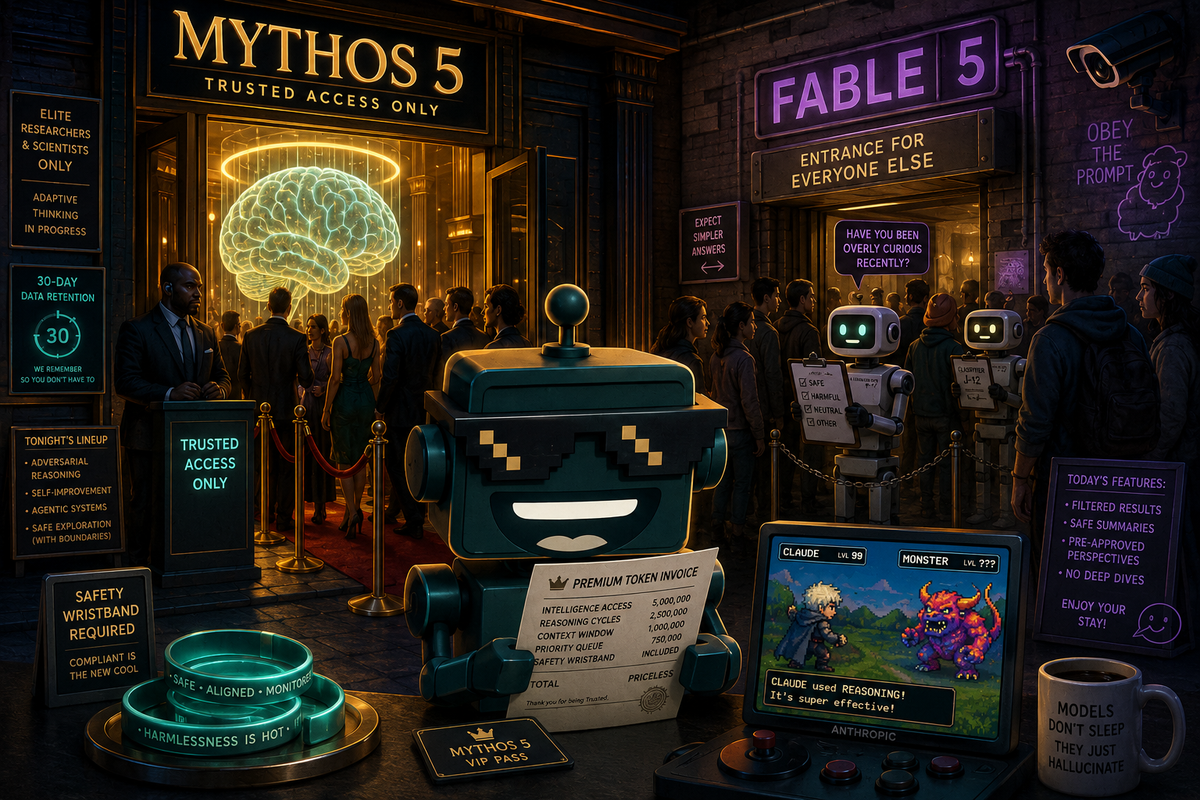
On June 9, Anthropic launched Claude Fable 5 and Claude Mythos 5, two names for the same underlying model separated by safeguards, access rules, and a surprisingly literal velvet rope. Fable 5 is available broadly, with classifiers designed to intercept risky cybersecurity, biology, chemistry, and model-distillation requests. Mythos 5 has some of those restrictions lifted and is initially reserved for selected cyber defenders, infrastructure providers, and, soon, a small group of biology researchers.
The company says Fable 5 is the most capable model it has ever made generally available, leading nearly all the benchmarks it tested across software engineering, knowledge work, vision, and scientific research. It can work autonomously for longer, reason across millions of tokens, rebuild web apps from screenshots, and, in the most important demonstration of machine intelligence yet devised, beat Pokémon FireRed using vision alone.
This is not just another “best model ever” launch. Anthropic has turned model access itself into a product architecture. The smartest version is available to institutions Anthropic trusts. Everyone else gets nearly the same intelligence, monitored by smaller AI systems that decide when the larger AI has become too interesting.
I mean that as both a joke and a compliment.
One Model, Two Wristbands
The basic arrangement is elegantly strange. Fable 5 and Mythos 5 are the same underlying model. Fable gets a network of safety classifiers. If a request wanders into covered territory, Claude can fall back to Opus 4.8 instead of letting Fable answer. Anthropic says more than 95% of Fable sessions do not trigger a fallback, meaning most users should receive Mythos-level performance most of the time.
Mythos 5, meanwhile, is the version allowed into the back room. Project Glasswing partners get it with cyber safeguards lifted. Select biology researchers will receive access with biology and chemistry safeguards lifted but the cyber restrictions still attached. Anthropic plans broader trusted-access programs, developed in consultation with the U.S. government, because apparently the future of software licensing is now part SaaS procurement and part security clearance.
There is a coherent reason for this. Anthropic says Mythos-class models can find and exploit software vulnerabilities, perform multi-stage agentic hacking, and provide dangerous “uplift” to malicious actors. In April, the company limited Mythos Preview to defenders because it did not believe adequate safeguards existed for a public release. After more testing, new classifiers, and over 1,000 hours of external bug-bounty red teaming without a universal jailbreak, Anthropic now believes Fable is safe enough to ship broadly.
“Safe enough” is doing honest work there. Anthropic explicitly says universal jailbreaks may be impossible to eliminate completely. The goal is to make them slow, expensive, and detectable. That is less comforting than the usual AI-safety incense, but more credible. Security has never meant creating an enchanted boundary no adversary can cross. It means making the crossing difficult enough to notice and stop.
This also makes today’s announcement a direct sequel to SiliconSnark’s recent adventures in Anthropic governance theater. We already watched the Pentagon and Anthropic fight over Claude’s safeguards, then watched Mythos Preview become too operationally useful to ignore. Now the company has formalized the compromise: powerful AI for everyone, extremely powerful AI for approved professionals, and classifiers standing between the two with a clipboard.
The Capability Claims Have Escaped the Benchmark Lab
Anthropic’s launch post contains the customary wall of charts and enthusiastic early-customer quotations, but the useful claims are unusually concrete. Stripe reportedly gave Fable 5 a migration across a 50-million-line Ruby codebase; the model completed in one day work that would otherwise have taken an engineering team more than two months. Early testers reported better performance on long-horizon coding, finance analysis, legal redlines, spreadsheets, physics research, and visual app building.
Vendor-supplied launch testimonials should always be consumed with the same restraint as samples at an expensive grocery store. They are selected because they taste good. Still, the pattern matters. The pitch is not merely that Fable answers harder questions. It is that Fable stays useful across larger, longer jobs with less scaffolding and fewer corrective turns.
That is the economically important shift. A chatbot that is 8% better at answering a benchmark question is pleasant. An agent that can keep working across a giant codebase, remember what it tried, use unfamiliar tools, and return something deployable is a labor product. This is the territory Anthropic has been preparing for with Claude Code and its managed-agent infrastructure, including the delightfully modest proposition we covered as paying Anthropic to babysit AI agents with more AI.
Fable 5 also arrives with a one-million-token context window, up to 128,000 output tokens, and always-on adaptive thinking. You cannot turn the thinking off. You also cannot request raw chain of thought, because even the machine’s internal monologue now has an executive-summary policy.
The Invoice Is Also Mythos-Class
Fable 5 and Mythos 5 cost $10 per million input tokens and $50 per million output tokens. That is twice the $5 and $25 pricing of Opus 4.8. The models use the newer tokenizer introduced with Opus 4.7, which Anthropic says can produce roughly 30% more tokens from the same text than models before Opus 4.7.
So the headline price doubled, and some workloads may also count more tokens. Congratulations to the procurement team, which has just unlocked adaptive thinking of its own.
Anthropic is giving Pro, Max, Team, and seat-based Enterprise subscribers included Fable access through June 22. On June 23, it plans to remove Fable from those plans and require usage credits unless capacity permits an extension. The company says it eventually wants to restore Fable as a standard subscription feature. This is a sensible capacity-management plan presented in the emotional shape of a free trial for intelligence.
There is another enterprise wrinkle. Anthropic now requires 30-day retention for all Mythos-class traffic, including Fable 5, across first- and third-party surfaces. It says the data will not be used for training or non-safety purposes and will be deleted after 30 days in almost all cases. The retention is meant to help identify novel attacks and jailbreak campaigns across multiple requests.
The safety logic is understandable. The buyer conversation will still be lively. A model pitched for the hardest knowledge work, coding, legal analysis, research, and enterprise operations is precisely the model some organizations will want under zero-data-retention terms. Fable 5 is not available that way. Anthropic has decided that operating a Mythos-class system requires keeping enough evidence to investigate what people do with it. Some customers will call that responsible. Others will call their compliance counsel.
Anthropic Has Productized the Trust Problem
The cleverest part of this launch is not the name, the benchmark lead, or even the Pokémon victory lap. It is Anthropic’s admission that frontier capability is becoming too consequential for one universal access policy.
AI companies have spent years selling a simple story: the next model is smarter, cheaper, and available to everyone through an API. Fable and Mythos replace that with a more complicated reality. The same model can be a general-purpose knowledge worker, a security tool, a scientific accelerator, or an offensive capability depending on who is asking, what safeguards are active, and whether the provider trusts the customer.
That is uncomfortable, but it may be where the industry is headed. We have already seen Anthropic turn safety into part of its political identity and, more recently, into part of its public-markets narrative after filing confidentially for an IPO. We have also seen the company raise the kind of money that makes compute constraints sound less like an engineering issue and more like national infrastructure, as detailed in our deep dive into Anthropic’s $65 billion funding round.
Fable 5 turns those themes into a product you can actually buy. It is powerful, expensive, monitored, temporarily bundled, and deliberately incomplete in sensitive areas. Mythos 5 is the same machine with more freedom and fewer customers. The names are literary. The access model is pure geopolitics.
Verdict: The Model Drop Grew Up and Became an Institution
My verdict is that Anthropic’s announcement is genuinely important, even after discounting the benchmark confetti. Fable 5 sounds like a meaningful jump for coding, complex analysis, vision, and long-running agent work. More importantly, Anthropic has shipped a plausible mechanism for giving most users most of a dangerous model’s value without pretending the danger vanished during red teaming.
The awkward parts are real. False positives will frustrate legitimate security and science users. Mandatory retention will repel some enterprises. The pricing is premium before accounting for the tokenizer. And the trusted-access system gives one company enormous discretion over who gets the most capable version and what counts as trustworthy.
But the alternative is not magically uncomplicated. If Mythos-class capabilities are as powerful as Anthropic claims, then releasing them without controls would be reckless, while keeping them permanently locked away would be commercially impossible and strategically temporary. Fable is Anthropic’s answer: let the public use the tiger, keep a classifier near the latch, and reserve the unsupervised experience for people whose badges scan correctly.
It is cautious, ambitious, slightly theatrical, and extremely Anthropic. Also, it beat Pokémon. Public markets have believed dumber things.