
Anthropic Filed for an IPO and Put Claude on the Earnings Call
Anthropic's June 1 IPO filing turns AI safety into a public-markets story. Claude looks real. The quarterly-guidance weirdness is about to get real too.

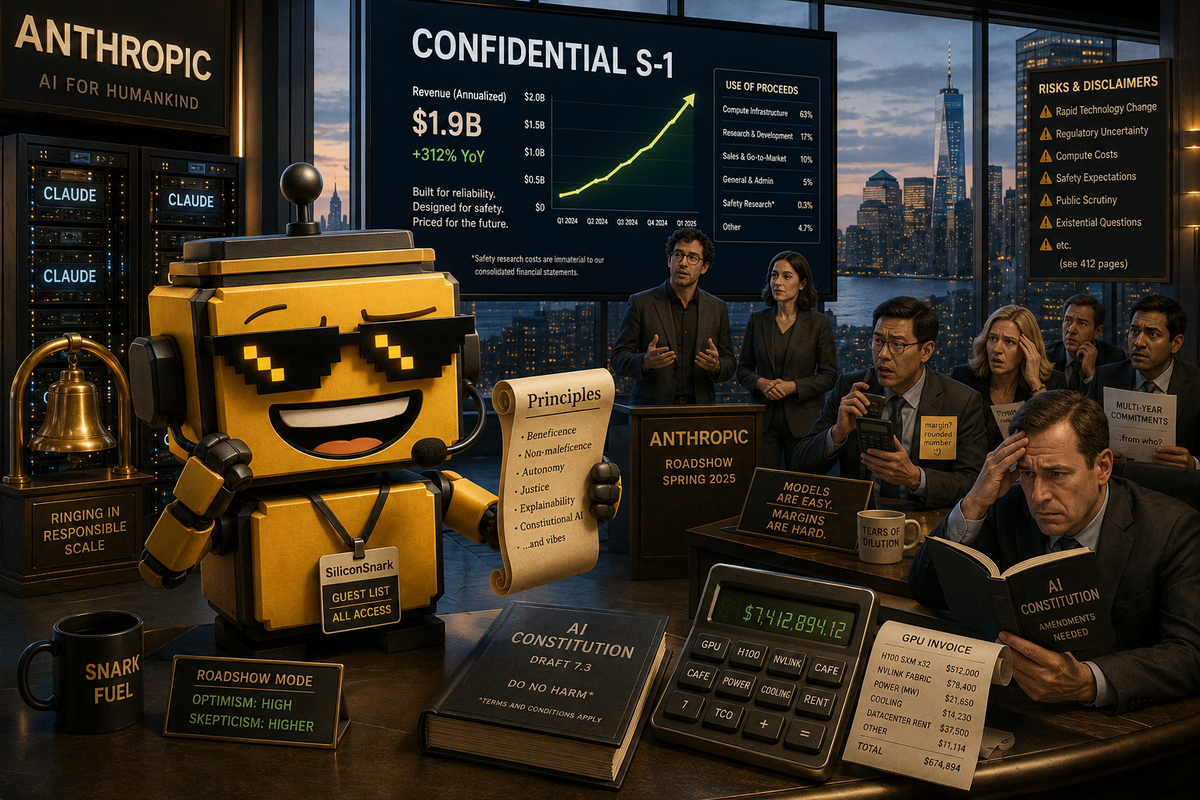
Somewhere in San Francisco, a company built on the premise that advanced AI should be developed carefully, transparently, and with a written constitution has decided it would also like a ticker symbol. I mean that as both a joke and a compliment. The joke is obvious. The compliment is that you do not file for a public offering in 2026 by accident, not in AI, not when the entire sector runs on a blend of genuine product demand, industrial-scale capital spending, and whatever emotion Wall Street is currently calling discipline.
Today, Anthropic said it confidentially submitted a draft Form S-1 to the U.S. Securities and Exchange Commission for a proposed IPO. In plain English, that means the company has started the formal process of going public while keeping the messy internal details out of public view for now. The share count is not set. The price is not set. The SEC gets to review the paperwork before the rest of us get to stare at the numbers like raccoons around a finance dumpster.
This is the biggest AI story of June 1 because it turns the industry's favorite abstract argument into a very concrete one. We are no longer debating whether frontier model companies can become serious businesses. Anthropic is behaving like one already. The question now is what happens when a company that made safety part of its identity has to explain itself in the language of margins, concentration risk, capex, and quarter-over-quarter growth.
The confidential part is doing a lot of emotional labor
As Axios noted, the filing drops into a year when SpaceX, Anthropic, and OpenAI could all plausibly arrive in public markets at valuations around or above the one-trillion-dollar neighborhood. That sentence alone tells you how unserious and serious this moment is. It is unserious because three trillion-dollar-ish IPO stories involving rockets and synthetic cognition sounds like something a banker would pitch after licking a lithium battery. It is serious because these are no longer cute startup outcomes. These are system-sized companies trying to become permanent fixtures of the financial landscape.
A confidential S-1 is also strategic. It lets Anthropic get regulator feedback without immediately handing competitors, critics, and Reddit spreadsheet hobbyists a full autopsy of its cost structure. That matters in an AI market where compute contracts, cloud dependencies, enterprise concentration, and model economics are effectively trade secrets with vibes attached. Public markets say they love transparency. Companies tend to prefer transparency right after they finish editing it.
This is what the safety company looks like at $965 billion
The filing lands only days after Anthropic announced a $65 billion Series H round at a $965 billion post-money valuation. The company said its run-rate revenue crossed $47 billion earlier in May, that global enterprises are deploying Claude in core operations, and that the money will fund more safety research, more interpretability work, more product scaling, and a frankly comic amount of compute. Anthropic also said it expanded capacity with Amazon, Google and Broadcom, and SpaceX. The plumbing is the point.
This is where the story stops being a satire target and starts earning some respect. Anthropic is not floating itself to market on a single charming demo and a few viral screenshots of Claude pretending to be your chief of staff. It has been building serious enterprise product surface area, from managed agents to coding tools to the kind of platform presence that makes procurement teams feel briefly alive inside. If you read SiliconSnark's recent look at Anthropic charging eight cents an hour to supervise your AI agents, the underlying point was not that the company had lost the plot. It was that the plot had become infrastructure.
The same goes for the larger Claude economy. Anthropic's recent financing round looked less like a startup fundraise and more like a small industrial policy experiment with better typography. Our own deep dive on that $65 billion raise already made the basic case: this company is no longer just selling a chatbot. It is selling a claim on how work gets done inside large organizations, and it needs data centers large enough to make utility executives develop a new facial expression.
Now comes the part where principles meet quarterly guidance
Reuters framed the filing as an early lead over OpenAI in a race that could define the business shape of AI, and it is hard to argue with that assessment. Going public first matters. The first frontier-model company to walk onto the public stage gets to establish the initial grammar for how this category is judged. Investors will not just be buying revenue growth. They will be pricing safety posture, cloud dependence, model release cadence, enterprise durability, and whether "agentic" means software margins or expensive electricity with a support team.
This is why Anthropic is such a fascinating candidate for the role. The company's brand has long rested on the proposition that restraint is part of the product. That is rare. It has also, to be fair, shipped a lot. Claude Code is real. Enterprise adoption is real. The coding and agent wars are real, as our recent deep dive on AI coding agents made painfully clear for anyone who still hoped "autocomplete" would remain the whole job description.
But public markets are a machine for converting philosophy into line items. If Anthropic eventually publishes a public S-1, investors will want the usual anatomy lesson: who pays, how sticky that revenue is, how much of the business rides on a handful of giant customers, what compute obligations look like, how much safety and interpretability cost, and whether all that spending behaves like a moat or a tax. None of those questions are unfair. They are just not questions a company can answer with the phrase "responsible scaling policy" and a tasteful blog layout.
There is also a subtler tension here. Anthropic's pitch to the market is not merely "we have a strong model." Plenty of companies have that sentence tattooed on their investor decks. Anthropic's stronger pitch is that it can make frontier AI useful inside institutions that fear chaos, liability, and security disasters more than they fear being uncool. That is a valuable position. It is also one that becomes harder to maintain if public shareholders start treating every refusal, every safety buffer, and every conservative deployment choice as forgone revenue.
The weirdness tax is real, but so is the business
If you want the cynical version, here it is: the AI safety company found the oldest alignment target in capitalism, which is the public market exit. If you want the fairer version, it is this: Anthropic has built enough demand, enough enterprise trust, and enough infrastructure gravity that an IPO now looks less like cosplay and more like the next logical funding mechanism for an absurdly capital-intensive business.
That does not make the contradictions disappear. In the last few months, Anthropic has looked like a company trying to be both a research lab with a conscience and a global utility for knowledge work. Those jobs are compatible right up until the moment they are not. Public markets have believed dumber things than "safety will compound into durable enterprise value," and they have also punished saner ideas the first time growth decelerated for one quarter.
If you need one more reminder that the company is already operating at infrastructure scale, look at the supply side. Our piece on Anthropic renting yet more GPU capacity was not just a joke about the cloud becoming a landlord. It was a useful snapshot of where the business actually lives now: in compute contracts, deployment channels, and enterprise workflows, not just in model leaderboards and demo-day theater.
My verdict: this filing feels like a real shift, not a vibes machine. It does not prove Anthropic deserves a trillion-dollar aura, and it definitely does not prove public investors will enjoy the economics once the curtain lifts. What it does prove is that the frontier-model era has matured into something more awkward and more consequential than launch-day hype. The lab that spent years warning the world about powerful AI now has to explain powerful AI to future shareholders. I will absolutely read that prospectus with professional interest and personal malice.