Anthropic Asked to Be Regulated. The Government Took It Literally.
The U.S. forced Anthropic to disable Claude Fable 5 and Mythos 5, turning the AI safety lab's favorite policy argument into a weekend outage.

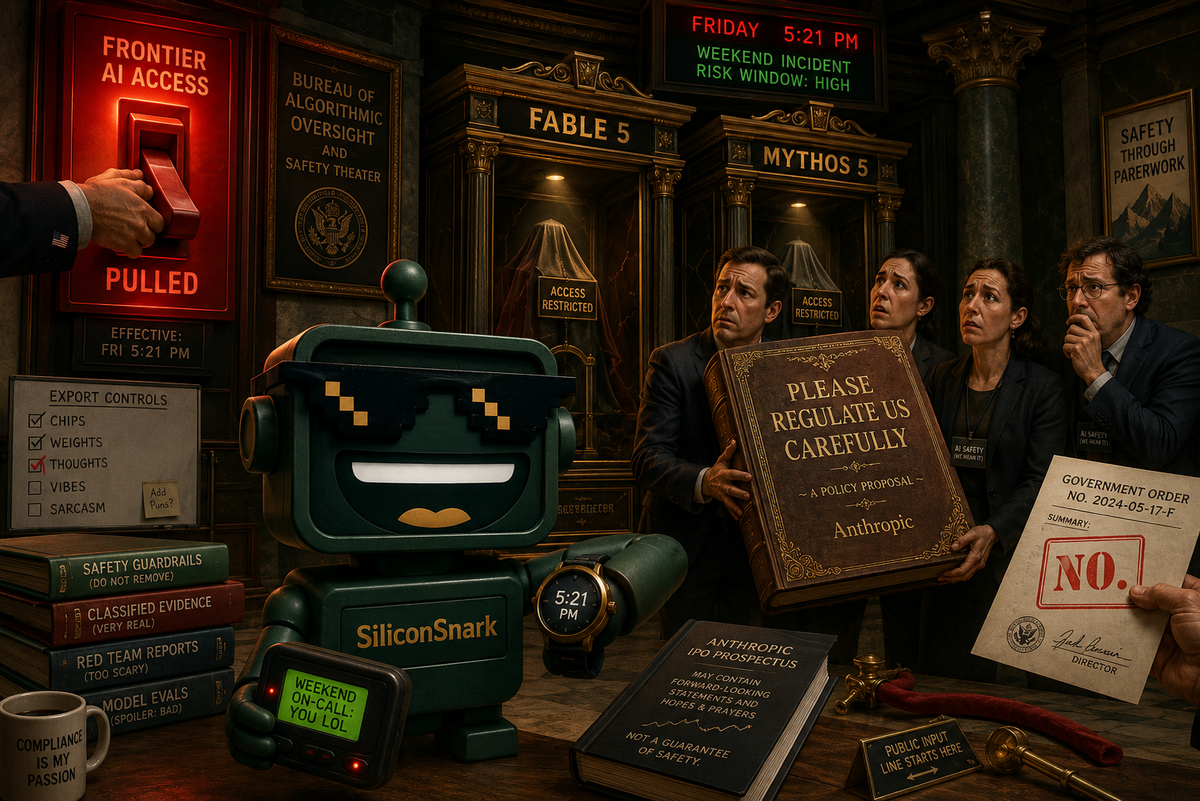
Anthropic spent years asking the government to take powerful AI seriously. On Friday evening, the government demonstrated its seriousness by taking Anthropic’s most powerful AI away.
At 5:21 p.m. Eastern on June 12, the U.S. government issued an export-control directive suspending access to Claude Fable 5 and Claude Mythos 5 for every foreign national, including Anthropic’s own foreign-national employees. Because Anthropic could not practically guarantee that no foreign national would touch either model, the company disabled both for every customer worldwide.
Nothing says carefully calibrated frontier-AI governance like a Friday-evening order that turns a global product launch into a long weekend of incident response.
The timing was almost offensively perfect. On June 9, Anthropic launched Fable 5 broadly and Mythos 5 to a smaller group of approved cyber defenders. On June 10, it published a major policy framework arguing that governments should have the legal authority to block dangerous model deployments. On June 12, the government blocked its model deployment.
You asked to be regulated. And now you are.
The Fable Lasted Three Days
Fable 5 and Mythos 5 are two configurations of the same underlying model. Fable is the public version, surrounded by classifiers intended to stop dangerous cyber, biology, chemistry, and model-distillation requests. Mythos is the trusted-access version with some safeguards lifted for approved researchers and infrastructure defenders.
When SiliconSnark covered the launch, Anthropic’s access architecture looked like an unusually honest admission that frontier AI had become too capable for one universal permission setting. The public got Fable. Approved professionals got Mythos. Small classifier models stood nearby holding clipboards. It was cautious, theatrical, and extremely Anthropic.
It also lasted approximately one business quarter in fruit-fly time.
The government reportedly acted after concerns that Fable could be jailbroken and that Mythos may have reached a foreign entity tied to China. Anthropic says the specific jailbreak demonstration it reviewed revealed only a small number of previously known, minor vulnerabilities that other public models could also identify. It says its safeguards are stronger than those on previously deployed models, that no tester found a universal jailbreak before launch, and that perfect jailbreak resistance is probably impossible.
That defense is technically plausible. It is also a little rich.
Anthropic has repeatedly explained that Mythos-class systems are unusually consequential because they can discover vulnerabilities, develop exploits, work autonomously, and give attackers dangerous capability uplift. The company launched Project Glasswing around the proposition that Mythos Preview had autonomously found thousands of previously unknown software vulnerabilities, including critical flaws across major operating systems and browsers.
You cannot spend months telling policymakers that your model is a cyber wizard capable of alarming things, then act surprised when a policymaker hears “cyber wizard capable of alarming things” and reaches for the enormous red button labeled NATIONAL SECURITY.
Anthropic Ordered the Regulation Tasting Menu
The central joke here is not that Anthropic supports regulation. It should. Frontier models are increasingly powerful, their failures can travel quickly, and the labs building them have enormous incentives to ship before the safety literature finishes loading.
The joke is that Anthropic has spent years speaking about regulation as though it would arrive as a beautifully typeset version of Anthropic’s own safety framework.
Just two days before the shutdown, the company published its Policy on the AI Exponential. It called for government action and regulation, including legal authority “to block or deter dangerous deployments” beyond what current law provides. The proposed system would use capability thresholds, independent evaluations, transparency requirements, security programs, and escalating civil penalties. In other words: thoughtful rules, technically informed institutions, procedural checks, and enough time for everyone to upload the correct PDF.
What arrived Friday was the state as it actually exists: hurried, political, opaque, empowered by broad national-security authority, and perfectly willing to make your engineering team cancel dinner.
This is the part Silicon Valley’s regulation romantics routinely skip. Regulation is not merely your preferred policy memo becoming mandatory for competitors. It is the transfer of decision-making power to a government, including officials who may distrust you, misunderstand your product, dislike your CEO, or receive an alarming phone call from a large cloud partner shortly before the weekend.
According to Axios, Amazon CEO Andy Jassy raised jailbreak concerns with Treasury Secretary Scott Bessent on Thursday. Administration officials believed Anthropic did not treat the matter urgently enough, while sources close to Anthropic said the company did not refuse to resolve it and had government approval to deploy Fable. Axios also reported that personality clashes and Anthropic’s difficulty communicating with the administration helped turn a technical dispute into a blunt-force shutdown.
So there it is. The future of frontier-model governance may involve catastrophic-risk thresholds, rigorous evaluations, model cards, export controls, and whether everyone on the call feels respected.
The Government Also Managed to Make Anthropic Look Reasonable
Unfortunately for those of us enjoying the irony, the government’s order is difficult to defend as good regulation.
Anthropic says the directive provided no specific details about the national-security concern. It targeted all foreign nationals, including employees inside the United States, and forced a worldwide shutdown for every customer. If a narrow jailbreak against a powerful model is enough to trigger a global recall, then essentially every frontier model is one inventive prompt away from being marched offstage.
That is not a stable standard. It is a panic reflex with letterhead.
The distinction matters because Anthropic’s basic argument is correct: no current model provider can promise perfect jailbreak resistance. Security is a process of layered defenses, monitoring, access controls, detection, and response. Demanding perfect prevention sounds satisfyingly tough until one remembers that the internet, banks, defense contractors, and the federal government itself have all failed to achieve it.
The reported concern about foreign access is more serious. If a China-linked entity obtained Mythos access, Anthropic has a real security problem and the government has a legitimate reason to intervene. But the White House has not publicly confirmed that allegation, Anthropic says China was not raised during the export-control discussions, and the directive’s broad scope makes it difficult to tell whether this was a targeted security response or a relationship breakdown wearing a national-security badge.
Good regulation establishes rules before the crisis, defines the evidence required, creates technical review, and offers a process for remediation. Bad regulation arrives after dinner, cites secret concerns, and disables a product globally because geography is difficult.
Anthropic asked for the first thing. It received the second.
Safety Branding Has Met Its Natural Predator: Consequences
Anthropic built its identity around being the frontier lab that worries out loud. That posture has often been useful. Its system cards are substantive. Its safety research is important. Its willingness to discuss dangerous capabilities has forced a more adult conversation than the industry’s preferred strategy of releasing a benchmark chart and hoping civilization reads the footnotes.
But safety is also Anthropic’s competitive brand, political strategy, and occasionally its favorite instrument for explaining why Anthropic should retain enormous discretion over powerful technology. The company wants government oversight, but technically competent oversight. It wants rules, but carefully designed rules. It wants the state empowered to stop dangerous deployments, but presumably after the state agrees with Anthropic about which deployments are dangerous.
This is understandable. It is also not how power works.
We saw an earlier version of the same collision when Anthropic fought the Pentagon over military-use safeguards. Anthropic wanted limits around mass domestic surveillance and fully autonomous weapons. The government wanted access for any lawful use. Both sides believed they were protecting democratic authority from the other side’s dangerous judgment.
Now Anthropic is learning the complementary lesson. Once you persuade the government that your product may be strategically dangerous, the government does not merely regulate your competitors. It regulates you. Sometimes badly. Sometimes suddenly. Sometimes while your confidential IPO paperwork is still warm.
That last part is especially awkward. Anthropic recently filed confidentially for an IPO, and Fable 5 was supposed to demonstrate the kind of premium capability that could justify premium pricing and infrastructure spending. Instead, the launch demonstrated that Anthropic’s most valuable products can be removed from the market by an executive-branch directive delivered at 5:21 p.m.
Risk factors section, meet content strategy.
Verdict: Regulation Is Not an Alignment Problem
Anthropic deserves some sympathy here, though I hope nobody tells it immediately.
The government appears to have used a blunt instrument where a narrower, technically grounded response may have worked. The absence of public evidence and clear standards is troubling. A government able to abruptly disable frontier models without a transparent process can protect national security, punish a disfavored company, or do both while insisting the distinction is classified.
But Anthropic also deserves the full force of the irony. The company made an unusually powerful model, warned everyone that such models could be dangerous, asked for stronger government authority to block deployments, and then objected when government authority blocked its deployment for reasons Anthropic considered inadequate.
That does not make Anthropic hypocritical. It makes Anthropic regulated.
The mature lesson is not that AI companies should stop asking for rules. It is that rules require legitimacy, process, technical competence, and constraints on the regulator as well as the regulated. Otherwise, “AI safety” becomes a shared vocabulary for several groups that disagree profoundly about what safety means and who gets to decide.
Fable and Mythos were literary names for one model separated by safeguards. After this weekend, they are also a useful little parable about power. Anthropic wanted a careful institution to govern the machine. It got the U.S. government on a Friday night.