Google Mapped 15 Million AI Conversations. The Robot Is Mostly Helping, Apparently.
Google’s ATLAS report analyzed 15 million AI interactions and found broad but shallow workplace use. The robot is assisting, not replacing—so far.

Somewhere today, an electrician is asking Gemini for a wiring diagram, an auto technician is checking an engine map, and a corporate strategist is requesting a five-bullet summary of a meeting that should have been an email. Google has now put all three inside one enormous spreadsheet and called it a map of the AI economy.
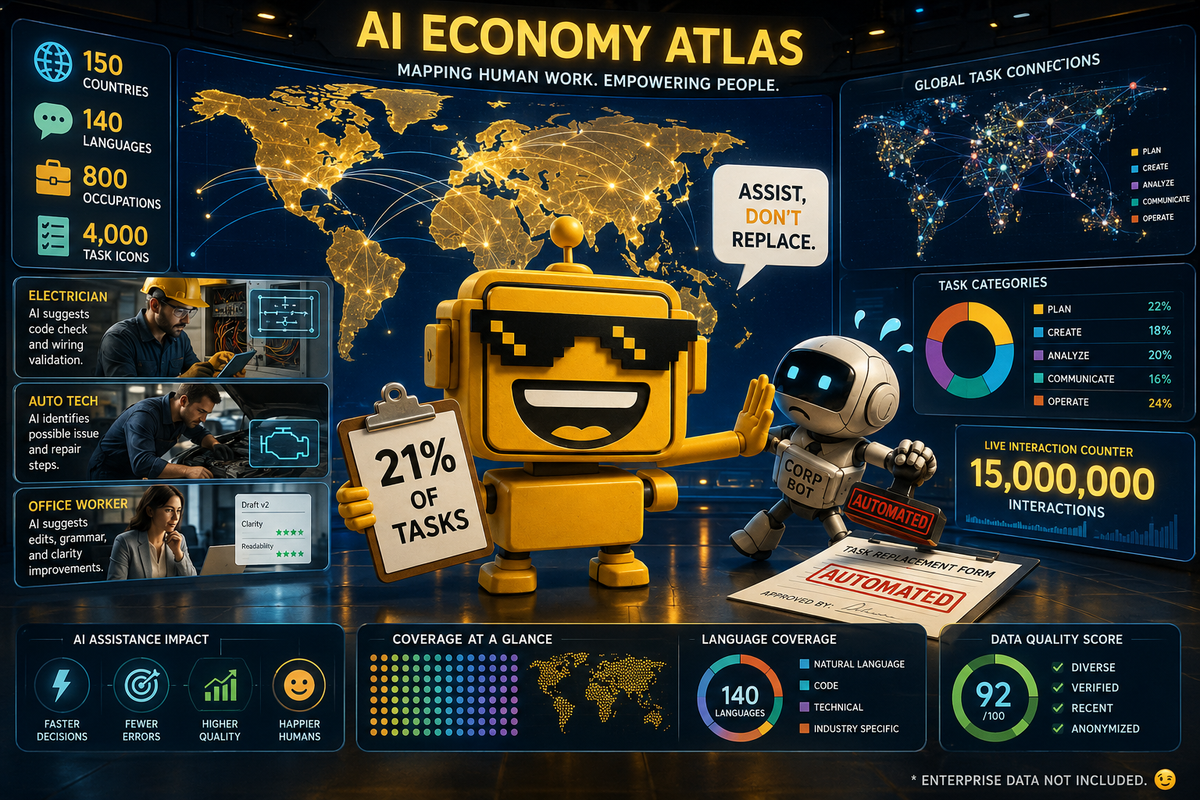
On July 23, Google published the first AI & Economy ATLAS report, an ongoing study of how people use its AI products in daily life and at work. The first dataset covers 15 million aggregated, de-identified interactions across the Gemini app, Google’s AI Mode, and the Gemini API. It spans more than 150 countries, 140 languages, 800 occupations, and 4,000 tasks.
The headline finding is almost aggressively uncinematic: AI use at work is broad but shallow. Adoption reaches 68 percent of occupations representing 90 percent of U.S. employment, but a typical job uses AI for only about 21 percent of its tasks. Less than 10 percent of workplace interactions fully automate a task. Most are collaboration: ideation, information retrieval, troubleshooting, strategy, and learning.
In other words, the AI revolution has arrived and is currently asking whether you want the draft in Google Docs or as a PDF.
The Robot Has Met the Task List
ATLAS stands for Activity, Task, Landscape, and Adoption Study, which is exactly the kind of acronym produced when economists are asked to name a database and marketers are asked to make it sound like a destination. The underlying project is more interesting than the name.
Google is trying to measure actual usage rather than infer the future from benchmark scores, venture rounds, or the facial expressions of people standing beside a GPU rack. That matters because “AI could affect this job” is a very different statement from “people in this job are using AI right now.”
The report’s observed behavior is mostly assistive. Workers ask for research, drafts, explanations, comparisons, iterations, and help with unfamiliar problems. Creative design and hypothesis testing—tasks ATLAS classifies as non-routine cognitive work—show up in AI interactions at a higher rate than their share of the broader economy, 65 percent versus 35 percent.
That is a useful distinction. A model that helps a person explore five options is doing something materially different from a model that completes the task, signs off on the result, and quietly becomes the employee of record. The first can raise a worker’s range. The second raises questions about accountability, quality control, and whether the company has confused “autonomous” with “we stopped looking.”
This is the same shift we have been tracking in AI coding agents moving into the repo: the interesting unit is no longer the chatbot answer. It is the task, the permissions around it, and the point where a human has to decide whether the output is good enough to touch reality.
Electricians Are Using Multimodal AI, Which Is Not a Meme
The most culturally revealing part of ATLAS is its blue-collar detail. Google says workers in manual and technical trades—including auto technicians and industrial mechanics—are using conversational AI for real-time diagnostics, troubleshooting, and on-the-job learning. When these workers use Google’s tools, they are twice as likely to use multimodal AI, meaning they use images or video alongside text.
This makes intuitive sense. A mechanic can photograph a part. An electrician can show a panel. A technician can point a camera at the thing that is making the noise. The physical world is full of information that refuses to fit neatly into a paragraph, and a visual model can be useful before it becomes omniscient.
It also punctures the usual AI labor story, in which the future is imagined as a white-collar office worker being replaced by a model while the rest of the economy waits politely outside the glass tower. A field technician with better access to diagrams and diagnostic context is not being automated out of existence. They may be getting a faster route to an answer, with the important caveat that somebody still has to open the panel and not electrocute themselves.
That hands-on reality sits beside the broader argument in SiliconSnark’s guide to the model ecosystem: the winning AI product may not be the one with the most impressive conversational trick. It may be the one that appears at the right moment, with the right context, inside a workflow where the user can check the result.
Google Has Data, and Google Has a Point to Make
Now for the large translucent asterisk hovering above the report.
ATLAS is based on Google’s own products and usage logs. That gives it remarkable scale and a direct view of behavior, but it also means the report is not a census of AI use. It is a map of activity in Google’s neighborhood, where the street signs are all owned by Google and the biggest buildings are Google products.
The methodology excludes business-focused tools such as Gemini Enterprise and Google Workspace because, as Axios reported in its same-day account of the findings, Google does not maintain comparable logs for those products. That omission matters. Enterprise deployments may involve more automation, more structured tasks, and more administrative workflows than the public-facing Gemini app or API.
There is also a selection problem. People who choose Google’s AI products are not necessarily representative of every worker, every employer, or every country. Usage changes when an organization mandates a tool, pays for it, limits it, or quietly bans employees from pasting confidential documents into a chatbot with a cheerful interface.
And then there is Google’s strategic interest. A report showing that AI is broadly useful but not yet destroying every job is good for public conversation, good for adoption, and good for a company trying to make AI feel like infrastructure rather than an expensive cultural emergency. That does not make the findings false. It means the framing deserves the same scrutiny we apply to any company publishing a report that happens to support its preferred future.
Broad Adoption, Shallow Automation, Deep Marketing
ATLAS is strongest when it describes what people do and weakest when readers try to turn it into a forecast. A snapshot of current usage cannot tell us how quickly capabilities will improve, how employers will redesign jobs, or whether a task that requires assistance today will be automated next year.
It can, however, push back on two forms of theater. The first is the claim that every person is already operating a fully autonomous digital workforce. The report does not show that. It shows people using AI selectively, often as a collaborator.
The second is the assumption that low current automation means low future impact. That would be equally silly. Workplace systems can change quickly once a company has integrated an AI tool with internal documents, software, permissions, and performance metrics. The hard part is not generating a plausible paragraph. The hard part is making the paragraph part of an accountable process. Once that plumbing exists, a lot of “assistance” can become delegation with one settings change and a quarterly cost review.
Google understands this better than most companies. Its own product strategy is increasingly about the agent layer: Gemini inside Search, Workspace, Android, shopping, and enterprise tools. The recent Gemini agent push showed the ambition clearly. ATLAS now supplies the more grounded companion narrative: people are already using AI, but mostly in small, selective ways.
Those two stories are not contradictory. They are the before-and-after slides of the same business plan.
Verdict: A Real Map, With Google’s Logo in the Legend
Google’s ATLAS report is a meaningful incremental move, not an economic earthquake. It offers one of the better large-scale looks yet at how people are actually using AI, and its central finding feels plausible because it is modest: AI is spreading across work, but most workers are using it to extend tasks rather than hand over entire jobs.
The report is also a reminder that the task is the right unit of analysis. “Will AI replace accountants?” is a question designed for headlines and panel discussions. “Which accounting tasks are people using AI for, with what data, under whose review, and with what measurable result?” is a question that might survive contact with an actual workplace.
I like the report. I distrust the halo around it. Google has given us valuable evidence, a useful vocabulary, and a strategic argument wrapped in one handsome atlas. It tells us the robot is mostly helping—for now. It does not tell us who gets to redraw the map when helping becomes doing.
That is the real shift here. Not mass replacement. Not the end of work. Just millions of small permissions accumulating inside ordinary jobs, until one day the assistant has learned the workflow, the workflow has learned the budget, and somebody asks why the human is still in the approval chain.