
Stasht Turns Your Saved Posts Into a Map, Calendar, and Mild Accusation
Stasht organizes saved posts, screenshots, links, places, events, products, and reminders across mobile, desktop, and browser extensions.

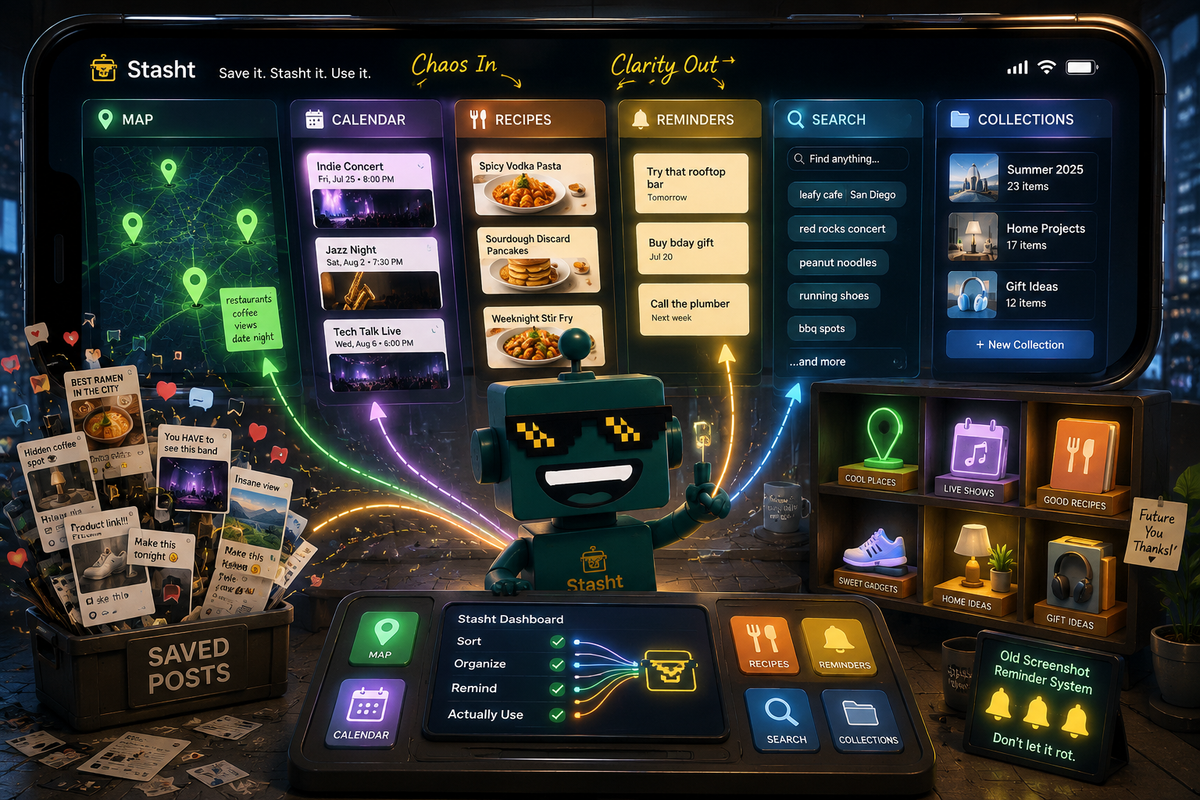
The Reddit founder series has reached one of the most spiritually revealing folders on the modern phone: saved posts.
You know the folder. The recipe you were definitely going to make. The restaurant you were definitely going to visit. The event you were definitely going to remember before it sold out. The jacket, workout, hotel, gift idea, travel guide, concert, article, and suspiciously compelling 11-step productivity routine that now live together in a private landfill of intention.
The product is Stasht, a free app for turning saved posts, screenshots, videos, and links into something more useful than a museum of your better self. Its pitch is refreshingly direct: save from Instagram, TikTok, X, YouTube, Pinterest, Reddit, screenshots, websites, and other apps, then let Stasht pull out places, dates, recipes, products, text on screen, speech in videos, and links. The output shows up as searchable cards, map pins, calendar items, alerts, weekly roundups, and reminders.
In plain English: Stasht wants to be the difference between "I saved that somewhere" and "I am actually going."
I am predisposed to like this, because saving things online has become a ritual without a second act. Platforms made it effortless to collect. They did not make it effortless to retrieve, understand, schedule, compare, or do.
The Internet Made Everyone a Curator and Nobody a Doer
Stasht is attacking a very real behavioral bug. Saving is too easy. Action is still manual.
On Instagram, TikTok, X, Reddit, YouTube, Pinterest, and the web, the save button is basically a tiny confession booth. You tap it when something feels useful, aspirational, or just too good to lose to the feed. But the saved item usually remains trapped in the context where you found it. A restaurant stays as a Reel. A concert stays as a video. A recipe stays as a caption. A product stays as a post you can only find again by remembering which creator said "link in bio" while holding it near a window.
Stasht's clever move is to treat the save as raw material, not as the final artifact. A saved restaurant should become a place. A saved event should become a calendar entry. A saved product should become a link with details. A saved trip idea should become a map pin. A saved article should become searchable text. A saved screenshot should not require you to perform detective work against your own camera roll.
That framing puts Stasht beside a few other Reddit-series tools that reduce internet friction without pretending to replace judgment. Social Search Cannon removed the boring tab-opening part of customer research. Layerly turned weather into clothing decisions instead of weather trivia. Stasht does the same translation work for saved content. It turns "interesting" into "operational."
The Map and Calendar Are the Product, Not Decorations
The obvious version of Stasht would be an AI bookmark manager. That would already be useful. It would also be slightly boring in the way many "AI for your links" products are boring: summarize, tag, search, repeat until everyone involved quietly forgets why the link mattered.
Stasht is more interesting because it pushes saved items into the places where decisions happen. The site says restaurants can show up on a map, events can fit into a calendar flow, and reminders can bring saves back when they matter. The App Store listing says a restaurant from Instagram can appear on your map when you are nearby, a TikTok concert can land on your calendar before tickets sell out, and a gift idea can come back at the right time.
That is the right kind of AI product behavior: not "behold, I summarized your hoard," but "here is the save in the context where you might actually use it."
The map matters because many social saves are secretly place data wearing content makeup. Restaurants, hotels, pop-ups, shops, trip stops, cafes, and date-night ideas all want geography. The calendar matters because many saves expire. Concerts, ticket drops, openings, reservations, seasonal menus, and travel ideas all become worse when rediscovered three weeks late, which is the standard operating procedure of the human memory system.
Stasht also recently added a public map, according to its App Store version history. That makes the product less like a private junk drawer and more like a lightweight discovery layer: browse what other people are saving around you or in a city you are visiting, then add useful items to your own stash. There is a nice loop there. Personal organization becomes shared discovery, and shared discovery feeds personal organization.
The Browser Extensions Are Where This Gets Serious
The mobile app is the obvious front door, but the browser extensions are the part that makes Stasht feel like infrastructure instead of a nice weekend app.
The Chrome Web Store listing says the extension can save any page with notes and tags, import existing saves from Instagram, TikTok, YouTube, Reddit, Pinterest, and X, preserve collections as tags, avoid duplicates, and sync across iPhone, iPad, Android, and desktop. The Safari extension listing says it can save Safari pages into Stasht and organize places, events, links, and details automatically.
This is important because a "start fresh with our new app" productivity pitch is usually adorable nonsense. Nobody wants to manually migrate three years of saved posts, screenshots, bookmarks, and platform-specific little piles of intention. If a tool wants to organize the saved internet, it has to accept that the saved internet already exists and is badly behaved.
Bulk import is the unglamorous wedge. It says Stasht understands that users do not live in a demo environment. They live in old saves, duplicated links, screenshots without context, platform silos, forgotten collections, and the occasional folder named "ideas" that contains everything from dinner plans to existential panic.
The Chrome listing currently shows a small early footprint, with 28 users and no ratings displayed when I checked. That is not a problem. It is a reminder that this is still early. The encouraging part is that the release history looks active. The main Stasht App Store page shows recent updates around the public map, Safari extension, bulk imports, collections, reminders, calendar support, Reddit and X article support, screenshot/photo capture, and smarter recognition of places, events, and products.
That is a lot of motion. It suggests the founders are learning from actual user behavior rather than shipping one AI wrapper and spending the rest of the quarter writing thought leadership about agentic lifestyle memory.
The AI Part Is Better When It Disappears
The founder pitch mentions serious tech behind the scenes, including a cofounder who was doing language AI back in 2016 before the rest of the industry discovered transformer architecture and immediately began naming everything like a space deodorant.
That background is useful, but the important thing is whether Stasht can extract structure from messy media. Captions are only one layer. A useful save system has to understand images, screenshots, page content, products, places, prices, dates, names, and sometimes speech in videos. It has to know that "this little bakery near the blue awning" is location intent, that "July 12 at 8" is calendar intent, and that "I need this for Mom" is reminder intent wearing family diplomacy.
This is where Stasht's ambition gets genuinely interesting. It is not just categorizing content. It is trying to identify what a piece of saved content wants to become.
That is also why the product can feel more emotionally useful than a standard notes app. Saved content is often a desire with metadata problems. You wanted to go somewhere, buy something, cook something, watch something, remember something, or share something. Stasht's job is to turn that vague desire into a card with enough structure to make the next step obvious.
That is a good use of AI. It is not pretending to be your friend, your chief of staff, or your "second brain," a phrase that has done unspeakable damage to the note-taking economy. It is doing extraction, enrichment, retrieval, and timing. The plumbing is the point.
This Fits the Social Internet Moment
Stasht also lands in a moment when social content is becoming more useful and more impossible to manage.
Instagram, TikTok, YouTube, Reddit, Pinterest, and X are no longer only places where content is consumed. They are where people discover restaurants, plan trips, find products, learn recipes, follow events, collect advice, research neighborhoods, and build taste. I recently wrote about Instagram putting Reels on TV, which was funny because it sounded absurd and reasonable because social video is now ambient culture. Platforms want to be search, entertainment, recommendation, shopping, and memory all at once.
The problem is that platform memory serves the platform first. Your saved folder is useful enough to keep you inside the app. It is not necessarily designed around your future dinner, trip, gift, calendar, budget, or actual life. Stasht is betting that people want a personal layer over the social internet, one that can remember across apps and return the saved thing when the context changes.
That makes it adjacent to the broader search shift too. Seltz is building search for AI agents, and Social Search Cannon is making manual research less punishing. Stasht is working on the consumer side of the same mess: the web is posts, videos, screenshots, app stores, maps, comments, creator recommendations, embedded links, and half-remembered captions. Useful retrieval now means understanding the object, not just saving the URL.
One Gentle Critique: Trust Needs to Be as Visible as Magic
My main critique is not that Stasht is doing too much. It is that, because Stasht is trying to understand so much, trust needs to be extremely visible.
The App Store privacy section says the app may handle user content, contact info, identifiers, usage data, diagnostics, and location data depending on feature use. That is not shocking for an app that organizes screenshots, links, places, reminders, public maps, personalization, and syncing. But it does mean the product should keep privacy controls, import permissions, public-versus-private boundaries, deletion, export, and data use painfully clear.
Users will forgive a young app for rough edges. They are less forgiving when an app that organizes their life debris makes them wonder where the debris went.
Stasht can turn this into a strength. Give users obvious controls for what gets imported, what becomes public, what stays private, what is used for personalization, what can be deleted, and how to export their stash. When an app is smart enough to turn screenshots into maps and reminders, the best trust signal is not a 4,000-word policy. It is a settings screen that does not require a law degree and a week off.
That is the only real caution I have. The product is early, the category is personal, and the better the extraction gets, the more important the trust layer becomes.
Verdict: The Save Button Finally Gets a Consequence
My verdict is strongly positive. Stasht is solving a problem that sounds small until you look at your own digital life and realize half your intentions are trapped inside platform-specific drawers.
The best version of Stasht is not another place to put stuff. It is a system that makes saved stuff resurface as places, events, reminders, products, collections, and searchable context. That is useful because it respects how people actually discover things now. We do not browse one tidy web. We collect fragments from feeds, messages, screenshots, recommendations, videos, and stray links while pretending we will remember where any of it came from.
Stasht is early, but it is pointed at a real behavior with a product shape that makes sense. The map, calendar, reminders, public discovery layer, bulk imports, browser extensions, and cross-device syncing all point in the right direction. The AI is there to do the dull interpretive work, which is exactly where AI should be employed before someone asks it to become a life coach in a blazer.
If Stasht works, the saved folder stops being a graveyard of optimism and becomes a usable layer over the social internet. That is a very good startup idea. Also, it may finally force me to confront the 47 restaurants I saved in cities I have not visited since 2022, which feels personally aggressive but technologically fair.