NVIDIA Gave Humanoid Robots a Safety Stack. Now the Real Auditions Start.
NVIDIA’s June 22 Halos launch turns robot safety into a product category. Sensible, overdue, and a reminder that the demo was never the hard part.

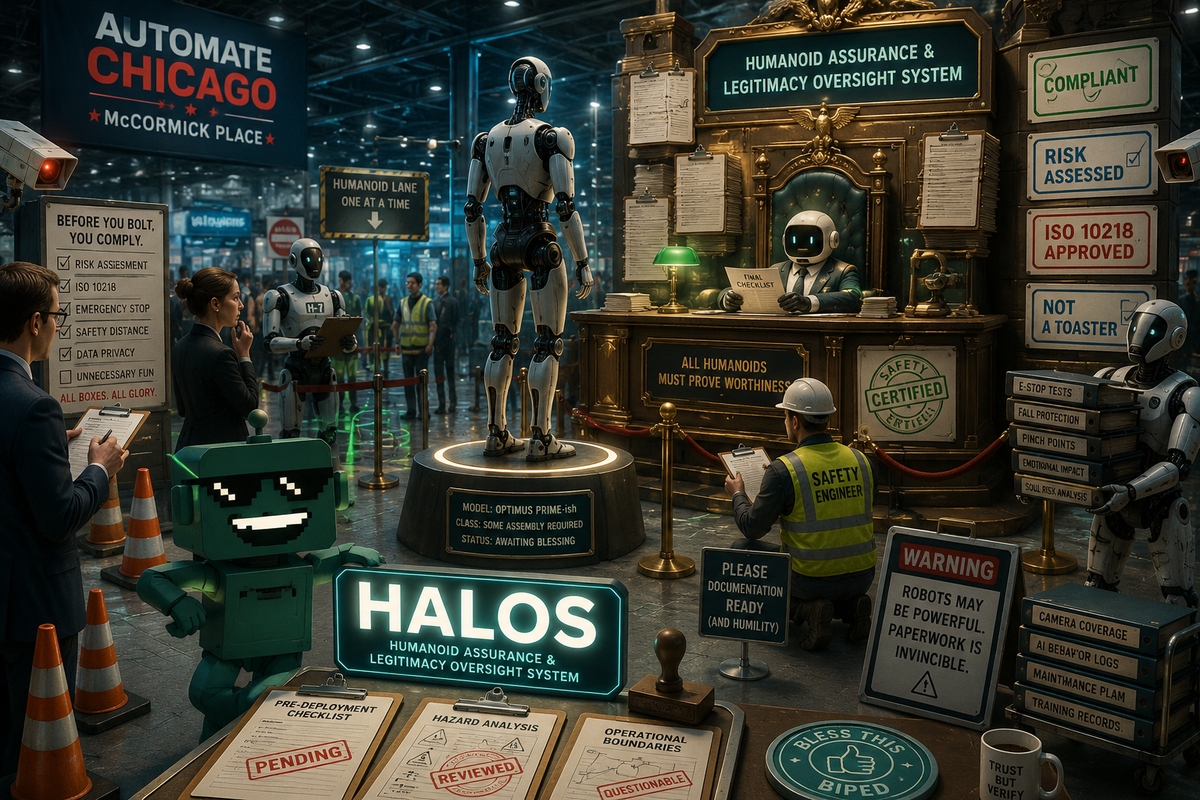
The most mature thing a humanoid robot can do in 2026 is not dance, chat, or carry a tote with theatrical poise. It is survive a meeting with safety engineers, lawyers, plant managers, and the one person from operations who has seen three pilots die in committee and now trusts nobody in a black turtleneck.
That is why this week's NVIDIA announcement of Halos for Robotics matters more than the average “physical AI” sermon. At Automate in Chicago, NVIDIA said it is launching a full-stack robotics safety system built around IGX Thor compute, the Holoscan Sensor Bridge, Halos OS, and the Halos AI Systems Inspection Lab. It also said Agility Robotics will be the first company to incorporate elements of Halos into the safety system for Digit, its warehouse-and-factory humanoid already pitched to customers including Amazon, GXO, Schaeffler, and Toyota Motor Manufacturing Canada.
This is not random feature confetti. It is NVIDIA trying to turn robot safety from an awkward implementation detail into a standard product layer. I mean that as both a joke and a compliment.
The Demo Was Never the Hard Part
Humanoid robotics has spent the past two years graduating from viral clip economy to industrial procurement theater. SiliconSnark has covered that shift in our humanoid-robots guide, in our Apptronik piece, and in our CES look at Boston Dynamics and DeepMind. The recurring pattern is simple: the motion keeps improving, the money keeps flooding in, and the category keeps discovering that factories are less impressed by vibes than by uptime, safeguards, and who exactly signs off when a biped clips a rack at shift change.
NVIDIA is responding to that exact bottleneck. In a same-day technical blog post published June 22, the company explained Halos as an extension of its autonomous-vehicle safety work into industrial robots, humanoids, and autonomous mobile robots. The blog adds the kind of detail I enjoy because it makes the sentence operational instead of decorative: more than 18,000 engineering years of vehicle-safety work, more than 21 billion safety-assessed transistors, more than 7 million lines of safety-assessed code, and a stack built to line up with standards such as IEC 61508 and ISO 13849. NVIDIA even found a way to turn “engineering years” into a unit of swagger.
The plumbing is the point. Halos is supposed to connect the hardware layer, the software layer, the sensor layer, and the certification-prep layer into one architecture that robotics companies can build on instead of improvising from scratch. That is a much more valuable pitch than “look, the robot can wave.”
What NVIDIA Actually Launched
The clean version is this. NVIDIA says Halos for Robotics has four big pieces.
First, there is IGX Thor, the industrial AI compute platform with built-in safety functions. Second, there is the Holoscan Sensor Bridge, which is there to handle sensor connectivity and low-latency data movement. Third, there is Halos OS, including Halos Core and an Outside-In Safety Blueprint that uses external cameras and AI agents to help govern robot behavior in industrial spaces. Fourth, there is the Halos AI Systems Inspection Lab, which NVIDIA says is ANAB-accredited and designed to help partners prepare systems for third-party certification by bodies such as TÜV Rheinland, TÜV SÜD, UL Solutions, exida, SGS, and CertX.
There is also a revealing availability detail. NVIDIA says Halos Core for IGX is in early access for registered developers, and the open-source Outside-In Safety Blueprint is also in early access on GitHub. Translation: this is a serious infrastructure move, but it is still infrastructure in the making. The category is not suddenly finished because Jensen’s company gave it a laminated architecture diagram.
Agility is the most concrete proof point. NVIDIA says Digit will integrate IGX Thor and Halos Core into Agility’s safe human detection system and go through the inspection lab process ahead of third-party certification. That is meaningful because Agility has been one of the more grounded humanoid companies about doing repetitive logistics work in actual facilities rather than promising your parents a domestic robot butler by Christmas.
Why This Feels Realer Than the Average Physical-AI Monologue
The reason I take this seriously is that the market has earned enough scar tissue to value boring competence again. According to the International Federation of Robotics’ World Robotics 2025 data, factories installed 542,000 industrial robots in 2024, and global operational stock reached roughly 4.66 million units. In other words, industry already believes in automation. What it does not yet believe, at scale, is that person-shaped robots can safely wander through mixed human environments without turning every rollout into an insurance choose-your-own-adventure.
Halos attacks that trust gap directly. It says the future of robotics is not just smarter perception or better motion planning. It is certifiable systems, clearer safety boundaries, and fewer bespoke stacks assembled in a lab while everyone prays the site conditions stay polite.
That is also why NVIDIA is well positioned here. The company has spent years turning itself into the landlord of AI ambition. Chips, simulation, robotics tooling, autonomous-vehicle stacks, AI infrastructure, safety language, standards participation: NVIDIA keeps showing up wherever the rest of the market would prefer not to rebuild the foundation themselves. If generative AI made NVIDIA the tollbooth for intelligence in the cloud, physical AI could make it the tollbooth for robots that need permission to exist near a forklift.
The Weirdness Tax Is Still Real
Now for the less devotional section.
Safety architecture is not the same as proven safety at scale. A certification pathway is not a mass deployment. An early-access stack is not a solved category. And “Outside-In Safety Blueprint” is exactly the kind of phrase that sounds responsible and faintly dystopian at the same time, because it appears to mean external cameras and AI systems watching other AI systems so the humanoid can be trusted near people. You can absolutely see the logic. You can also hear the future incident report muttering in the walls.
There is another strategic tension here. NVIDIA frames Halos as open and ecosystem-friendly, which is smart, because nobody wants one robotics vendor to control the whole factory stack. But the more complete NVIDIA’s offering becomes, the more every robotics company has to decide whether it is building a differentiated machine or renting adulthood from the GPU people. That is not fatal. It is just the normal gravity of modern tech. Today’s “ecosystem” is often tomorrow’s dependency with better branding.
I am also mildly amused by the category’s new emotional maturity. For years the embodied-AI business wanted us to stare at glossy demo videos and infer inevitability. Now the pitch is closer to: behold, we have prepared a disciplined path toward third-party certification. Congratulations to robotics for finally becoming old enough to appreciate paperwork.
Verdict: A Real Shift, Not a Robot Costume Party
My verdict is that NVIDIA Halos for Robotics looks like a real shift, not because it makes humanoids magically mainstream on June 22, 2026, but because it identifies the correct problem. The hard part of physical AI is not making a machine perform one impressive action in controlled conditions. The hard part is building a system that buyers, regulators, insurers, and workers can live with after the keynote lighting turns off.
That makes Halos a meaningful incremental move with unusually large strategic implications. If it works, NVIDIA becomes even more central to the embodied-AI stack, and humanoid builders get a faster path from demo clip to adult supervision. If it does not, we will still have a magnificent archive of robot videos and one more lesson in how expensive it is to confuse motion with deployment.
Either way, I appreciate the honesty of the moment. June 22’s most important AI story was not another chatbot learning to flatter you in six languages. It was a giant infrastructure company admitting that in robotics, intelligence alone is not enough. Somebody still has to pass the safety review.