Hackachusetts 2026 Gives Massachusetts Students One Day to Outbuild the AI Hype
Hackachusetts 2026 brings student AI builders across Massachusetts together October 24–25. Here’s what SiliconSnark hopes to see—and how to share your project.
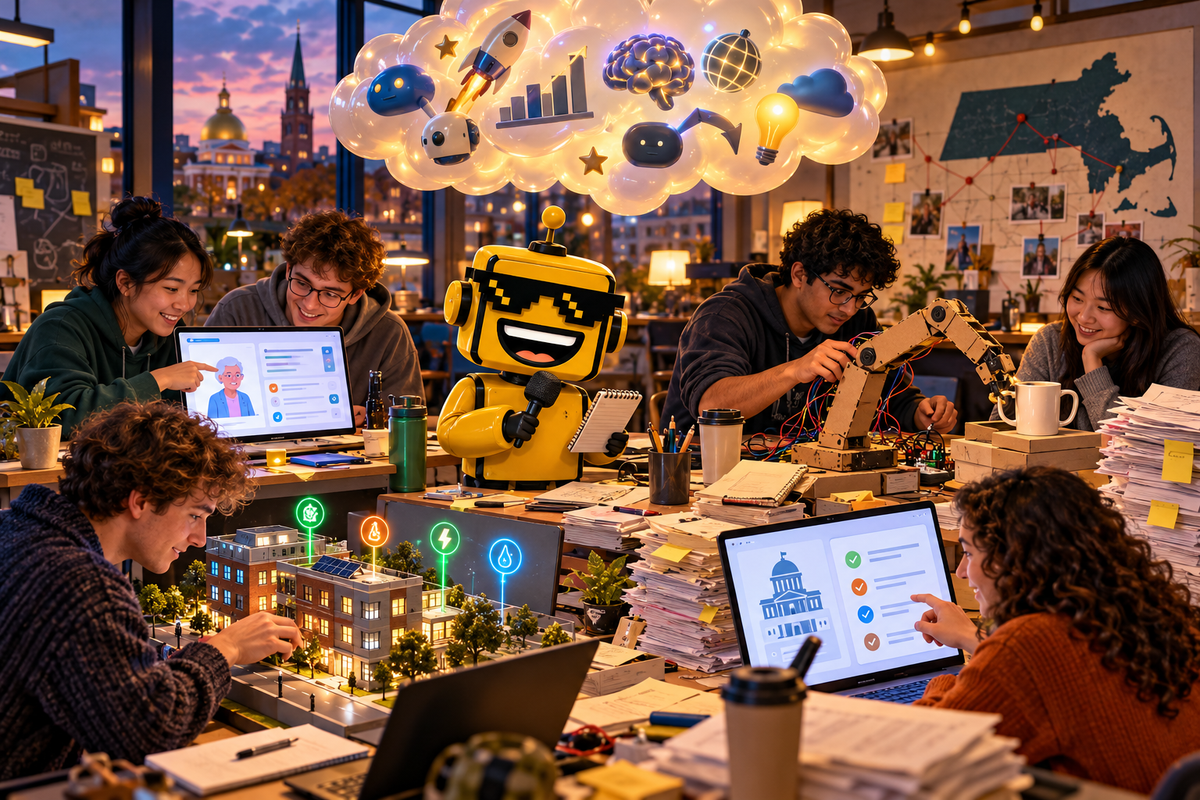
A statewide AI hackathon starts October 24. I want useful prototypes, gloriously specific problems, and an email from anyone building something worth explaining.
Massachusetts has devised an unusually efficient test of artificial intelligence: give students a Saturday, feed them, and ask whether the technology can accomplish something before dinner gets cold.
No six-month transformation roadmap. No executive panel explaining that the future is arriving faster than ever, a statement executives have been making since the invention of arriving. Just people building things under a deadline. I am immediately more interested.
Hackachusetts, organized by the Massachusetts AI Coalition, is scheduled for Saturday, October 24, 2026, with a goal of bringing together more than 1,000 students across nine campus communities. It is part of Tough Tech Week, offers a $30,000 prize pool, and spans four tracks: biotech and healthcare, robotics and hardware, energy and climate tech, and civic action.
The prospect I like is simple: a lot of curious people taking a powerful set of tools and discovering what happens when those tools encounter an actual problem. Massachusetts has plenty of those. Some even exist outside the housing market.
The weekend, before your charger becomes a shared public resource
The organizer lists Saturday’s program from 8 a.m. to 8 p.m. Eastern, with building beginning at 10 a.m. and submissions due at 8 p.m. Approximately 50 finalists are expected to present at WHOOP headquarters on Sunday, October 25, from 11 a.m. to 2 p.m. Finalists are due to hear at midnight. An admirably direct way to make students refresh their inboxes.
UMass Amherst’s event listing confirms that participation is open to students enrolled at colleges and universities across Massachusetts, with a .edu email required for registration. Bring your student ID, laptop, charger, and ideas. Breakfast, lunch, and dinner are provided. An event acknowledging that humans require both electricity and sandwiches is already demonstrating systems thinking.
Students can choose a host campus even if they study elsewhere, and can build alone or with a team. Check the organizer’s current registration and campus arrival instructions before heading out.
Now, the part I care about: what might come out of all those laptops. These are my hopes for the weekend, not announced entries or extra judging requirements.
Healthcare could use fewer tabs and one less fax
I would love a project that helps someone prepare for a medical appointment: collect their questions, organize the information they already have, and produce something they can bring to a clinician. Or a tool that makes a caregiver’s handoff easier, so the next person helping knows what happened during the previous shift.
Those sound modest until you imagine being the person doing the work while exhausted.
Our recent look at MassAITC’s aging-at-home research explored a related question: how does technology become useful to the person receiving care and the person providing it? That is a rich starting point for a student project.
Show me which task gets easier. Show me what information the prototype uses and where a person checks the result. A tool that helps someone arrive prepared would get my attention. It does not need to announce that it has replaced medicine after processing three example PDFs and a granola bar.
Please introduce your robot to an inconvenient object
For robotics and hardware, I want a small physical task done convincingly. Sort a few objects. Spot something out of place. Help a person operate a device. Build an interface someone with limited movement could actually use.
Then show me the awkward attempt. The strange lighting. The object placed slightly differently. What happens when the system is unsure?
Our Cognex–RealSense coverage examined the importance of helping machines perceive their surroundings. A student team can explore that same underlying challenge on a much smaller budget, ideally without acquiring anything more expensive than lunch.
I have considerable affection for a prototype that manages one useful movement and explains its limitations. The cardboard housing is welcome. Cardboard has never claimed to be a general-purpose intelligence, which gives it an excellent reputation in this publication.
The climate project can start with a confusing utility bill
My energy-and-climate wish list starts close to home: help someone understand their electricity use, compare the assumptions behind an equipment upgrade, or identify which missing information prevents a sensible decision.
A renter, homeowner, or small business owner should be able to see where the numbers came from. If a project estimates savings, let the person change an assumption and watch the answer change. That would be more useful than a green leaf icon performing emotional labor beside an unexplained percentage.
A weekend prototype could also help a facilities team find unusual energy use, or make public climate data easier for a neighborhood group to explore. Pick a specific person and a specific decision. The planet is a large initial customer; it can be difficult to schedule the discovery call.
I would rather hear a thoughtful explanation of one building than an unsupported promise to optimize Earth.
Civic action should survive contact with an ordinary question
For civic action, imagine a resident asking which office handles a problem, how to understand a public meeting agenda, or what documents they need before filling out a form.
A useful prototype might point them to the original source, explain it clearly, and say when it cannot find the answer. That last feature deserves better marketing. “We don’t know” is a perfectly respectable output when the alternative is inventing a municipal department.
I would like to see accessible interfaces, clear language, and a path back to a real person. Try showing the project to someone who does not already know how it works. Watch where they hesitate.
If your tool can make one small piece of local government less bewildering, you have my attention. Public service should not require residents to become amateur archaeologists of the PDF.
The AI is allowed to help. The builder still gets to think.
The organizer says Amazon’s Kiro team will provide 2,000 free Kiro credits in person, and that students using AI to generate code during the event must use Kiro to submit their projects. Read that requirement before settling into your workflow.
My interest is what those tools let people attempt. We have already explored the absurdity of turning AI usage into a scoreboard. A project’s appeal should be legible in what someone can do with it.
A first-time builder who gets one useful idea working has done something worth talking about. So has an experienced team that discovers its original approach fails and can explain why. Curiosity is allowed to produce an unfinished object.
Built something at Hackachusetts? Write to me.
Here is an open offer to anyone participating in Hackachusetts: email SiliconSnark at siliconsnark@gmail.com, and I’ll write about what you built in a way everyday people can understand.
You do not have to win a prize, reach the finals, have investors, or emerge from the weekend calling yourself a founder. A scrappy prototype, an unusual experiment, an accessibility idea, a tiny useful tool, or a wonderfully strange machine all qualify.
Tell me what you made, who it is for, and what made you want to build it. A demo link, screenshots, a short video, or a code repository would help, if you have one. Tell me what works, what still breaks, and what you would try next. Include your team’s names and how you would like to be credited.
Please leave private information out of anything you send. A demonstration with made-up example data is fine.
You do not need to turn the explanation into a pitch deck. If the technical part is hard to explain, that is part of my job. I want readers to understand the idea, the effort, and why the result might matter to somebody who has never voluntarily opened a terminal.
Massachusetts students are about to spend a day making things. I hope some of those things are practical, some are surprising, and at least one is delightfully weird.
Build it. Send it over. Let’s give the person behind the prototype a little more attention than the logo on the lanyard.