Cognex Bets $500 Million on RealSense Because Robots Should See the Forklift
Natick-based Cognex agrees to acquire RealSense for about $500 million, betting on depth cameras and robot perception beyond the humanoid demo circuit.

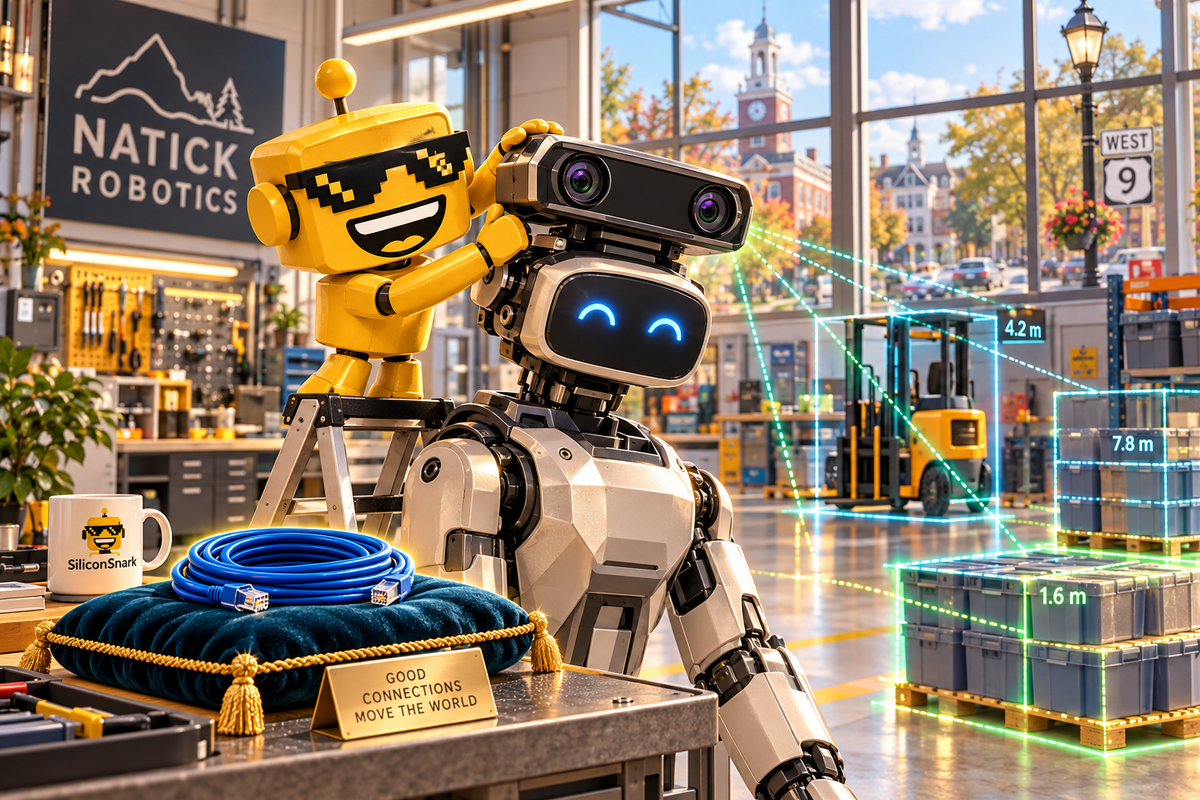
Massachusetts has found another way to participate in the robot revolution without requiring everyone to attend a panel called Embodied Intelligence and the Future of Everything. This one involves Natick, half a billion dollars, and the reasonable proposition that a machine should know where the forklift is before developing strong opinions about its next action.
On September 22, Cognex announced an agreement to acquire RealSense for approximately $500 million, funded from existing cash and investments. Closing is expected in the fourth quarter, subject to customary conditions. This is an agreement, not a completed acquisition.
My verdict: a serious industrial bet with unusually legible logic. If robots are going to graduate from impressive footage to repeatable work, somebody has to supply their understanding of distance, objects, and inconveniently solid things. Cognex is buying further into that layer. The robot can leave the keynote; the geometry follows it home.
Natick has entered the depth chat
Cognex’s corporate headquarters is at 1 Vision Drive in Natick, an address so committed to the business model that a branding agency would probably reject it as insufficiently subtle. The local connection is the buyer itself, rather than an honorary Boston connection bestowed because someone once changed trains at Kendall.
That matters to the regional story. Massachusetts’s robotics strength includes the less photogenic equipment behind the machines: sensing, inspection, integration, and all the work that makes a demonstration reproducible. Our coverage of Boston Dynamics’ planned Waltham expansion follows the same industrial question from the building-and-manufacturing side. Here, the strategic asset is perception.
The appeal reaches beyond Massachusetts. A robot builder anywhere needs components that can be designed into a product, supplied consistently, and supported after the original engineer has changed teams. Acquisitions in this layer deserve attention because they can influence those choices. The camera may be a small part of the machine, but replacing it can become a large part of someone’s year.
Two eyes, considerable homework
Stereo depth sensing starts with two views of the same scene. Corresponding features appear in different positions in the images; the system uses that difference, along with the camera geometry, to estimate distance. Instead of merely producing a picture of a box, it can produce information about how far away parts of that box are.
For an illustrative warehouse task, that is the difference between recognizing “a tote” and having the spatial information needed to approach it. Recognition, motion planning, and control still have their own jobs. Giving a robot depth perception does not automatically give it judgment, any more than putting glasses on a consultant guarantees a useful slide.
RealSense’s architecture documentation describes dedicated hardware for depth computation and an open-source SDK shared across its camera portfolio. That software development kit supplies interfaces and tools developers can build around. The value proposition therefore extends beyond the lenses: hardware, processing, and the software that lets another engineering team use the measurements.
This is a useful companion to our earlier Boston Dynamics and Google DeepMind coverage. Robot intelligence has multiple dependencies. Better models are exciting; getting trustworthy information into those models remains a separate engineering obligation.
The Ethernet cable gets its moment
Consider the existing RealSense D555, which combines stereo depth and color imaging with onboard processing and Power over Ethernet. One network connection can carry power and data. RealSense also describes native ROS 2 streaming, connecting the camera to a widely used robotics software ecosystem.
These are product capabilities, not features launched by this acquisition announcement. They help explain why the purchase is more interesting than a fashionable phrase in a deal deck. A camera that fits the rest of a machine’s network can spare an integration team an assortment of adapters, bridging software, and increasingly personal arguments with a cable.
Even that apparently mundane convenience has prerequisites. The company’s D555 setup guide calls for suitable Ethernet equipment, including a Gigabit-or-better PoE switch or injector with jumbo-frame support, plus compatible software and firmware. Physical AI, meet network configuration. Please take a number.
For buyers, the practical test will be installation effort, predictable behavior, and maintenance. Our guide to humanoid robots and factory economics keeps returning to that distinction: a capable machine becomes valuable when its usefulness survives an ordinary shift.
Keep the people who know why it works
The deal announcement also specifies a three-year cash retention program targeted at $56.5 million, subject to performance modifiers, and approximately $50 million in restricted stock units, dependent on the grant-date share price. Those are additional employee arrangements, separate from the roughly $500 million purchase price.
That is an instructive detail. Buying intellectual property is one thing; keeping the people who understand calibration, firmware, customer integrations, and the reasons a seemingly harmless change breaks something is another. An engineering organization carries knowledge that does not conveniently fit into the closing binder.
RealSense began inside Intel in 2014 and spun out in 2025. Cognex projects its 2026 revenue at $80 million to $90 million, more than 50% above the prior year. Before closing, the facial-authentication product line is to become a separate independent company.
The forecast is evidence of the commercial scale management expects, not a completed-year result or proof that the purchase will pay off. Likewise, separating facial authentication defines what is leaving the business; it does not answer every future question about the uses of robot cameras.
A useful future needs a support ticket
The opportunity is persuasive: combine an established industrial-vision business with a depth-perception platform that other builders can use. The execution questions are equally concrete. Will developers retain straightforward access to tools? Will product support stay predictable? Can customers adopt improvements without rebuilding their systems?
Those are questions to monitor, rather than benefits to award in advance. A camera acquisition also cannot certify an entire robot’s safe behavior. Perception has to work with planning, controls, testing, and the operating environment. No press release gets to repeal that homework.
Still, this is an encouraging Massachusetts story. Cognex is making a substantial commitment to a component of robotics with a clear job to do. Natick does not need to win the global contest for most inspirational humanoid video. Helping the humanoid correctly locate the loading dock would be an excellent contribution.