
NACON Gave the Xbox Controller a Knob for Your Thumb
NACON’s €129.99 Xbox controller lets you tune thumbstick tension by hand. Smart competitive hardware, with just enough pro-gamer overreach.

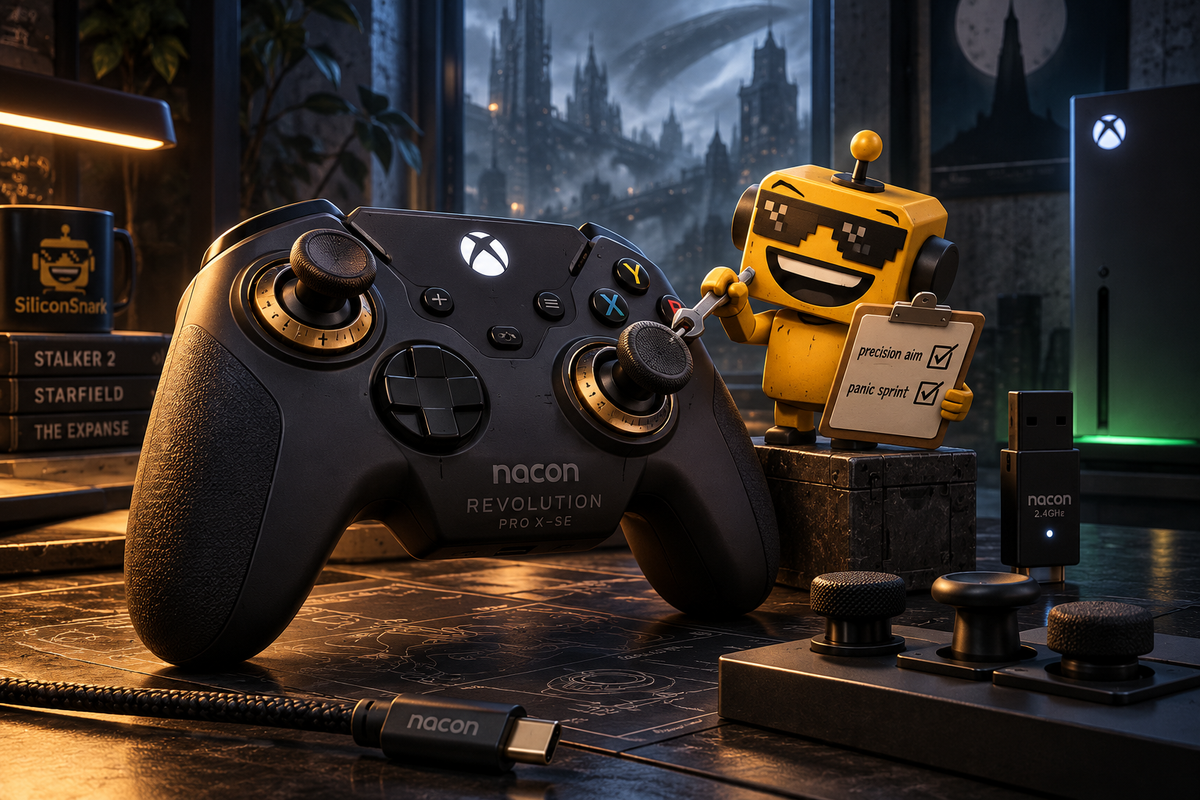
There are two kinds of people who buy a premium game controller. The first wants four extra buttons, a charging dock, a carrying case, and perhaps a small touchscreen to explain what the other buttons are doing. The second wants the left stick to feel a little heavier because they are about to play a racing game, and then a little lighter because they are about to shoot somebody in the face.
NACON’s new Revolution Pro X–SE is for the second person, who is more reasonable in theory and probably owns more controller settings than I do. Announced on October 22 and available across Europe at €129.99 or £109.99, it is an officially licensed Xbox controller for Xbox Series X|S, Xbox One, PC, and compatible smart TVs. Its headline feature is a physical control ring that changes the mechanical tension of each thumbstick. Turn the ring one way and you get more resistance for fine aiming. Turn it the other way and the stick loosens up for faster movement.
This is the rare gaming accessory pitch that can be explained without a keynote, a cloud diagram, or an executive pretending latency is a moral virtue. The stick feels different because you turned the thing. I understand it already.
The thumbstick has discovered a volume knob
The official product page describes the Revolution Pro X–SE as a controller with adjustable-tension joysticks, contactless Hall-effect sensors, tactile micro-switches, and dual-mode triggers. The control ring changes the physical resistance, while the magnetic sensors are meant to avoid the friction wear associated with traditional potentiometer sticks.
That combination is more interesting than it first sounds. Hall-effect sticks are now common enough that manufacturers can no longer announce them as though they have discovered electricity. Adjustable tension is different. It addresses the part of a controller experience people usually describe with vague, deeply personal language: “This one feels mushy,” “that one fights me,” or “I can aim with it, but only after my hands have filed a complaint.”
NACON says the resistance can move from roughly 40 to 120 grams, depending on the setting. That is not a universal measure of skill. It is a way to make the controller less of a fixed object and more of a tool you can tune for the job. Precision aiming, fast camera movement, and racing-game steering do not ask the same thing from a thumbstick. The Revolution Pro X–SE at least acknowledges this instead of giving every genre the same spring and wishing it luck.
It also helps that the idea is mechanical rather than app-dependent. The gaming accessory industry has spent years hiding useful functions inside software menus, where they can be accompanied by a login prompt, a firmware update, and a notification asking whether you would like to join a community. A ring you can turn with your finger is a pleasingly analog answer to the modern peripheral ecosystem.
It brings the pro-controller starter pack, with fewer ceremonial extras
The rest of the feature list is familiar but sensible. There are two programmable rear buttons, a Pro Shooter mode with zero-dead-zone aiming, interchangeable concave and convex stick caps, and an interchangeable D-pad. The face buttons and D-pad use micro-switch components for a more tactile click, while the triggers can switch between analog Hall-effect travel and short-throw instant mode.
There are four vibration motors, including impulse motors in the triggers, a headset jack, a 2.4GHz wireless dongle, and a three-meter braided USB-C cable. Wired PC mode runs at a claimed 1,000Hz polling rate with 1ms latency. The controller is not trying to be a tiny Xbox command center. It is trying to let a competitive player decide whether the next match needs a heavy stick, a light stick, a short trigger, or a different D-pad without buying another controller shaped like a disappointed robot.
That restraint is welcome. The last few years have produced gamepads with screens, profiles, extra buttons, removable modules, lighting zones, charging stations, and enough packaging to suggest the box is also under consideration for a career in logistics. Turtle Beach’s $200 controller with a touchscreen is a good example of the genre: excessive, but sometimes smart because the screen puts buried settings within reach.
NACON’s controller is making the opposite argument. Put the important adjustment on the hardware and leave the little screen in the factory where it belongs.
The wireless part is useful, which means it needs footnotes
The Revolution Pro X–SE works wirelessly through its included 2.4GHz dongle, then switches to wired play over USB-C. NACON positions it for Xbox, PC, and compatible smart TVs, with configuration handled through its software on Xbox and Windows. That is a practical spread for a controller at this price: console on the sofa, PC at the desk, and perhaps a television that has become a suspiciously large Steam machine.
It is also a reminder that “wireless” remains a word with several asterisks in gaming. The dongle matters. The platform matters. The device’s software matters. The fastest advertised PC mode is wired. None of that makes the product dishonest; it makes the phrase “zero friction” one of the most durable myths in consumer electronics.
The controller has another small but meaningful advantage over the luxury end of the market: the price. At €129.99, it sits below many flagship wireless pads that justify their cost with displays, accessory cases, or an ecosystem so elaborate it deserves a quarterly planning meeting. ComputerBase’s launch coverage places it between lower-cost Hall-effect options and much pricier premium controllers, which is probably the right neighborhood. You are paying for a real mechanism, not just a phrase like “esports DNA” printed in silver.
Hell is Us has supplied the outfit, naturally
The special-edition styling is inspired by NACON’s game Hell is Us, which means the controller arrives with a minimalist art direction and the faint aura of an object discovered in a bleak European corridor. I am fond of this. Gaming hardware has two common visual modes: black plastic that wants to be invisible and black plastic that wants to cosplay as a fighter jet. A restrained licensed design is a useful third option.
Still, the license is not free spiritually. You are buying a controller for Xbox and PC, but part of its identity belongs to a game that many buyers may never play. This is not a serious flaw. It is the usual reminder that modern peripherals must be both tools and tiny billboards. At least this one is not shaped like a weapon or covered in fake carbon fiber.
The more serious question is software quality. Adjustable hardware is only as good as the profile system around it. If switching modes is quick and the app remembers sensible settings, the tension ring becomes a daily-use feature. If the software makes you create profiles named “FPS 2 FINAL FINAL” and rediscover the same calibration screen every week, the controller will have converted a useful physical idea into another small administrative career.
Verdict: a niche hit with an actual thesis
The NACON Revolution Pro X–SE is not for everyone. The standard Xbox pad remains perfectly capable, and casual players do not need their thumbsticks to offer a range of emotional intensities. The controller also cannot promise that adjustable tension will make you better at a game. It can only make the tool less stubborn about fitting your hand.
That is enough. The best case for this product is not that it contains every premium feature. It is that it spends its engineering budget on one physical idea you can understand immediately, then surrounds it with the sensible upgrades—Hall-effect sensing, tactile switches, rear buttons, wireless connectivity, and a useful wired mode.
Compared with abxylute’s aggressively affordable Hall-effect PS5 pad, NACON is selling refinement rather than bargain shock. Compared with SCUF’s button-heavy approach, it is less interested in giving your hands new responsibilities. And compared with Valve’s perpetually complicated controller launch, it has the decency to tell you what the product is and let you buy it now.
My verdict is cautiously enthusiastic. The Revolution Pro X–SE is a niche hit, especially for players who know exactly how they want a stick to feel and are tired of explaining that preference to controllers that do not speak human. It is not a revolution in the marketing sense. It is a small, well-aimed mechanical improvement, which is a much rarer and more valuable thing.
Someone at NACON looked at the modern gamepad arms race and decided the next innovation should be a knob. Against all odds, that may be the most sensible button-adjacent decision of the year.