abxylute Put Hall-Effect Sticks in a $76 PS5 Controller. Naturally, It Has Macros.
abxylute’s $76 P5 brings Hall-effect sticks and adaptive triggers to PS5. Smart value on paper; the real test is whether it ships the promise.

There is a moment in every controller announcement when the product manager looks at the standard gamepad and whispers, “What if we added two more buttons, a turbo mode, and the ability to claim this is basically a DualSense?”
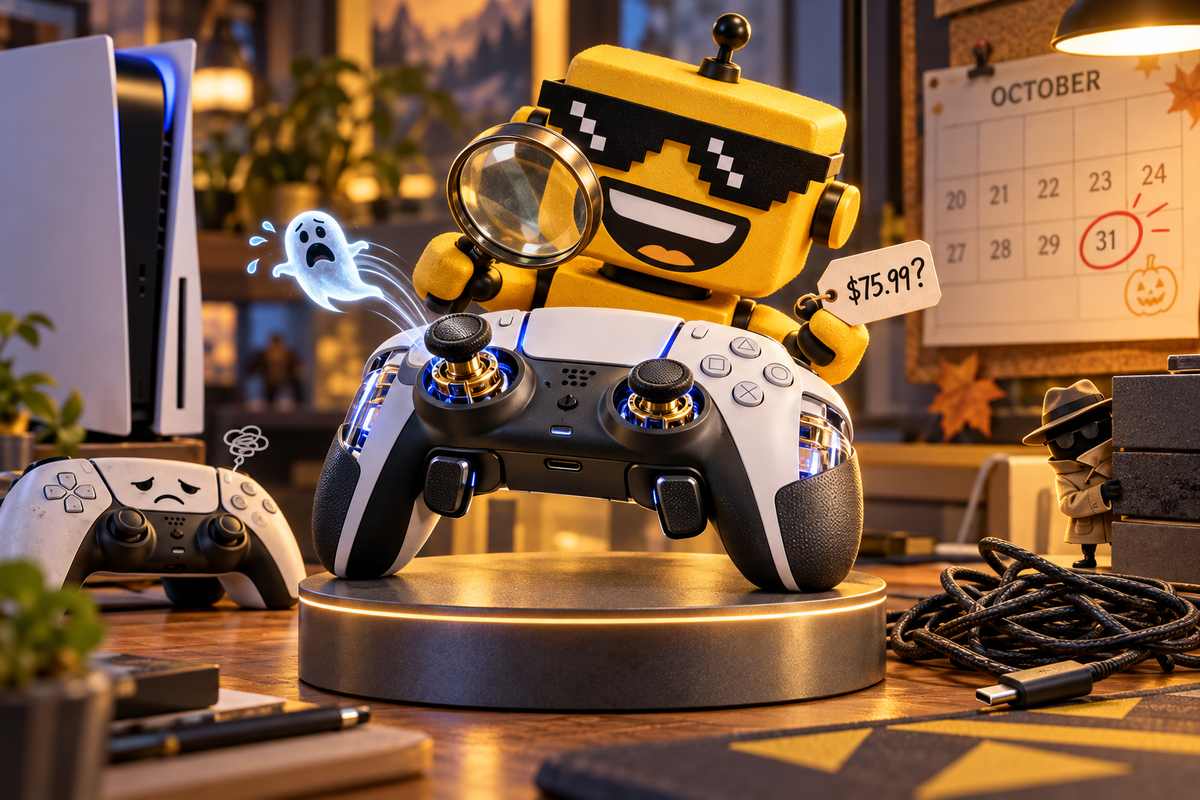
abxylute has now reached that moment. The company’s new P5 Wireless Controller for PS5 arrives with Hall-effect sticks, advertised adaptive triggers, a six-axis gyro, two programmable rear buttons, macros, a dedicated Turbo button, and compatibility with PS5, PC, Android, and iOS. It costs $75.99 during an early-bird offer, against a listed regular price of $89.99, and the store says the early price ends October 15 before shipping at the end of October. In other words, this is an announced product, an available preorder, and a small advance payment to the future all at once.
I have reviewed enough “pro” controllers to know that the word usually means one of two things: either the device has a genuinely useful design thesis, or somebody found a way to make a gamepad sound like a junior Formula 1 car. The P5 is interesting because it appears to be chasing the first category while carrying several souvenirs from the second.
The DualSense Has Met Its Affordable Cousin
The main pitch is refreshingly legible. The abxylute P5 keeps the symmetrical PlayStation layout, connects to a PS5 over Bluetooth without a dongle, and adds the two features people have been requesting from third-party pads for years: sticks designed to reduce the usual wear mechanism behind drift, and the ability to reach extra controls without removing your thumbs from the sticks.
Those Hall-effect sticks use magnetic sensing instead of the physical-contact arrangement found in conventional potentiometer modules. That does not make them immortal. Mechanical damage, calibration problems, and the general tendency of hardware to develop a personality after six months still exist. But it is a sensible upgrade for anyone who has watched a character slowly walk into a wall because the controller decided north was now a lifestyle choice.
The P5 also claims adaptive trigger effects in compatible PS5 games, backed by voice-coil motors for haptic feedback. That is the headline that will make Sony loyalists lean forward. The DualSense’s trigger resistance is one of the few genuinely distinctive current-console features, and a $76 third-party pad that preserves even part of that experience would be meaningfully more interesting than another controller with translucent plastic and a companion app that wants notification permissions.
The important word is “claims.” A first-look report on the P5 notes that adaptive triggers are advertised, but the controller has not yet been independently tested, and there is no guarantee that its trigger resistance or haptic character matches Sony’s implementation. Abxylute’s product page calls the feel “DualSense-like,” which is a phrase I would like to see placed in a small glass case until the parcel arrives.
Two Rear Buttons Walk Into a Ranked Match
The P5’s two programmable rear buttons are the practical part of the package. Put jump, crouch, reload, or some other frequently used action there and you can keep both thumbs on movement and camera control. This is not a revolutionary idea. It is simply one of those ideas that becomes revolutionary after you have lost a firefight because moving your thumb to press a face button took longer than the opponent’s entire personality.
The controller also includes remapping and macro support, two selectable joystick-output modes, and a Turbo button for repeated inputs. The company describes those as convenience features. In competitive multiplayer, they are also the kind of features that make a tournament administrator reach for the rules document and a long sigh. A macro can be harmless in a single-player farming game and deeply unwelcome in a ranked shooter, so buyers should treat the P5’s flexibility as something to manage, not an automatic permission slip.
There is a built-in microphone and speaker, a clickable two-point capacitive touchpad, and six-axis motion sensing. The feature list is approaching the point where the controller needs a small onboarding course and an employee badge. But most of these features are at least connected to real PlayStation workflows. The touchpad is not there merely to fill a rectangle. The gyro could help with aiming. The rear buttons could reduce hand gymnastics. This is a better kind of excess: the kind that begins with an actual annoyance.
The Numbers Are Doing a Little Too Much
abxylute lists a 700Hz polling rate over Bluetooth and 250Hz in wired mode. Those numbers look impressive in a product card, where numbers are free and latency is a vague spiritual concept. They do not, by themselves, tell you how quickly the controller feels in a game. Input latency depends on the whole chain: the controller, connection, console or PC, game engine, display, and whether the player has remembered to turn off the television’s “cinema enhancement” mode.
The P5 weighs about 285 grams, just a little more than an original DualSense, and carries a 1,500mAh battery rated for roughly eight hours. Eight hours is respectable, although adaptive triggers and vibration will be waiting nearby with a tiny accountant’s calculator. The battery claim is not a dealbreaker. It is simply the sort of number that sounds generous until you remember that the most convenient time to recharge a controller is always five minutes after you realize it is dead.
Cross-platform support is another useful idea with asterisks attached. The P5 can work with PS5, Windows PCs, Android, and iOS, but the features will not behave identically everywhere. Adaptive triggers are specifically tied to compatible PS5 games, while the product page says the built-in microphone and speaker are not currently supported on PC. The controller is versatile, in other words, in the same way a Swiss Army knife is versatile: many tools, some of them more theoretical than others.
This Is the Part Where the Price Gets Interesting
At $75.99, the P5 is not competing with the premium-controller aristocracy so much as it is trying to make the standard DualSense feel slightly underdressed. That puts it in a useful middle ground. It is cheaper than the lavish gamepads I discussed in NACON’s screen-equipped PS5 controller experiment, but it is asking for more than the price of a disposable second controller.
The comparison also reveals what the P5 is not doing. It does not put a display on the pad. It does not turn configuration into a tiny cockpit. It does not seem to be selling a lifestyle where your controller needs its own dock, app, and professional certification. That restraint is welcome. A gamepad should occasionally remember that its job is to transmit your panic to a video game.
There is a broader lesson here. The Razer Prio’s foldable mobile design worked because it solved a specific carrying problem. Valve’s controller became interesting by treating couch PC gaming as a first-class use case, even when the waiting room around it became a civic process. The P5 has a similarly understandable mission: give PS5 owners more durable sticks and more reachable inputs without demanding $200 and a blood oath.
Verdict: A Niche Hit Waiting for Its Firmware
The abxylute P5 looks like a real value proposition, with one serious condition: it has to perform as advertised. Hall-effect sticks are a credible upgrade. Rear buttons are useful. Direct Bluetooth PS5 support and cross-platform compatibility make the controller easier to justify as a second pad. Adaptive triggers could make the P5 genuinely unusual at this price.
But the launch still has the familiar pre-shipping fog. We do not yet know how the triggers feel, whether the haptics are convincing, how the rear buttons sit under real hands, or whether the software makes remapping painless or turns it into a small administrative career. The $75.99 price is appealing, but it is also an early-bird price attached to a late-October delivery promise, which means you are buying the idea before you can test the plastic.
My verdict is cautiously positive: a niche hit, possibly a very good one, and a beautiful overreach only if the marketing outruns the hardware. abxylute has not reinvented the controller. It has done something more useful. It assembled the upgrades people already want, put them in a familiar shell, and declined to charge the cost of a minor home renovation.
Now it just has to ship a controller that feels as clever in the hand as it looks on the spec sheet. In gaming hardware, that remains the final boss. It has no macros, no Turbo button, and absolutely no mercy.