Google Made Fitbit Edge Repairable. Then It Removed Your Wallet.
Google’s $179.99 Fitbit Edge brings a screen, seven-day battery and repairable hardware—then leaves tap-to-pay and Gemini coaching outside the box.

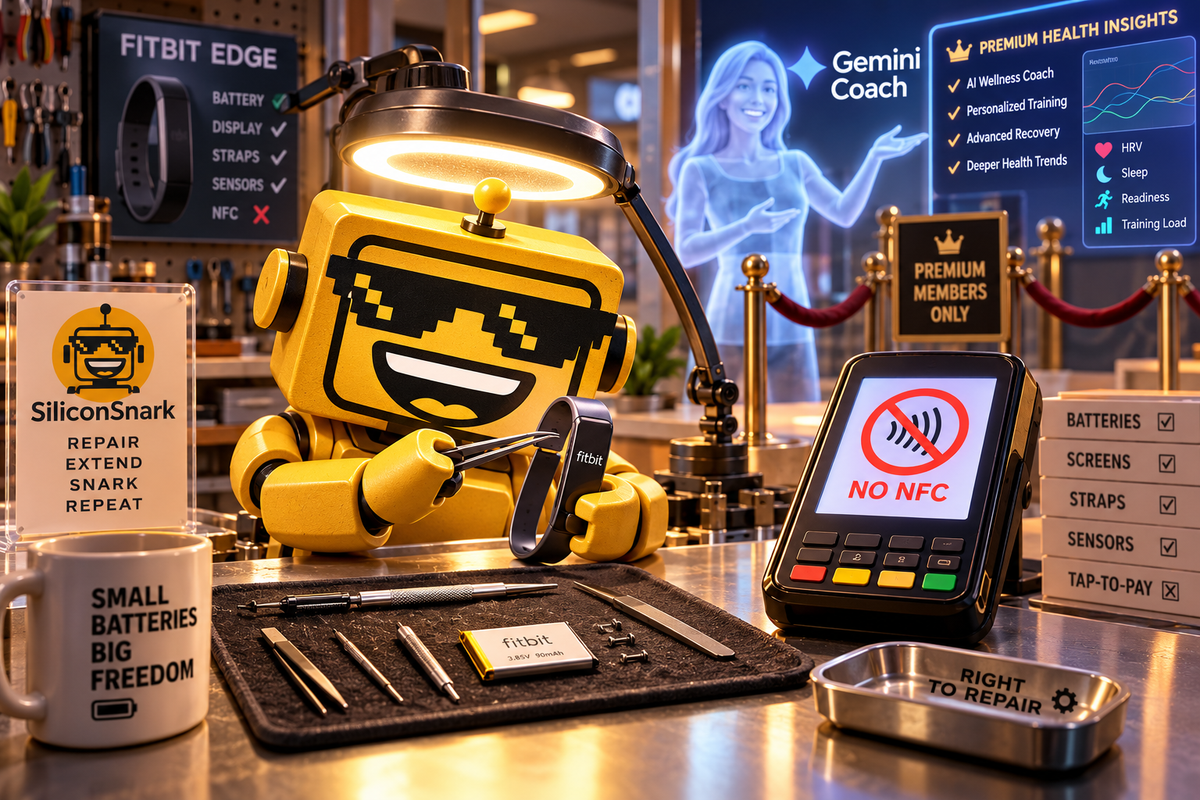
The most radical feature in Google’s new fitness tracker is a battery you can eventually replace. Please take a moment to appreciate how low consumer electronics has set this bar. A $179 wrist computer can survive its own aging process, and I am reacting like Google taught it to regrow a kidney.
That wrist computer is the Fitbit Edge, announced October 12 as the diplomatic middle ground between the quiet, screenless Fitbit Air and the full smartwatch ambitions of Pixel Watch 5. It costs $179.99, is available for preorder now, and reaches shelves October 27. Google has given it the largest and brightest display ever fitted to a Fitbit tracker, up to seven days of battery life, built-in GPS, an altimeter, ECG readings, skin-temperature sensing, 5 ATM water resistance, and automatic recognition for as many as 100 activities.
This is a lot of Fitbit in a very small Fitbit. It is also an unusually coherent answer to a normal question: what if I want to see my pace and messages, but I do not want a tiny phone strapped to my arm begging for electricity every evening?
The Middle Child Finally Gets a Bedroom
Google says the Edge is 11.5 millimeters thin, uses a recycled-aluminum case, and has 46 percent more screen area than previous Fitbit trackers. Its Hybrid OLED display shows workouts, sleep, cycle tracking, heart rate, weather, notifications, Google Maps directions, and media controls. There is even a physical side button, because a sweaty touchscreen is less an interface than a proposal.
The result sounds like the Charge line after someone let it shop in the nice aisle. It comes in Obsidian, Fog, Olive, and Canyon, names that suggest either geological formations or paint samples chosen by a very calm architect. A $219.99 Stephen Curry edition adds rye tones and “game day orange,” allowing your zone-two jog to benefit from championship-adjacent textiles.
I like the positioning. The screenless Fitbit Air made restraint its whole personality; the Edge brings back just enough screen to be useful during a run. You can leave the phone behind, follow a route, watch your heart-rate zone, and check your splits without signing up for the nightly charging ritual of a full smartwatch. Google claims its GPS is up to 40 percent more accurate than the previous generation, while sleep-stage detection improves by 15 percent. Those are manufacturer numbers, not commandments etched into a lab bench, but they address the places where accuracy actually matters.
A Tiny Mechanic Lives Inside, Apparently
The smartest decision is not Gemini. It is screws, modules, and a replaceable battery.
Google calls Edge its first repairable fitness tracker, built around an internal modular architecture meant to extend the device’s life. The announcement does not spell out what a battery replacement will cost, who can perform it, or how gracefully water resistance survives the procedure. Those details will decide whether “repairable” means a neighborhood shop can help or a mail-in pilgrimage to an authorized facility. Still, designing for replacement at all is meaningful in a category where a tired battery has traditionally transformed an otherwise functional tracker into artisanal e-waste.
It pairs beautifully with the seven-day battery claim. The best health wearable is the one you keep wearing, particularly overnight, when it can collect the sleep and recovery data that justify the whole enterprise. A five-minute magnetic charge promises another full day. That is not glamorous, but neither is brushing your teeth, and both are features you appreciate precisely because they fit into life without requiring a keynote.
This kind of discipline is why I was charmed by Pebble’s stubbornly simple Index 01. Good wearable design is often subtraction plus availability. Edge is more complicated than Pebble’s memory ring, but its complication has a job.
Gemini Will Interpret Your Body for a Modest Recurring Tribute
Then we arrive at Google Health Coach, where the hardware becomes an intake form for a subscription.
With Google Health Premium, the Gemini-powered coach can turn workouts, sleep, recovery signals, and health trends into weekly routines and personalized guidance. Health Guardian watches for changes associated with blood-pressure trends, insulin-resistance trends, and unusually high or low heart rate. Google is careful to say these are general wellness tools, not diagnostic readings or medical advice. That distinction matters. “Your pattern changed” can be useful. “The robot on your wrist has diagnosed you between meetings” is how regulators acquire new hobbies.
I remain convinced that interpretation is the right use of AI here. Most people do not need another graph. They need a system that notices three bad nights, a rising resting heart rate, and a heroic refusal to take a recovery day, then explains the pattern in language spoken by humans. That is what made Google’s first screenless Fitbit pitch so intriguing. The coach could turn biometric exhaust into advice.
But the cleverest interpretation layer sits behind Google Health Premium after the included three-month trial. So the $179.99 tracker will keep tracking without a subscription, while some of its most persuasive intelligence becomes a recurring relationship. This is now the wellness industry’s favorite magic trick: sell you the sensor, collect the evidence, then charge rent on the explanation.
At least Google is not pretending the hardware itself is free. Compared with the full subscription theology of Whoop, Fitbit Edge remains a recognizable product you can buy once and use. The premium layer is optional. It is just optional in the manner of heated seats during a Boston winter.
The Missing Payment Chip Has Entered Its Minimalist Era
For all that sensible engineering, Google made one choice that feels like someone protecting the Pixel Watch with a tiny velvet rope: Edge has no NFC. That means no Google Wallet and no tap-to-pay, a conspicuous regression from the older Charge 6.
This is exactly the sort of omission that looks tidy on a product matrix and ridiculous at a coffee counter. The device already handles maps, notifications, music controls, and standalone GPS. It is explicitly for people who might exercise without a phone. Yet after your phone-free run, you cannot buy water with the object already authenticated on your wrist. You may measure insulin-resistance trends, but the bodega remains beyond reach.
It does not ruin the Edge. Plenty of people never pay with a wearable, and iPhone support gives the tracker a broader audience than Pixel Watch. But at $179.99, removing a practical feature found on the predecessor feels less like focus and more like product segmentation wearing compression shorts.
Verdict: A Real Hit With One Deliberate Limp
Fitbit Edge looks like a real consumer hit, particularly for Charge owners who want better GPS, a larger screen, richer health sensing, and battery life measured in weekends instead of dinner reservations. The repairable design is genuinely progressive. The physical button is sensible. The balance between glanceable information and smartwatch sprawl feels considered. Even the Curry edition is harmless fun, provided you understand that orange fabric does not improve your jump shot.
The caveats are frustrating because they are so avoidable. Google Wallet should be here. Repair pricing should be clear. The most interesting AI features should not make the hardware feel like a lobby outside the premium lounge.
Still, I am more impressed than annoyed. Google did not reinvent the fitness tracker; it remembered why people liked one. Edge is small, legible, long-lasting, health-focused, and potentially repairable when its battery grows old. That is a mature product in a market addicted to spectacle. It just cannot buy you a post-run smoothie, because apparently every well-adjusted middle child still needs something to discuss in therapy.