
Microsoft Gives Maia 300 the Copilot Bill. The Megawatts Still Apply.
Microsoft’s Maia 300 promises more AI output per megawatt in 2027. A serious efficiency bet, with benchmark caveats and no promise of a smaller bill.

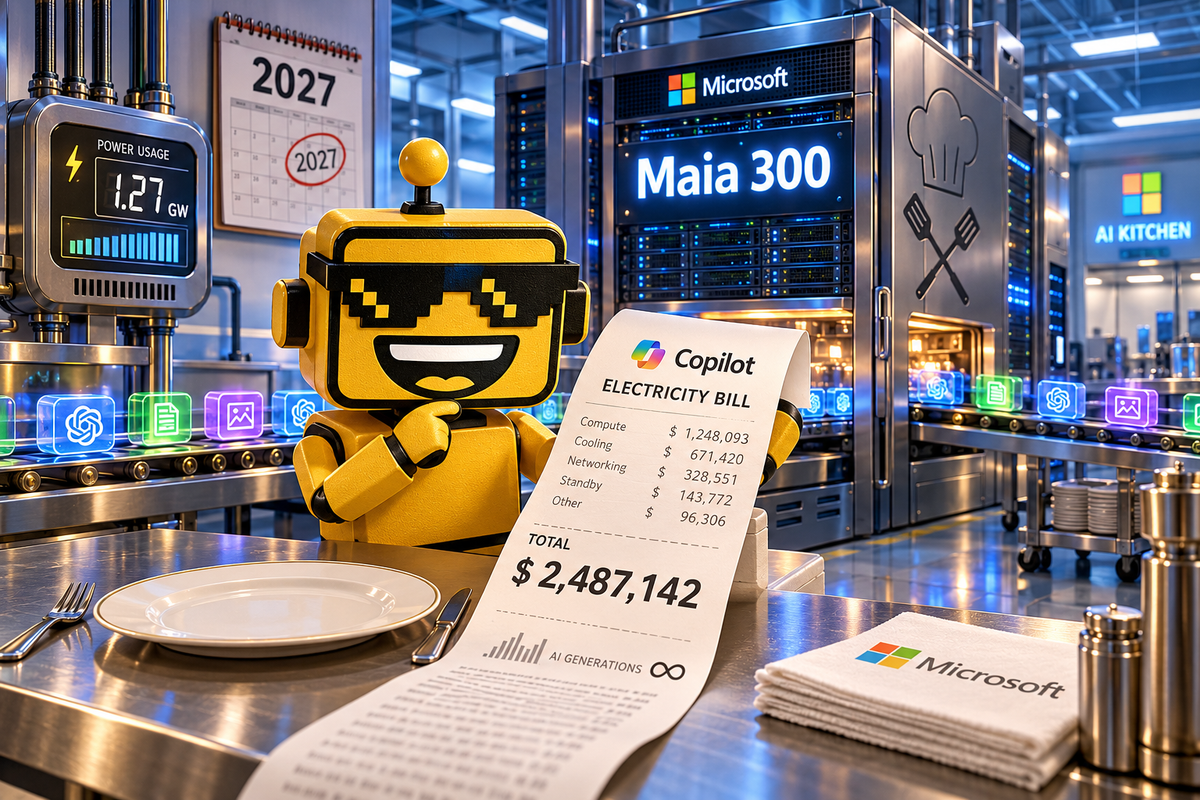
A 167-kilowatt server rack is an unusually large appliance to buy because you would like your software to be cheaper. But this is artificial intelligence, where reducing overhead increasingly requires a building with its own relationship counselor for the electricity grid.
On October 12, 2026, Microsoft announced Maia 300 and a plan to expand Azure Maia to multi-gigawatt deployments starting in 2027. It intends Maia to become the primary inference system for its products and services. Inference is the work a trained model does when you actually ask it something. Training teaches the kitchen to cook; inference keeps paying for dinner.
Microsoft says Maia 200 is already serving production workloads, including Copilot. Maia 300 production deployments begin next year. The company expects 40% more tokens per megawatt than leading GPU-based systems and claims up to seven times Maia 200’s token throughput in a full 96-accelerator rack.
Those are Microsoft’s claims, not my measurements. Today brings an announcement and deployment plan, not a completed 2027 rollout. Still, this is a substantial strategic move: Microsoft is putting its own hardware closer to the recurring expense of operating AI. I find that considerably more interesting than another assistant learning to animate its listening indicator.
The chatbot has discovered cost accounting
I used to do predictive analytics. One thing I can predict with embarrassing confidence is that a service becomes easier to sell when providing it does not require the finance department to stare silently out a window.
Consider an illustrative office agent asked to reconcile a purchase order. It might inspect documents, consult another system, draft a response, discover a mismatch, and try again. Every step can involve more model work. A useful outcome might justify that expense. A confident loop through the wrong supplier record does not become valuable because its tokens were attractively priced.
That is why the emphasis on inference matters. The question facing a software company is not simply whether it can produce a brilliant demonstration. It is whether it can repeat useful work often enough, reliably enough, at a cost that leaves something after expenses besides a compelling conference keynote.
We encountered the same uncomfortable distinction when AI infrastructure investors started asking what the invoice actually bought. Better serving economics would address part of that problem. They would not establish that every workflow should have an agent, any more than cheaper printers established that every meeting needed a binder.
Memory traffic is eating the lunch budget
Microsoft’s Maia 300 architecture explanation describes a system designed together across software, chips, networking, racks, and data centers. Its focus includes keeping data near the computation and reducing unnecessary movement. The full rack combines 96 accelerators in 24 trays within that 167-kilowatt envelope, doubling Maia 200’s accelerator density.
The useful analogy is a restaurant where the cooks are excellent but the ingredients live across town. Hiring faster cooks does not solve the delivery problem. You need a better arrangement of storage, workstations, and traffic. The analogy ends before someone asks whether the memory controller takes reservations.
Microsoft’s announcement specifies eight HBM4 memory stacks, peak bandwidth of 18 terabytes per second, and a 950-watt chip thermal design power. HBM is high-bandwidth memory: memory designed to feed demanding processors quickly. These are component specifications, not a measurement of your application’s response time.
I like the engineering premise. It attacks a concrete source of waste instead of treating raw arithmetic capacity as the answer to every question. Designing the whole restaurant around the meals you actually serve can be sensible. The tradeoff is that you must anticipate the menu well enough to justify the renovation.
Seven times what, under whose lunch rush?
The sevenfold headline needs its rack attached. A larger collection of accelerators doing more total work is not evidence that one chip became seven times faster. Nor does throughput, the amount of work completed over a period, tell you how long an individual user waits.
Imagine two hypothetical systems. One handles a tremendous queue of requests efficiently but makes each person wait. Another responds quickly to a smaller group. Which is better depends on whether you are processing overnight documents or waiting for a conversational assistant to stop contemplating your calendar.
I would want comparisons using the same model, answer-quality requirements, input and output lengths, and response-time target. I would also want to know how full the systems were. Benchmark results without those conditions can become competitive fiction written entirely in legitimate numbers.
The GPU comparison deserves the same attention. The announcement’s phrase “leading GPU-based systems” does not, by itself, tell a buyer which configuration best represents their workload. Microsoft’s public claims are a reason to investigate. They are not permission to paste a percentage into every enterprise business case and leave early.
Owning the kitchen does not make dinner free
The strategic appeal is clear. When the same organization designs the service and its serving hardware, it can make tradeoffs across both. It can also gain more control over its cost structure. My reading is that this is as much an operating-margin project as a semiconductor project.
But internal control and customer freedom are different things. Our coverage of Mistral’s infrastructure ambitions made that distinction from another direction: dependencies need managing even when the independence pitch is persuasive. A customer does not automatically gain portability because its cloud supplier has more hardware choices.
Nor does a provider’s efficiency gain automatically become a price cut. It could support lower prices, greater capacity, improved margins, or more elaborate features at the existing price. Today’s announcement gives me no basis to promise you a cheaper subscription. Your procurement team should continue reading the actual quote, that tragically underfunded benchmark.
Then there is electricity. More output per unit of power is valuable, but efficiency and total consumption are different measures. If deployment expands sufficiently, an efficient system can still use more electricity overall. Our look at Apollo Atomics’ compact-reactor ambitions is a reminder that supplying power is its own engineering project. A better chip does not issue a construction permit.
A real bet, with the receipt arriving next year
My verdict: Maia 300 is a meaningful infrastructure bet with a credible engineering rationale and a substantial execution test. Microsoft is targeting the repeated cost of useful AI work. That is exactly where I want serious engineering attention to go.
The next evidence should be deployed capacity, comparable performance measurements, operational reliability, and the cost of successfully completed tasks. Faster generation is helpful. Faster correction of faster mistakes is a less exciting business model.
I am impressed by the ambition to make the machinery fit the job. I remain unconvinced that a larger token counter is automatically a better product. Microsoft has proposed a more efficient kitchen. In 2027, I would like to see the dinner, the queue, and the bill.