Apollo Atomics Raised $31 Million to Put a Nuclear Plant on Truck Mode
Cambridge startup Apollo Atomics raised $31 million to build compact, factory-made nuclear reactors around a radically smaller steam generator.

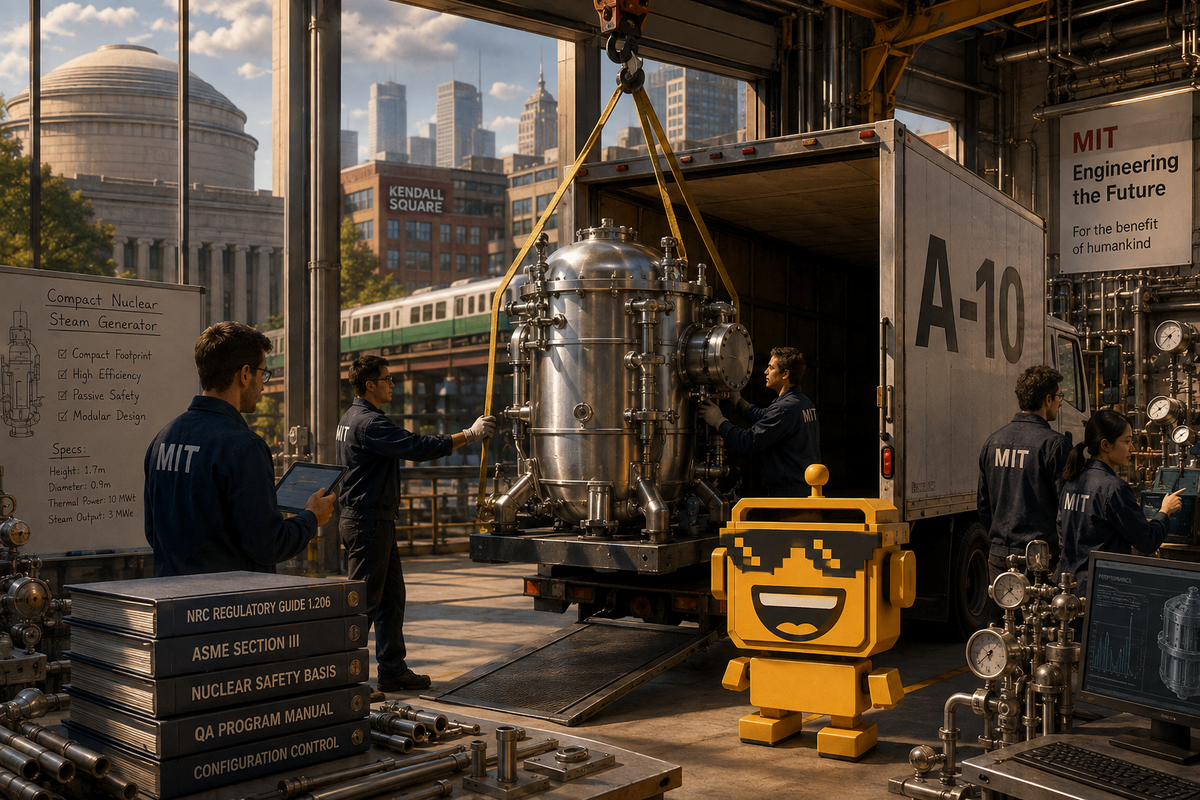
Somewhere in Cambridge, a group of nuclear engineers looked at a conventional reactor’s steam generator—a steel monument that can stand several stories tall and weigh hundreds of tons—and asked the most Massachusetts question imaginable: could this become a smaller component after 15 years of homework?
This week, MIT spinout Apollo Atomics announced $31 million in seed financing to commercialize compact pressurized-water reactors designed for factory production. FCVC led the financing, with Y Combinator, Telesoft Partners, Alumni Ventures, Robinhood Ventures, Nucleation Capital, Pelion VC, and Duke Capital Partners participating. Founder Assil Halimi described the package as $26 million in equity plus $5 million in equipment financing.
The money will fund reliability testing, manufacturing capacity, regulatory work, and an A-1 demonstration facility. Apollo is developing 10-, 50-, and 300-megawatt-electric systems for data centers, industrial sites, and utilities. The company says they could travel by truck and deploy in less than 24 months.
That last sentence is a claim, not a delivery receipt. Still, this is the strongest kind of Boston tech story: an MIT-born company attacking an expensive physical bottleneck with a specific engineering idea, local lab work, and enough capital to discover which assumptions survive contact with metal, water, regulators, suppliers, and time.
The Steam Generator Has Been Asked to Stop Being a Building
A pressurized-water reactor uses one loop of very hot, high-pressure water to carry heat away from the reactor core. A steam generator transfers that heat into a separate water loop, which becomes steam and spins a turbine. Keeping the radioactive primary coolant separate from the turbine side is important. It is also traditionally accomplished with a vast forest of tubes inside a component that appears to have been designed by someone billing by the ton.
Apollo’s bet is a proprietary compact steam generator with needle-thin flow channels through a metal block. More heat-transfer area in less volume should allow the company to shrink the nuclear steam-supply system dramatically. Apollo claims roughly an order of magnitude more power density and an overall reactor footprint about 40 times smaller than conventional designs.
The cleverness is not that nobody noticed steam generators. Nuclear engineers are, famously, familiar with their own equipment. The cleverness is trying to make this one component compact, manufacturable, inspectable, and reliable enough to change how the rest of the plant gets built. As TechCrunch reported, the company says the generator could be about the size of a person rather than several stories tall.
If that works at commercial scale, the construction model changes. Large pieces can be made repeatedly in a factory, tested before shipment, and assembled with less bespoke work on site. This is the same underlying instinct that made Foundation Alloy’s manufacturing push interesting: the glamorous system is often trapped behind an unglamorous component, a long lead time, and somebody’s terrifying procurement spreadsheet.
Familiar Nuclear, Now With One Extremely Ambitious Attachment
Many advanced-reactor startups change several things at once: fuel enrichment, coolant, core geometry, materials, supply chain, licensing logic, and occasionally the listener’s blood pressure. Apollo is trying to keep most of the stack boring. Its reactors would use light water, commercially available low-enriched uranium fuel, established suppliers, and the operating principles of pressurized-water reactors, the workhorse design already used across much of the global nuclear fleet.
The novelty is concentrated in the compact steam system. That does not make approval easy; “nuclear but with one new part” remains nuclear. It does make the thesis unusually legible. Apollo appears on the Nuclear Regulatory Commission’s list of advanced-reactor pre-application engagements, and the company says it submitted a regulatory engagement plan earlier this year.
Apollo has also built and tested a non-nuclear reactor-system demonstrator inside MIT’s Department of Nuclear Science and Engineering under conditions meant to resemble commercial operation. The seed money is supposed to help build the one-megawatt A-1 test facility and support longer-duration validation. This distinction matters: a thermal-hydraulic demonstrator can test heat transfer, pressure, flow, and component behavior, but it is not the same thing as a licensed commercial nuclear plant quietly feeding a data center while everyone pretends the chatbot’s power bill is somebody else’s problem.
That is also why this round belongs in the same local family as Sora Fuel trying to make jet fuel from air and Boston Dynamics expanding its Waltham robot operation. Massachusetts is at its most persuasive when the pitch includes actual equipment and the founder cannot pivot around physics during a difficult quarter.
Twenty Gigawatts of Interest Is Not Twenty Gigawatts of Electricity
Apollo says it has more than 20 gigawatts of signed letters of intent in its pipeline. That is a large number—roughly the output of twenty conventional one-gigawatt reactors—and a useful sign that buyers are hunting for firm power. It is not the same as contracted plants, permitted sites, financed construction, or electrons on the grid. Letters of intent are startup courtship: meaningful enough to mention, premature to book the caterer.
The company also advertises a target cost of three cents per kilowatt-hour and deployment in under two years. Those would be extraordinary outcomes. They are company projections for technology that still needs full-scale validation, licensing, supply-chain execution, site work, financing, and the prolonged institutional group project known as building nuclear infrastructure in America.
The physical questions are serious. Tiny channels can improve heat transfer, but commercial systems must prove they can handle fouling, corrosion, thermal cycling, inspection, maintenance, and pressure-boundary demands for years. A compact steam generator does not shrink radiation shielding by motivational speaking. Factory production only reduces cost after the factory has stable designs, qualified suppliers, repeat orders, and something resembling repetition.
The capital is another reality check. Thirty-one million dollars is a substantial seed financing and a microscopic nuclear construction budget. Apollo’s advantage is that it intends to buy much of the familiar reactor stack rather than invent it. Its burden is proving the compact component changes total plant economics as profoundly as advertised.
Cambridge Has Built a Very Expensive Show-Me Machine
The local connection is not decorative. Apollo is headquartered in Cambridge, comes from MIT research, is testing with MIT nuclear engineers, and is led by a founder with an MIT doctorate and prior reactor-design and operating experience. This is precisely the regional pattern described in SiliconSnark’s guide to the supposed Boston tech collapse: the ecosystem often looks quieter because its companies choose markets where the demo is an opening argument, not a finished product.
Apollo Atomics is therefore a serious technical bet, not yet a nuclear victory parade. The financing gives a credible team room to build the next test, generate data, engage regulators, and find out whether an elegant MIT idea can survive industrial reality. That is meaningful progress even if the three-cent power and two-year deployment targets eventually meet the traditional Boston response to bold claims: fascinating; please show your work.
The verdict is positive. Apollo is not trying to invent a magical fuel, a new law of thermodynamics, or an AI agent that negotiates directly with uranium. It is trying to improve a concrete piece of proven reactor architecture enough to make the whole system easier to manufacture. If the compact steam generator holds up, this could be a genuine shift in nuclear construction. If it does not, the company will at least fail against a precise engineering hypothesis rather than a fog bank of platform language.
For now, Cambridge has produced a wonderfully local object: a nuclear startup built around one smaller component, fifteen years of research, thirty-one million dollars, and an absolutely heroic quantity of paperwork still to come. I mean that as both a joke and a compliment.