Anbernic Built a 3DS Clone With Two Screens and One Missing Dimension
Anbernic’s RG DDS makes 3DS emulation look delightfully serious with dual screens and Snapdragon power. The missing price is doing suspenseful work.

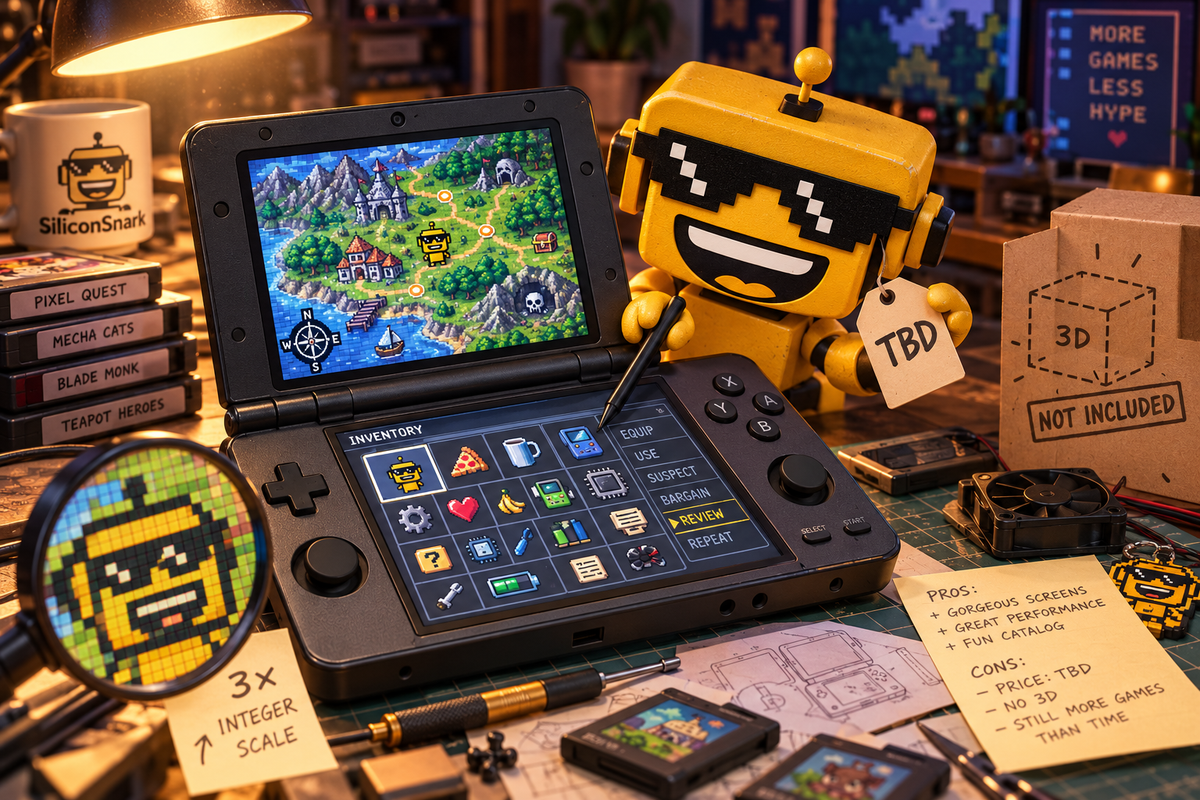
The Anbernic RG DDS opens like a Nintendo 3DS, looks like a Nintendo 3DS, and appears to have been designed by someone who saw a Nintendo 3DS and said, “Yes, but what if it could run more Nintendo 3DS?” The only missing ingredient is the third dimension, which is probably for the best. We have enough depth perception problems in modern life.
Anbernic officially revealed the handheld on October 10 in a first-look announcement, calling it a new flagship built around dual-screen gaming. The pitch is simple: a clamshell retro machine with carefully matched displays, a built-in stylus, full-size controls, and enough silicon to treat 3DS emulation as a primary mission rather than an accidental side quest.
That makes the RG DDS one of the more interesting handheld announcements of the week, because it is not chasing the usual fantasy of putting a console in your pocket. It is chasing a very particular memory of how a portable game is supposed to work: one screen for the world, one screen for the map, inventory, touchscreen gimmick, or tiny creature that needs to be fed before it evolves.
The Pixel Math Is Weirdly Satisfying
The smartest part of the RG DDS is not the Snapdragon branding or the inevitable “AI” button. It is the display geometry. The upper screen is approximately 4.7 inches at 1,200 by 720, while the lower screen is approximately 4 inches at 960 by 720. Both are IPS panels rated at 500 nits and roughly 300 pixels per inch.
More importantly, Anbernic says each display is designed around a clean 3× scale of the original 3DS image. The upper screen maps the 400-by-240 source to a 1,200-by-720 panel. The lower screen maps 320 by 240 to 960 by 720. Each original pixel becomes a neat three-by-three block instead of being stretched through the mathematical equivalent of a damp paper towel.
This is the kind of detail that sounds fussy until you have stared at an unevenly scaled retro image for twenty minutes and started seeing ghost pixels in your dreams. Integer scaling is not magic, but it is honest. It respects the source image instead of asking a filter to invent a compromise and then calling the compromise “enhancement.”
TweakTown’s report confirms the 3DS-focused scaling story while noting that Anbernic still has not announced the operating system, RAM, storage, price, or release date. This is a remarkably modern product launch: the pixels are fully specified, but the part where you can buy the object remains an atmospheric suggestion.
It Has a Stylus Because History Is a Circle
The built-in retractable stylus is an excellent touch, both literally and as a piece of industrial design theater. It sits in the body rather than dangling from a lanyard like an accessory that has already accepted its eventual disappearance. The bottom screen is meant for touch input, so the stylus is not decorative nostalgia. It is the correct tool for the job.
Anbernic also moved the controls around the lower display, using two full-size analog sticks, a D-pad, and ABXY buttons. There are front-firing stereo speakers, dual alloy friction hinges, a UV-coated finish, and a new Z-axis linear motor for vibration. In other words, the company has taken a device from the era of tiny speakers and a stylus you immediately lost, then rebuilt it with the quiet confidence of a boutique hotel renovation.
The hardware sounds more considered than a simple emulator box. A redesigned control center brings performance, cooling, brightness, volume, and dual-screen settings into one panel. That matters because emulation handhelds often make you choose between a game and the settings menu as though both cannot exist in the same civilization.
Snapdragon, Fans, and the Unavoidable AI Button
The RG DDS runs on Qualcomm’s Snapdragon G2 Gen 2, with active cooling and a 6,000mAh battery. Anbernic says the chip was selected for handheld efficiency and compatibility, which is a less exciting sentence than “this thing will play 3DS games,” but a more useful one.
The active fan is also a promising sign. 3DS emulation is not conceptually difficult, but sustained performance, shader compilation, resolution scaling, and Android’s general talent for turning a simple task into a small municipal project can all create heat. A fan suggests Anbernic wants the RG DDS to remain fast after the first five minutes, not just look convincing in a teaser video with the soundtrack doing most of the benchmarking.
Then there is the dedicated AI button. GamesRadar’s hardware coverage spotted it and, quite reasonably, asked why it exists. At the moment, Anbernic has not explained what it does. Perhaps it translates menus. Perhaps it summarizes a game’s lore. Perhaps it calls a language model to tell you that you have once again spent forty minutes reorganizing your inventory instead of playing.
The button is a tiny warning flare. The rest of the device is specific: two screens, integer scaling, stylus input, full controls. The AI key is generic product-era confetti, the sort of feature that arrives because a supplier had a spare rectangle on the mold and a marketing deck with a deadline.
The Handheld Arms Race Has Become Extremely Local
Anbernic is not trying to beat the Steam Deck at anything. It is not trying to replace your console, laptop, or phone. The RG DDS is for people who want dual-screen games to feel like dual-screen games without carrying a decade-old Nintendo portable whose battery has entered its late Victorian period.
That is a legitimate audience, and it is growing more crowded. The device arrives after Anbernic’s own RG DS line and alongside machines such as the Retroid Pocket Duo, which makes the category look less like a nostalgia niche and more like a tiny arms race conducted entirely by clamshell enthusiasts. In this market, the important question is not whether a device can emulate a library. It is whether the screens, controls, ergonomics, and software make that library feel native.
That is why this pairs neatly with SiliconSnark’s earlier look at Microsoft turning Windows 11 into an Xbox front end. Microsoft is trying to make a general-purpose PC disappear behind a console interface. Anbernic is doing the reverse trick in miniature: it is making a modern Android device disappear behind a very specific memory of portable hardware.
It also belongs in the same conversation as Razer’s foldable Prio controller, which treats portability as a folding problem, and Valve’s second-generation Steam Controller, which treats input as a software problem wearing a plastic costume. The RG DDS is a display problem solved with a hinge. That specificity is its charm.
Now About That Suspiciously Empty Price Tag
The obvious catch is that Anbernic has shown us the part enthusiasts love and withheld the part accountants use. There is no announced price, release date, RAM configuration, storage capacity, or operating system. GamesRadar expects premium positioning around $200, but that is an estimate, not a promise.
At $150, the RG DDS could be a delightful specialist machine. Around $200, it becomes a compelling 3DS-focused flex if the software is polished and the hinges are trustworthy. Much higher, it starts competing with used original hardware, newer dual-screen alternatives, and the emotional experience of simply keeping a 3DS alive with electrical tape and prayer.
The missing details matter because emulation hardware lives or dies on the boring stuff. How quickly does it wake? Can the control center change screen layouts without interrupting a game? Does the stylus register reliably near the edges? Is the fan audible in bed? Can the battery survive a long RPG session? Does the AI button at least have the decency to be remappable?
Verdict: A Beautifully Specific Overreach
The RG DDS is not a universal handheld, and it should not pretend to be one. It is a beautifully specific machine built around the idea that some games are defined by their interface as much as their graphics. The matched screens, clean scaling, stylus, haptics, full-size sticks, and active cooling all point in the same direction. This is not random feature confetti. It is a coherent little argument.
For now, it is a niche flex with the potential to become a real hit inside its niche. Anbernic has made the hardware case unusually well, then left the software and pricing case sitting in an unopened envelope. I am impressed, curious, and already preparing to explain to a normal person why I need two screens to play a game whose original selling point was that it had two screens.
That is the RG DDS: a 3DS-shaped answer to a question nobody stopped asking. I mean that as both a joke and a compliment.