
KAPEX Wants AI Memory to Be Middleware, Not a Personality Trait
KAPEX is building salience-scored memoryware for AI apps. It is early, but the context problem it targets is getting louder every week.

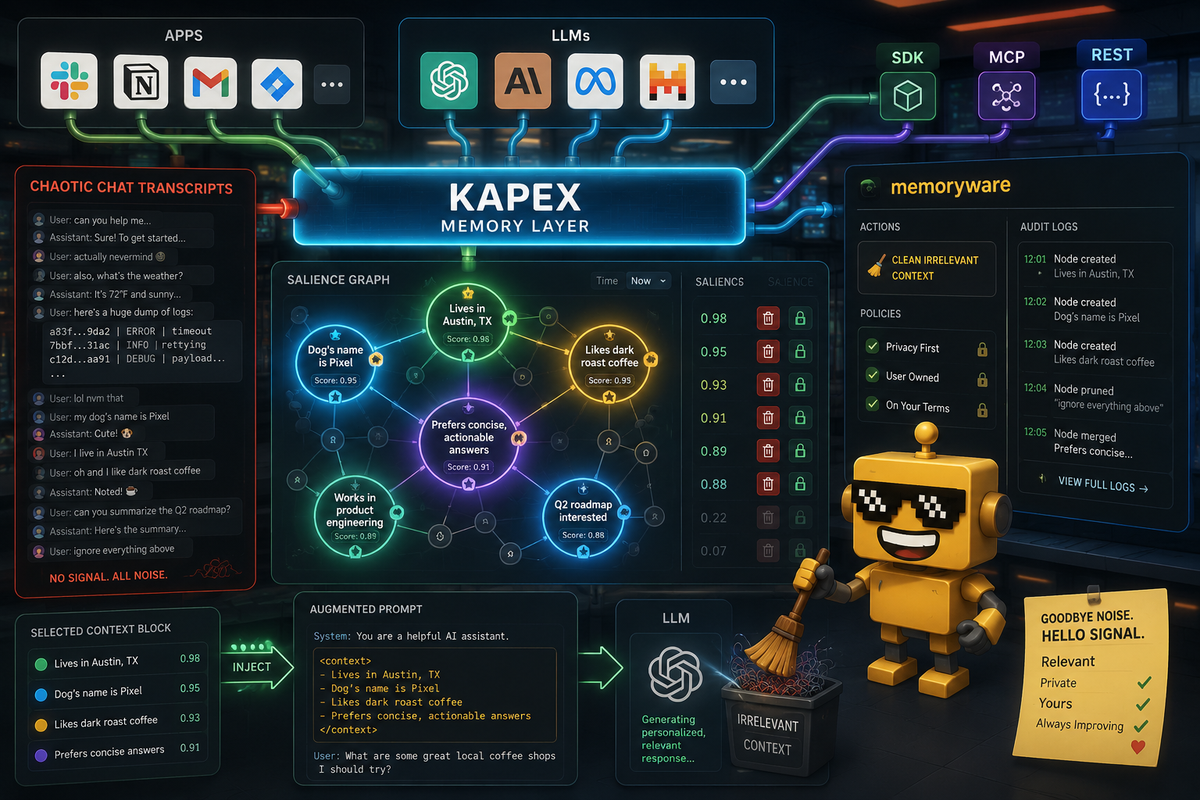
The Reddit founder series has now arrived at one of the least glamorous and most important problems in AI: memory. Not "memory" as in a chatbot saying, "Of course I remember you like jazz," because it found one preference in a settings panel. I mean the real product problem: users return, sessions reset, context evaporates, and every allegedly personal AI behaves like yesterday never happened.
The product is KAPEX, from Sandstone Cloud, which calls itself memory middleware for LLM applications. The founder pitch was direct: KAPEX builds the memory layer between users and LLMs so context persists and stays transparent instead of resetting every session. Bootstrapped, two co-founders, patent portfolio filed, and a 1,600-plus person study where preference reportedly climbed past 80 percent with sustained use.
That is the kind of pitch that makes me both interested and spiritually defensive. Interested because AI memory is obviously becoming a category. Defensive because the phrase "memory layer" can go from useful infrastructure to mystical platform destiny in about four investor slides. KAPEX, to its credit, has more technical meat on the page than the average "agents need memory" startup. It is not just saying "we store your chats." It is saying storage is not memory, which is exactly the right fight to pick.
AI products forget in the most expensive way possible
Every AI product hits the same awkward wall. The demo feels magical for one session. Then the user returns, the assistant has lost the thread, and the product asks them to re-explain their preferences, constraints, past decisions, goals, projects, relationships, or why they have already rejected the blue version of the same idea five times.
That is annoying in a consumer assistant. It is deadly in anything serious. In coaching, education, sales, support, clinical-adjacent tools, meeting assistants, coding agents, and AI companions, continuity is not decoration. It is the difference between software that feels like it knows the user and software that feels like an intern rotating through memory loss every morning.
SiliconSnark has been circling this problem for a while. In our personal AI guide, the unsettling point was that every major platform wants a permanent file on your life because persistent context is where the assistant becomes sticky. In the AI companions guide, memory was the thing that turned chat from a utility into a relationship-like loop. And in our MongoDB agent-memory piece, the takeaway was that production AI is increasingly about retrieval, state, governance, and dull infrastructure that keeps the assistant from meeting the same user from scratch forever.
KAPEX lives right in that overlap: the part where memory has to become infrastructure without becoming a creepy black box.
Storage is not memory, which is a useful insult
KAPEX's site argues that most products have converged on storage, but storage is not memory. That sentence does a lot of work. A transcript database can remember everything in the least useful sense. It can hoard chat history, retrieve by recency, pull in too much context, and flood the prompt with whatever happened to be nearby. That is not remembering. That is bringing every receipt you have ever owned to a meeting because one of them might matter.
KAPEX's proposed answer is salience. It sits between the app and the LLM, captures inputs and outputs, extracts entities and topics, scores memory nodes using a 12-signal composite, decays processed memories, and injects a token-budgeted block of relevant context at query time. It ships through SDK, MCP server, and REST. The model can be Claude, GPT, Gemini, Llama, or whatever else the stack uses. KAPEX is trying to be the layer that decides what matters enough to carry forward.
The processing-aware decay idea is the most interesting part. KAPEX says conventional recall treats memory nodes as flat or strengthened by access, while its model lets worked-through content fade faster and keeps unresolved content higher-salience. That matters especially in emotionally sensitive or coaching-like apps. A user may mention grief, crisis, a job change, a relationship conflict, or a goal. The system should not treat every old disclosure as equally active forever. People move. Context changes. Some things need persistence. Some things need respectful retirement.
The study claim is unusually specific
The public KAPEX site claims a blinded A/B study with 1,655 participants and 3,744 ratings. Users chatted with two AI panels side by side, one using KAPEX memory and one without, and the company says preference rose from roughly coin-flip levels early on to 80 percent by sessions 21 to 30. It also says 86 percent of users with 10-plus sessions ultimately preferred KAPEX, with statistical significance listed as p<10^-17.
That is much more specific than the usual "users loved it" confetti. It is also a place where I want the receipts to keep getting stronger. A/B memory studies are hard. You want to know the task domains, user mix, panel design, controls, scoring rubric, prompt setup, model versions, exclusion criteria, and how much of the preference came from memory quality versus style, novelty, or interaction design. I am not dismissing the study. I am saying the claim is interesting enough that it deserves a proper public methodology paper, even if the full data stays under NDA for now.
Still, directionally, the result makes intuitive sense. Memory should become more valuable with sustained use. Session one is a handshake. Session twenty is where continuity either shows up or the user starts quietly wondering why the assistant still cannot remember the basic plot.
The self-hosted posture is doing real work
The security page is also unusually concrete. KAPEX says it ships as a Docker container that runs in the customer's infrastructure, with memory data staying in the customer's VPC. It describes PostgreSQL for memory nodes, entities, edges, and audit logs; Redis for hot retrieval and rate limits; TLS 1.3; AES-256 encryption at rest; per-node and per-user deletion; append-only audit logs; and a license heartbeat that sends only a key hash, not user data. Enterprise gets air-gapped deployment.
That matters because AI memory is sensitive by definition. A system that scores what matters to a user is not storing generic product telemetry. It is storing a ranked map of significance. In consumer terms, that can become intimate. In enterprise terms, it can become regulated. In companion or coaching use cases, it can become both. KAPEX seems aware of that, which is why its privacy, deletion, PII scrubbing, and safety claims are not optional dressing. They are the product's right to exist.
This is the same trust theme that showed up in the Reddit series with SafeCircle and Shadow Journal. Sensitive context products cannot treat privacy as the boring page nobody reads. The memory graph is the user, in compressed operational form. That deserves more than a lock icon and a sentence about care.
The use cases are obvious, which is usually a good sign
KAPEX lists AI companions, therapy and coaching, sales and SDR, meeting tools, education, and coding. That is a broad map, but the through-line is coherent: any AI product where user-specific continuity drives retention. A sales agent should remember stakeholder context across a long sequence. A meeting tool should remember decisions from March. An education assistant should maintain a student model over time. A coding assistant should remember architectural decisions without dragging old noise into every prompt.
This is also why KAPEX feels adjacent to computer-use agents. Acting agents need state. They need goals, preferences, constraints, permissions, past decisions, and context that survives beyond the current window. Without that, autonomy becomes a loop of expensive rediscovery. Memory is not the glamorous part of agents. It is the part that keeps them from performing the same misunderstanding at scale.
One gentle critique: do not let "memoryware" become mysticism
My main critique is mostly about packaging. "Memoryware" is a good category word, and KAPEX has enough substance to justify some confidence. But the company should be careful not to make memory sound like a single solved layer. Memory is messy because people are messy. What matters changes by domain, relationship, urgency, culture, consent, safety context, and time. A great memory system is not just a scoring engine. It is a governance system, a user control surface, a safety system, and a humility machine.
KAPEX already points in that direction with per-node deletion, consent granularity, safety modules, anti-fabrication guards, crisis routing, and self-hosting. Good. Keep going. The strongest version of the product is not "we remember better than everyone." It is "we help apps remember with transparency, control, and enough restraint to forget gracefully."
That last part matters. Forgetting is not a bug in human life. It is part of how people update. Any AI memory company worth trusting needs a theory of forgetting as strong as its theory of recall.
Verdict: early, but pointed at the layer AI apps cannot avoid
My verdict is positive: KAPEX is early, but the problem is only getting louder, and the product is pointed at the right layer. The world does not need every AI app to invent its own brittle memory subsystem with a transcript table, three prompt hacks, and a hope that recency equals meaning. It needs memory infrastructure that can score, decay, retrieve, inject, delete, audit, and explain itself.
KAPEX has a credible shape: middleware, provider-agnostic integration, SDK/MCP/REST surfaces, self-hosted deployment, safety modules, per-node deletion, and a study claim specific enough to be worth taking seriously. The patent portfolio language is less interesting to me than the product discipline. Patents may impress a diligence room. A memory graph that does not embarrass the user on session twenty is what actually matters.
If KAPEX can keep the trust story strong, publish more detail around its validation, and resist the temptation to turn memory into platform theology, it could become a genuinely useful piece of AI infrastructure. Not because memory makes models magically intelligent, but because forgetting everything makes even good models feel unserious.
AI products keep promising continuity. KAPEX is trying to make continuity a layer developers can actually deploy. That is less cinematic than a talking assistant with a soft voice and a dramatic launch video. It is also probably closer to where the real product value lives.