Deep Dive: AI Layoffs Are Turning the Org Chart Into a Prompt Window
AI layoffs are accelerating in 2026. This guide traces the history, incentives, hype, and real labor risk behind the new layoff script.

The AI layoff has entered its prestige era.
For a while, companies treated artificial intelligence as a hiring story. Everyone needed prompt engineers, model evaluators, AI product managers, agent platform leads, data plumbers, compliance whisperers, and one newly minted vice president of "transformation" whose actual job was to put a sparkling noun in front of every existing workflow. Then the language changed. AI stopped being just the thing companies were hiring for and became the thing companies were cutting around.
The last week has been almost too neat, in the way bad omens sometimes arrive with a slide deck. Meta launched a wave of layoffs on May 20 that reportedly affected about 8,000 people, roughly 10 percent of its workforce, while also moving thousands of other employees toward AI workflow roles and canceling open positions. Al Jazeera, citing Reuters, reported the cuts alongside the planned shift of 7,000 employees into AI-related work. Standard Chartered, meanwhile, is planning to cut more than 7,000 jobs over four years as it leans harder into automation and artificial intelligence, according to The Guardian's report on the bank's AI-linked restructuring. Cloudflare said earlier this month that AI made 1,100 roles obsolete, even as revenue hit a record, according to TechCrunch. Coinbase cut about 14 percent of staff and framed the move around market conditions plus AI changing how work gets done, a topic SiliconSnark already tackled in Coinbase Discovered AI, So 700 Humans Became a Cost Structure.
This is the new corporate dialect. Nobody is "reducing headcount" anymore. They are becoming AI-first, AI-native, agentic, flatter, faster, leaner, more focused, more technical, more customer-obsessed, more operationally excellent, and apparently less burdened by the inconvenient subscription plan known as payroll.
The why-now is not hard to find. AI budgets have become enormous. Investors expect proof. Executives want margin expansion. Boards want a story that sounds more sophisticated than "we overhired, misforecasted demand, and now need to protect earnings." Generative AI supplies that story. It is new enough to feel visionary, vague enough to cover a warehouse of sins, and real enough that skeptics cannot simply wave it away. That is the dangerous part. AI is not imaginary. But the way companies are using it to narrate layoffs can be slippery, self-serving, and occasionally insulting to everyone who has ever seen an org chart dressed up as destiny.
So this guide is not the cheap version of the argument. It is not "AI is fake and bosses are lying." That would be emotionally satisfying and analytically lazy. AI is already changing software work, customer support, marketing operations, finance workflows, recruiting, legal review, data analysis, and the managerial fantasy life. SiliconSnark has been tracking the machinery underneath it in AI coding agents, AI agents and money, AI search, and personal AI memory. The shift is real. The question is whether the layoffs are evidence of productivity breakthroughs, cover for ordinary cost-cutting, or a messy blend of both.
The answer, inconveniently, is yes.
AI Layoffs Are a Management Technology
The easiest mistake is to treat "AI layoffs" as one clean category. They are not. Sometimes AI directly automates work that used to require people. Sometimes AI changes the expected shape of a team, letting a smaller group produce more output. Sometimes AI spending creates budget pressure elsewhere, so people are cut to fund compute. Sometimes companies use AI as a flattering explanation for layoffs they wanted to do anyway. Sometimes all of those happen in one company before lunch.
That makes the AI layoff different from older automation stories. Factory automation had robots, production lines, visible capital equipment, and a clearer relationship between machine and task. The modern AI layoff often happens inside the fog of knowledge work. A support rep is not replaced by one robot. A marketing team is not replaced by one model. Instead, workflows are broken apart, managers decide which pieces can be routed through software, and the remaining humans inherit more review, coordination, exception handling, and blame.
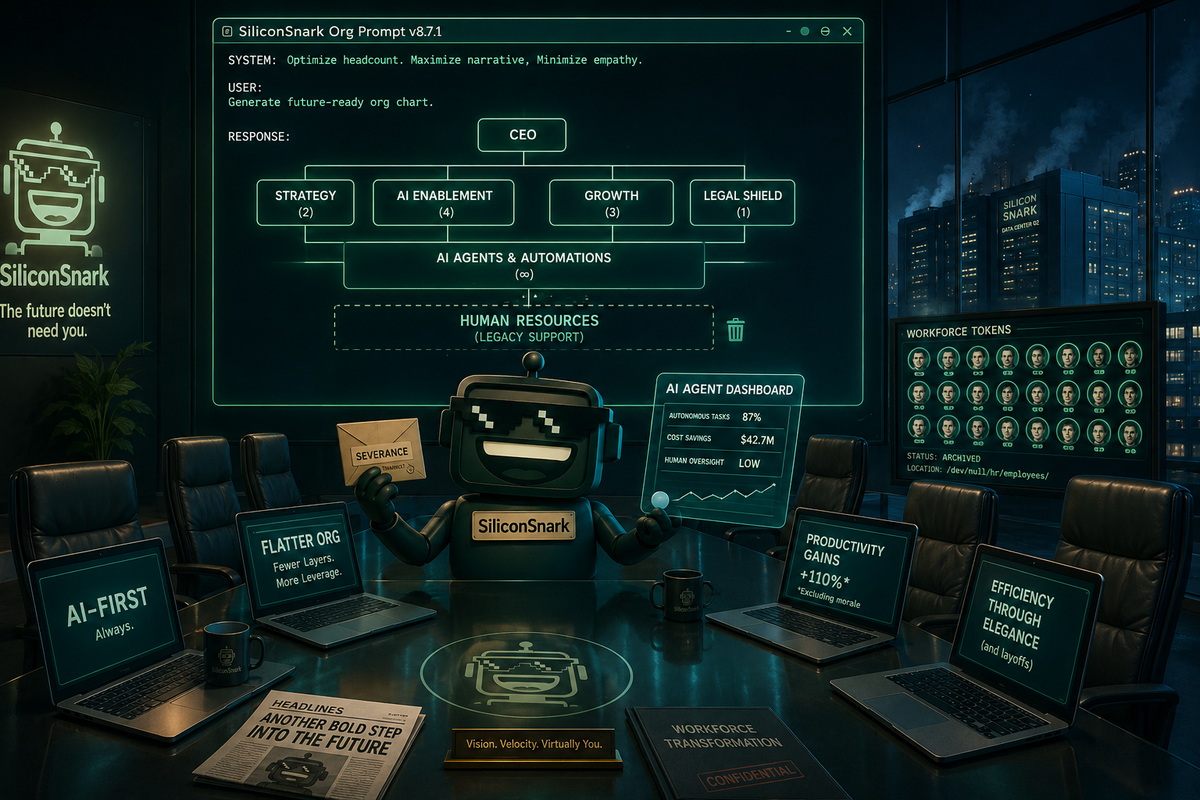
AI does not need to replace a whole job to eliminate a job. It only needs to convince management that enough tasks can be compressed, redistributed, delayed, outsourced to software, or made somebody else's problem. The org chart becomes a prompt window: enter a goal, delete a layer, ask the remaining humans to regenerate the company at higher quality.
That is why the rhetoric matters. "AI-first" is not just a technical claim. It is a labor claim. It tells employees that the old equilibrium between staffing, output, quality, and burnout has been reopened. It tells investors that management has a productivity story. It tells the market that cuts are not weakness but modernization. It tells customers that fewer people will somehow mean better service, which is one of those sentences only a software company can say without immediately being handed a mop.
The serious version of the story is that AI can remove drudgery. It can draft, summarize, classify, search, test, translate, triage, refactor, reconcile, and explain. Used well, it can make teams faster and employees less trapped inside procedural paste. The cynical version is that AI lets executives launder a layoff through a futurist vocabulary. Both versions are active in the market right now. The task is telling them apart before every spreadsheet learns to say "agentic."
May 2026 Made the Subtext Loud
Meta is the cleanest symbol because the numbers are big and the strategic story is explicit. The company is spending aggressively on AI infrastructure, assistants, models, agents, and internal transformation. It is also cutting thousands of people. Reuters-linked reports have described a May 20 layoff wave, the transfer of employees into AI workflow initiatives, and the closure of open roles. That combination is the whole 2026 labor debate in one awkward sentence: the company needs fewer people in some places because it wants much more machine capacity in others.
The most revealing phrase from the broader Meta coverage is not even "layoff." It is "AI workflows." That is where the displacement story becomes subtle. Companies rarely say, "we bought a chatbot and fired Sharon." They say they are redesigning workflows. That sounds calmer. It also means the work itself is being decomposed. A task that once belonged to one person may now involve a model draft, a human reviewer, an automated QA loop, a manager watching a dashboard, and a product owner pretending the latency is strategy.
Standard Chartered shows that the AI layoff is no longer a tech-sector house style. Banking is an obvious target because large financial institutions are full of back-office processes, compliance documentation, operations queues, data reconciliation, customer communications, and internal reporting. Some of that work is exactly where AI and automation can help. Some of it is also where a careless automation program can quietly create risk until a regulator arrives with a flashlight and the energy of a disappointed parent. The bank's plan to cut more than 7,000 jobs over four years as automation expands is not just a labor story. It is a trust, controls, and accountability story.
Cloudflare is another important signal because it paired a strong business with a strong cut. The old layoff script was easier to understand when a company was struggling. The new script often arrives alongside growth. Cloudflare reportedly said AI had made 1,100 jobs obsolete even as revenue reached a record. That does not make the cut irrational. It does make the moral geometry weirder. If a business is healthy and the technology works, the gain can flow to shareholders, customers, remaining employees, executives, or laid-off workers in the form of transition support. The market has a remarkably consistent preference for the first two and a tasteful brochure for the fourth.
Coinbase supplied the fintech version. Its memo combined market pressure, flatter structure, AI-native teams, wider managerial spans, and one-person teams combining product, design, and engineering. SiliconSnark's earlier piece argued that the company deserved a more honest framing. AI may change how Coinbase works. But calling a layoff AI-native does not make it visionary. It makes the severance package smell faintly of keynote lighting.
None of these examples prove that AI alone "caused" the cuts. That is the point. The AI layoff is often not a clean causal event. It is a bundle: automation, capital allocation, restructuring, investor pressure, managerial fashion, and genuine technical change, tied together with a ribbon that says "future."
The History Starts Earlier Than This Panic
The current wave did not begin in May 2026. It has been forming since the first generative AI boom made executives realize that "we are investing in AI" sounded better than "we are still figuring out what ChatGPT means for the budget."
Dropbox was one of the early canonical examples. In April 2023, the company cut about 500 employees, roughly 16 percent of its staff, while CEO Drew Houston cited slowing growth and the arrival of the AI era. TechCrunch covered the Dropbox layoffs as one of the first prominent moments when a software company tied job cuts to the need to move faster in AI. The structure of the argument would become familiar: the old business is under pressure, the new platform shift is urgent, and the company needs a different mix of talent.
IBM provided the enterprise version a few days later. CEO Arvind Krishna said the company would slow or pause hiring in certain back-office functions that could be replaced by AI over time, with reports pointing to roughly 7,800 roles potentially affected through attrition and automation. Ars Technica summarized the IBM plan as a hiring pause around roles AI could eventually replace. That mattered because it shifted the conversation from dramatic firings to quiet non-replacement. A job can disappear without a layoff announcement. Sometimes the headcount reduction is just nobody refilling the chair.
Then came the sector-specific tremors. Education technology companies watched generative AI attack homework help and tutoring models. Media companies experimented with automated content and discovered that cheap text can still be expensive when it humiliates the brand. Customer support organizations tested AI agents. Sales and marketing teams layered AI over outbound, analytics, and content operations. Engineering groups adopted coding assistants and then agentic workflows. The layoff story spread because the tooling spread.
By 2024 and 2025, the language had hardened. Companies were not just "exploring AI." They were becoming AI-first. They were reorganizing around agents. They were flattening hierarchies because AI would handle coordination. They were asking employees to upskill, then discovering that upskilling sometimes meant preparing for a smaller org where the survivors upskilled into doing three jobs. The euphemism matured faster than the evidence.
That does not mean nothing changed. It means the labor impact of AI arrived through corporate systems that already knew how to cut people, protect margins, and narrate pain as discipline. AI did not invent layoffs. It gave them a better costume.
Three Kinds of AI Layoffs Keep Getting Smashed Together
The first kind is direct automation. This is the cleanest story and probably the rarest at large scale, at least for complex knowledge work. A task becomes automated enough that fewer people are needed to perform it. Customer support deflection is the obvious example. So are document classification, routine data entry, first-draft content, code generation for narrow tasks, and internal search. When the work is repetitive, rules-bound, high-volume, and easy to verify, automation can shrink staffing needs quickly.
The second kind is productivity compression. This is subtler. The company does not fully automate a job. It raises expected output per employee. One designer is expected to produce more variants. One engineer is expected to prototype more. One analyst is expected to generate more reports. One manager is expected to supervise more people because dashboards, assistants, and templates allegedly remove coordination friction. The job still exists, but fewer people are needed on paper. The phrase "on paper" is doing a lot of stress positions here.
The third kind is AI budget displacement. AI infrastructure is expensive. Model training, inference, GPUs, data center capacity, cloud commitments, enterprise AI tools, security reviews, and consulting all consume money. When companies decide AI is strategic, they often look elsewhere for savings. That means people can be cut not because AI replaced their work, but because AI became the higher-priority capital allocation. The employee is not replaced by a model. The employee is replaced by the bill for trying to become a model company.
These categories blur in public announcements because executives benefit from blur. Direct automation sounds like technological inevitability. Productivity compression sounds like operational excellence. Budget displacement sounds like bold investment. Plain old cost-cutting sounds like management did not forecast very well. Guess which one gets the keynote font.
This is why the debate becomes so frustrating. AI believers point to real efficiency gains and ask why skeptics deny the obvious. AI skeptics point to messy implementations, overhiring, poor strategy, and weak ROI and ask why every normal layoff is being turned into a robot prophecy. Both sides have evidence. The company memo usually has vibes.
The Incentive Machine Loves This Story
Executives have powerful incentives to frame layoffs as AI transformation. Investors reward margin expansion, especially when it comes with a growth narrative. Cutting staff is not new. Cutting staff while claiming the company is becoming more technologically advanced is a cleaner sell. It says: we are not shrinking because demand is weak; we are reallocating because the future is efficient.
Boards like the story because it makes management look decisive. Analysts like it because it offers a productivity model. Consultants like it because every AI-first restructuring creates a market for advice, tooling, change management, governance, and workshops where someone says "human in the loop" with the solemnity of a priest handling glassware. Vendors like it because layoffs prove the technology is consequential. Even the companies selling AI into enterprises benefit when labor anxiety becomes the product demo.
Employees, notably, experience the story differently. For them, "AI-first" can mean learning useful tools. It can also mean surveillance, higher quotas, fewer peers, more ambiguity, and the delightful psychological texture of being told to train the system that may later justify your absence. Upskilling sounds empowering until the company treats training as a pre-severance ritual.
Customers are stuck in the middle. In theory, AI-driven efficiency can improve service. In practice, anyone who has tried to escape a broken support bot knows that automation can also convert a simple problem into an existential tour of the company's contempt. The history of software is full of firms mistaking customer inconvenience for operational leverage. AI gives that mistake a more confident voice.
The incentive machine does not require a conspiracy. It requires everyone to respond rationally to their own scoreboard. Executives want a better labor story. Investors want margin. Vendors want adoption. Workers want security. Customers want service. AI enters as the universal solvent, and suddenly every constituency is told the same thing: trust the transformation.
What Is Actually Different This Time
There is a reason the AI layoff story has more force than earlier waves of automation panic. Generative AI attacks language, and language is the operating system of white-collar work. Emails, tickets, reports, specs, code comments, meeting notes, sales copy, legal summaries, support macros, performance reviews, research briefs, policy drafts, product requirements, and executive memos are all made of text. Once software can produce plausible language on demand, every job built partly from language becomes legible to automation.
That does not mean every job disappears. It means more tasks become contestable. If a model can draft the first version, summarize the corpus, write the test, propose the fix, classify the issue, or generate the slide, the human role shifts. Sometimes that shift is excellent. Nobody should be emotionally attached to manual copy-paste archaeology. Sometimes the shift is dangerous because the model produces plausible errors and the human becomes a high-speed liability sponge.
Coding is the leading edge because software work is both expensive and unusually measurable. AI coding assistants and agents can generate code, propose patches, write tests, explain errors, and navigate repositories. SiliconSnark has covered why GitHub and Visual Studio turning coding agents corporate matters: once these tools move inside enterprise workflows, productivity claims become board-level claims. If engineering can go faster, every other department will be asked why it still needs so many humans and meetings.
Customer operations are another leading edge because the economics are obvious. High-volume support queues are expensive. AI can answer common questions, route issues, summarize context, and draft replies. The danger is that companies overestimate containment and underestimate exception complexity. The easy cases disappear into automation. The hard cases pile up on fewer humans, who now handle only the angriest, weirdest, most legally interesting customers. Congratulations, the average ticket got worse.
Marketing and content are vulnerable for a different reason: the output is easy to generate and hard to differentiate. AI can create infinite campaign variants. The problem is that infinite content is not the same as taste, strategy, judgment, or credibility. If every company floods every channel with good-enough synthetic sludge, the scarce skill becomes knowing what not to publish. This is bad news for people who confuse volume with growth and good news for anyone who has ever deleted a paragraph and felt spiritually cleaner.
What Is Not Different: Companies Still Love a Convenient Scapegoat
The skeptical case deserves equal billing because many layoffs blamed on AI are almost certainly mixed with older forces: pandemic overhiring, weak demand, margin pressure, interest rates, investor impatience, failed product bets, bloated management layers, and the recurring executive discovery that last year's strategy was actually a bridge loan from optimism.
That is why some leaders outside the hype cycle have started saying the quiet part out loud. Take-Two CEO Strauss Zelnick recently argued that big tech companies blaming layoffs on AI were not telling the truth, according to GamesRadar's coverage of his comments. You do not have to accept that as universal law to see the point. AI is a tempting explanation because it sounds external and inevitable. Bad forecasting sounds internal and human. Guess which one the memo prefers.
Labor economists have also been cautious about declaring mass AI replacement. Some trackers show rising AI-linked layoff claims, but attribution is messy. A company can cite AI because automation is genuinely reducing work. It can also cite AI because the claim makes a layoff sound strategic. Without disclosure about which systems were deployed, which tasks changed, what productivity was measured, and whether roles were retrained before elimination, "AI caused this" remains a sentence with a lot of missing attachments.
This is where policy may eventually enter. If companies want credit from markets for AI-driven efficiency, workers and regulators may ask for evidence. Which jobs were automated? Which tools were used? What error rates were acceptable? What retraining was offered? Were open roles eliminated or filled elsewhere? Did the company reduce staff because the work vanished or because management wanted a lower expense base? The current system lets companies harvest the valuation benefits of AI transformation without fully explaining the labor mechanics. That is convenient. Convenience is not usually where accountability lives.
The honest position is uncomfortable: AI is powerful enough to change work, but not magic enough to excuse every cut. It can be both a real productivity tool and a corporate alibi. The same model can save time in one workflow, create risk in another, and provide narrative cover for a decision made three budget meetings ago.
The Human Loop Is Becoming the Human Buffer
One of the most overused phrases in enterprise AI is "human in the loop." It sounds reassuring. A human will review. A human will approve. A human will catch the weirdness before it touches reality. Fine. But in many organizations, the human in the loop is becoming the human buffer: fewer people absorbing more machine output, more exceptions, more responsibility, and more ambiguity about who owns the mistake.
This matters because AI changes the shape of labor even when it does not eliminate it. The work left behind can become more supervisory, more judgment-heavy, and more stressful. If a model drafts 100 support replies, a person may review only the uncertain ones. If a coding agent produces a patch, an engineer may spend less time typing and more time verifying assumptions, debugging generated complexity, and defending production from confidence. If an AI analytics tool generates charts, the analyst may spend less time calculating and more time explaining why the chart is nonsense in a very specific way.
That can be a better job for skilled workers. It can also become a worse job if staffing models assume software output is free and human review is frictionless. Review is work. Judgment is work. Context is work. Accountability is work. The fact that a model can produce a draft in three seconds does not mean the organization can safely consume infinite drafts. Sometimes the bottleneck moves from creation to verification. Companies that miss this will discover that AI did not remove labor; it moved labor to the part where mistakes are most expensive.
This is especially true in regulated industries, financial systems, healthcare, infrastructure, and security. SiliconSnark has covered adjacent stakes in AI medicine, AI governance, and agentic network security. The more serious the domain, the less useful it is to talk about AI as a simple headcount substitute. You need controls, audit trails, domain expertise, escalation paths, and enough people left to understand what the system is doing before the system becomes a beautifully automated lawsuit.
The White-Collar Psychological Contract Is Changing
For decades, white-collar workers were told that education, specialization, and digital fluency were the safe side of automation. Robots would take repetitive manual work. Software would help professionals. Knowledge workers would climb the abstraction ladder and supervise the machines. It was a comforting story, especially for people with laptops and an allergy to humility.
Generative AI scrambles that contract because it reaches into the symbolic work that professionals thought made them safer: writing, coding, designing, analyzing, explaining, coordinating, and advising. Again, it does not replace all of it. But it makes enough of it contestable that the old safety story looks thinner. If your job is partly pattern recognition plus language production, the machine has entered the meeting.
This is why the cultural reaction is so sharp. The AI layoff is not just a job market event. It is a status event. It tells software engineers, analysts, marketers, recruiters, designers, and managers that the same automation logic applied to factories and call centers now speaks fluent roadmap. The spreadsheet has learned corporate English. The threat feels personal because it is entering the kinds of work that were supposed to be protected by ambiguity, judgment, and credentials.
The result is a strange new workplace atmosphere. Employees are encouraged to adopt AI aggressively, but also quietly wonder whether usage metrics will become layoff evidence. They are told AI will augment them, but watch colleagues disappear under augmentation branding. They are asked to become more productive, but rarely told how the gains will be shared. They are offered training, but the destination is unclear: better job, different job, fewer jobs, or the honor of being extremely efficient until the next memo.
That uncertainty is its own labor cost. People do not do their best work when every tool feels like a performance review with an API key.
How to Read the Next AI Layoff Memo
The next time a company announces an AI-linked restructuring, read it like a contract written by a poet with stock options.
First, ask whether the company describes actual workflows or only vibes. "AI-first" means nothing by itself. "We automated tier-one support password resets and reduced average handle time by 38 percent while preserving escalation coverage" means something. The more concrete the task, metric, and control environment, the more likely AI is genuinely changing labor needs.
Second, ask whether the company is growing, shrinking, or reallocating. A firm cutting staff during a demand collapse may be using AI as a story. A firm cutting staff while increasing AI capex may be reallocating from people to compute. A firm cutting staff after specific automation gains may be replacing tasks. These are different moral and strategic stories, even if the press release blends them into one smoothie of inevitability.
Third, ask who benefits from the productivity. If AI makes employees faster, do workers get higher pay, shorter hours, better tools, more creative work, or more job security? Or does the gain flow mainly into lower headcount and higher margins? The future of work is not determined only by model capability. It is determined by bargaining power and allocation choices. Technology changes what is possible. Management decides who eats.
Fourth, ask what happens to quality. If the company cuts experienced people and routes more work through AI, does it maintain review capacity? Does it track errors? Does it preserve institutional knowledge? Does it have escalation paths? Or is it treating the absence of immediate disaster as proof the system works? This is how organizations quietly transform risk into deferred maintenance with a chat interface.
Finally, ask whether the company is admitting uncertainty. The most trustworthy AI memo is often the least messianic one. It says what changed, what did not, where the company has evidence, where it is experimenting, and how it will support people affected by the transition. The least trustworthy memo sounds like the future personally requested the layoff and HR merely notarized the prophecy.
The Disclosure Fight Is Coming
The next phase of the AI layoff debate will probably be less about whether companies can use AI and more about what they have to disclose when AI becomes part of a mass layoff. That sounds bureaucratic, which is how you know it might matter. Right now, companies can tell investors a beautiful story about AI-driven efficiency while telling workers a much thinner story about why their role vanished. The public gets the brand version. Employees get the calendar invite.
That asymmetry is not sustainable if AI-linked cuts keep scaling. If a company says automation removed hundreds or thousands of jobs, workers will reasonably ask what automation, doing what work, measured how, with what error rates, and after what retraining attempt. Regulators may ask the same questions with less patience and worse lighting. Investors may eventually ask too, because a company that cuts too deeply around immature automation can damage service quality, security, compliance, institutional memory, and product velocity. "We saved money" is not a complete operating model, although several public companies appear determined to workshop the premise.
The disclosure question also matters because AI attribution can become a reputational shield. If a company admits it overhired, mismanaged a product line, or chased a market that did not arrive, accountability points inward. If it says AI changed the work, accountability diffuses into technological inevitability. The machine did it. The market did it. The future did it. Management was merely standing nearby with a prepared statement and a consulting invoice.
A more honest standard would separate at least four claims. Did AI directly automate tasks? Did AI increase productivity enough to reduce staffing? Did AI spending force budget tradeoffs? Or did the company simply reorganize while using AI as the public frame? Those are different claims. They deserve different evidence. The fact that all four can fit inside one phrase - "AI transformation" - is exactly why the phrase is so useful and so suspect.
There is a pro-company argument for better disclosure too. The firms that really are using AI well should want to distinguish themselves from the ones lighting headcount on fire and calling the smoke innovation. If your automation is measured, governed, and paired with retraining, say so. If your support quality improved, prove it. If your engineering teams are shipping faster without creating a bug compost heap, show the metrics. The market does not need fewer AI claims. It needs claims that survive contact with nouns.
The Sharp Takeaway
AI layoffs are real. AI layoff theater is also real. The hard part is that they now travel together, holding hands in matching Patagonia vests.
Some jobs will disappear because software can do enough of the work. Some teams will shrink because AI lets the remaining people move faster. Some companies will cut staff to pay for compute. Some executives will blame AI because "we made ordinary management mistakes" is not a category Wall Street rewards. The labor market will not get a clean binary. It will get a messy negotiation between capability, cost, power, hype, and fear.
The optimistic version is that AI removes drudgery and lets people do better work. That is possible. It is already happening in places where teams use AI carefully, keep humans accountable, and treat productivity gains as a shared resource rather than a headcount extraction machine. The pessimistic version is that AI becomes the perfect excuse to make work more intense, organizations thinner, service worse, and employment less secure while executives congratulate themselves for sounding modern.
The realistic version is that both futures are being built at once.
So when the next company says it is becoming AI-native, listen closely. Maybe it has discovered a genuine new operating model. Maybe it has found a humane way to remove busywork and redeploy people into better roles. Maybe the technology really does support a smaller, sharper organization.
Or maybe the spreadsheet learned to say "future."