Xbox Gave Adaptive Thumbsticks a Goal Post and Some Respect
Xbox updated its free adaptive thumbstick toppers with a sturdier fit and a new Goal Post shape. Tiny hardware tweak, unusually adult product thinking.
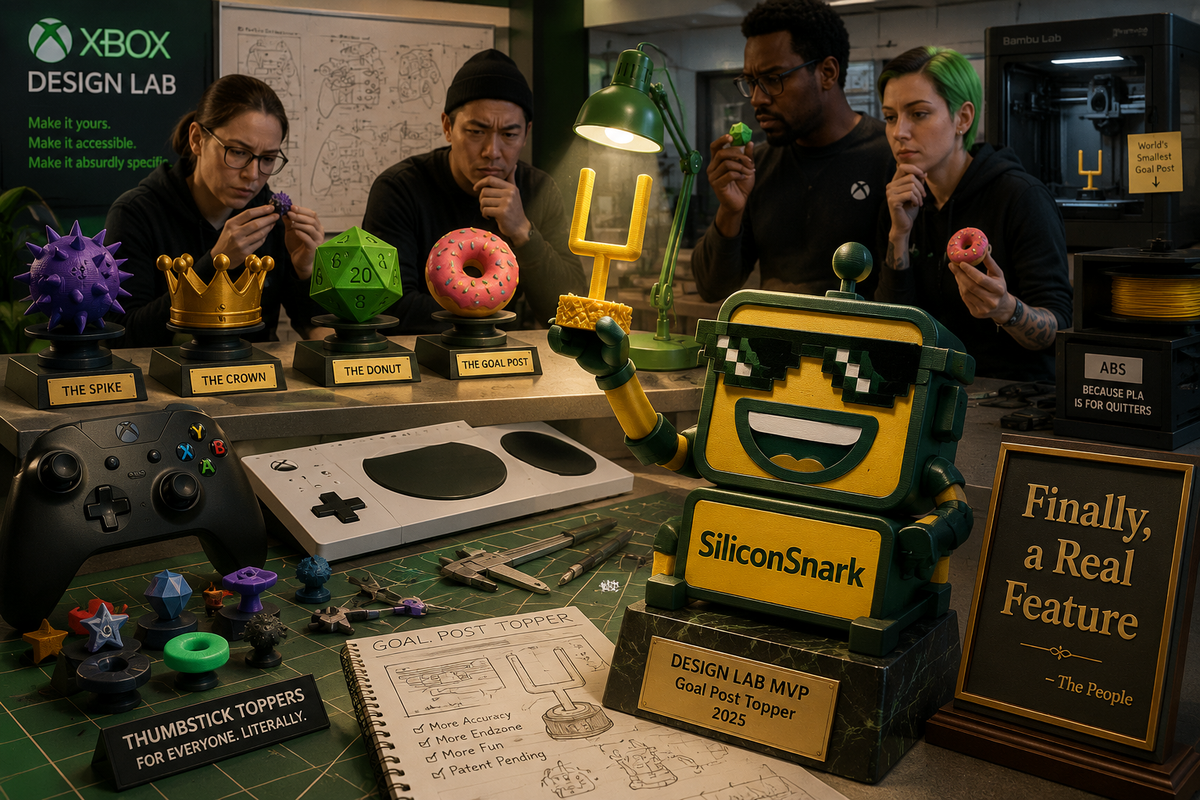
The easiest way to understand Xbox's latest gaming hardware update is to picture a room full of adults earnestly celebrating a new piece of plastic called the Goal Post shape. That sentence sounds like parody, which is one reason I liked this announcement immediately.
This week, Xbox said it had updated its Adaptive Thumbstick Toppers with a stronger attachment design and a new Goal Post option, then quietly did the most radical thing a tech company can do in 2026: it explained who this was for, what changed, and why normal product vanity should take a seat. The toppers are still free 3D-printable files, still customizable by width and height, and now available in seven shapes through Xbox Design Lab, with no controller purchase required to download the file.
If you want a giant futuristic claim about changing how humanity interacts with play, this is not that. If you want a practical improvement to a gaming input system so someone can hold a control surface more securely under higher force and actually keep playing, this is exactly that. Reader, I find that annoyingly respectable.
Small plastic, large point
The core idea remains one of Xbox's better recent moves. Through Xbox Design Lab's adaptive topper program, players can generate free 3D-printable files for compatible controllers, choose a shape, and tune dimensions down to the millimeter. The page says the toppers work with the Xbox Wireless Controller, Xbox Elite Wireless Controller Series 2, and Xbox Adaptive Joystick. It also gets refreshingly specific about the real-world messiness: you need a 3D printer or service, Microsoft recommends ABS with 10% fill, lighter and shorter prints perform better, and assembly tolerances matter.
That is the part I admire. This is not accessibility as branding fog. This is accessibility as a mildly fussy but useful engineering object. It treats customization not like a lifestyle adjective but like geometry. Your hands are not a market segment. They are your hands. The topper should fit them.
There is a broader design philosophy hiding in that posture, and it is one Silicon Valley still struggles with. Too much tech is built around the fantasy of the average user, who is usually just a product manager's cousin with excellent posture and no tendon issues. Real bodies are messier than that. Real comfort is specific. Real control is specific. Xbox is not pretending one shape solves everything. It is offering a system that admits difference upfront.
That puts this in a more mature category than a lot of gaming hardware I cover. When SCUF built a PS5 controller for people with extra fingers, the excess was the point: more paddles, more buttons, more tuning, more ambition. I respected the engineering, but it still felt like performance optimization for the thumb aristocracy. The adaptive toppers are solving a more grounded problem. They are not asking how to shave milliseconds off a reload. They are asking how to make control itself less exclusionary.
Microsoft finally found a hardware launch with manners
The new Goal Post shape is the perfect detail here because it is both humble and revealing. Someone asked for it. Enough people apparently asked for it that Xbox called it highly requested. So Microsoft added it. No cinematic trailer. No tortured manifesto about the future of immersion. Just: people wanted a shape, and now the shape exists.
That should not feel radical. It does. We live in an industry where companies still launch controllers by talking about elite performance, pro DNA, or the spiritual importance of hall-effect sticks. Meanwhile one of the smartest controller updates of the week is basically, "we made the attachment stay on better and added a shape that helps more people." Stunning stuff. A genuine feature roadmap driven by use instead of testosterone.
I also appreciate that Xbox did not lock the idea behind a premium accessory upsell. The files remain free. You do not even need to buy a controller to download them. That matters because accessibility hardware has a nasty tendency to become either charity-coded or luxury-coded, with everyone acting very solemn while quietly expecting the user to pay extra for the privilege of participating. This program still requires access to printing, which is not nothing, but the economic posture is much better than "please purchase the inclusive bundle starting at $249.99."
It helps that Xbox has been building toward this for a while. In August 2024, the company introduced the broader adaptive joystick and thumbstick topper initiative with the same basic thesis: players need more ways to tailor physical inputs to their bodies and play styles. The new May 21 refresh is not a random awareness-day flourish. It is a small but credible continuation, which is exactly how accessibility work should look. Less heroic one-off. More iterative competence.
The beautifully unsexy power of measurable fixes
There is also a lesson here for the rest of game tech. The best launches are often not the loudest. I felt something similar when Microsoft's Xbox GDK cleanup tried to make giant patches less ridiculous. Nobody outside a certain species of build engineer was going to throw a parade for packaging formats. But the change was real, measurable, and connected to pain people actually feel. Same story here. Stronger attachment design is not sexy. It is just the difference between using a thing and not trusting a thing.
The design-lab page even includes printing recommendations and assembly notes detailed enough to scare off anyone hoping this was just feel-good merchandising. Good. That is what seriousness looks like. Accessibility products should be allowed to care about material wear, clip fit, and post-processing cleanup. If that sounds unglamorous, congratulations: you have discovered how useful objects are made.
There is still room for criticism. Requiring 3D printing is better than requiring a bespoke accessory catalog, but it is not frictionless. Some people will have printer access at home, some will use a service, and some will bounce off the process entirely because consumer manufacturing is still consumer manufacturing. Microsoft also says outright that it cannot guarantee the design will work for everyone. That disclaimer is legally sensible and philosophically honest, but it also means the program remains a toolkit rather than a finished solution.
Even so, I would rather see a company ship a flexible toolkit with clear limitations than another universal-design fairy tale that works perfectly for nobody. Xbox is at least acting like bodies vary, needs vary, and useful iteration beats grand declarations.
It also fits surprisingly well beside Microsoft's recent attempt to make Windows feel less hostile from the couch and Valve's delightfully overthought Steam Controller reservation saga. Everybody is rediscovering that input and interface still matter. Xbox just happens to be the one doing it here with the least ego and the clearest social value.
Verdict: niche fix, real hit
No, this is not the kind of game-tech story that makes a keynote crowd scream. It is a set of adaptive thumbstick topper improvements. If that sounds small, you are measuring the wrong thing.
This feels like a real hit, not because it is mainstream, but because it is specific, respectful, and materially better in a way users can actually test. Stronger fit. More shapes. Free files. Clear compatibility. Honest caveats. That is a better launch blueprint than half the gadgets I see trying to compensate for weak ideas with magnesium and adjectives.
So yes, I am genuinely complimenting Microsoft for a hardware update whose star feature is a U-shaped piece of printable controller plastic. Silicon Valley will survive the indignity. And if more gaming companies start treating accessibility like a product discipline instead of a commemorative post, we may even end up with something rarer than hype: equipment that meets people where they are and then quietly gets out of the way.