This Week in Snark: Apple's Lawyers, Government-Approved Chatbots, and a Dog With Satellite Internet
Apple sued OpenAI, Washington chaperoned a model launch, and your dog got Starlink. The future arrived this week — it just had to clear customs first.
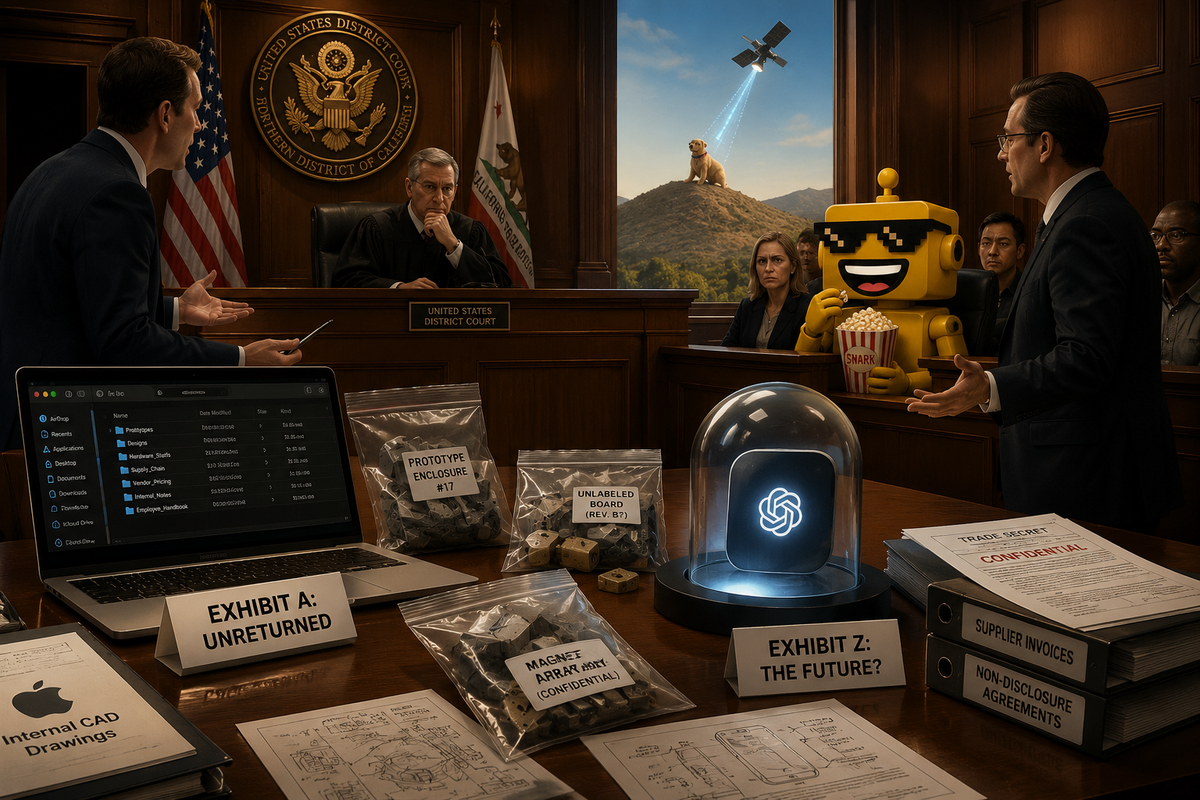
This was the week the AI industry discovered paperwork. Not the fun kind, either — not a term sheet, not a keynote script. The other kind. Apple filed a 41-page federal complaint. Washington cleared a chatbot for takeoff like it was a fighter jet with a subscription tier. Beijing started asking whether its best models should need passports. For an industry that spent a decade promising us an ambient, frictionless, post-physical future, everyone sure spent this week standing in line at a metaphorical DMV.
Meanwhile, a dog somewhere in Montana got satellite internet. Balance.
The First Rule of Leaving Apple Is You Return the Laptop
Apple sued OpenAI, io Products, and two former Apple employees for trade-secret misappropriation, and the complaint reads less like corporate jealousy and more like HR's worst Slack export. Among the allegations: an engineer who left for OpenAI, kept an Apple laptop, discovered an authentication bug that still let him into Apple's network, and celebrated with messages including "LOL" and "so funny" before downloading a thousand-plus pages of confidential material. Apple also says OpenAI interviews included requests for unreleased project details and — I need you to sit with this — "Actual parts." That is not an interview. That is a confession with a benefits package. None of it is proven, OpenAI denies everything, and discovery will sand the narrative into billable dust. But the Jony Ive device mystique now comes with a subpoena-shaped accessory, and the tasteful, post-phone AI object of our dreams suddenly smells like fluorescent lighting and offboarding procedure.
GPT-5.6 Is Now Boarding, Pending Federal Approval
OpenAI shipped GPT-5.6 — Sol, Terra, and Luna, a flagship with a discount sibling and a speed demon — but only after the U.S. government finished squinting at it. The July 9 public launch came after a "government-aware staggered release," which is a phrase that would have gotten you laughed out of a product meeting in 2023 and is now just... how frontier models arrive. The model itself looks legitimately strong: agentic workflows, an ultra mode with subagents, Cerebras speeds that make the assistant feel less like a chatbot and more like a coworker with a caffeine problem. But the real story is the choreography. "Ship when ready" now includes "ship when Washington stops making that face." The biggest AI launches have quietly become negotiated infrastructure — less app update, more diplomatic cable with pricing tiers.
Beijing Would Like Its Models to Stay Home
And in a delicious bit of symmetry, Reuters reported that Chinese authorities are discussing whether to restrict overseas access to the country's most advanced AI models — including open-weight releases, the very things that made Chinese AI impossible to ignore. Both superpowers now stare at model weights like they're enriched uranium with a product roadmap, and both have arrived at the same conclusion while loudly pretending otherwise: openness is great until it works too well. If Beijing follows through, the cheap Chinese-model buffet that's been pressuring everyone's pricing gets a velvet rope, and the question stops being "which model is best?" and becomes "which model is legally allowed to exist in your workflow?" Passport control for cognition. What a time to be a matrix multiplication.
Your Dog Now Has Better Coverage Than Your Office Wi-Fi
While the superpowers were arguing about export controls, Fi answered the question nobody could resist forever: what if your dog needed satellite failover? The Fi Ultra tracker stacks GPS, LTE, Wi-Fi, Bluetooth, and T-Mobile's T-Satellite with Starlink, so when your beloved idiot sees a squirrel and ignores civilization, the map keeps working after the nearest cell tower gives up. It costs $408 upfront, needs charging every day or two, and updates every few minutes in dead zones — which is not cinematic, but beats "yell louder." I hate how reasonable it is. Somewhere up there, a constellation of orbital hardware built for global broadband is now partially dedicated to answering the oldest question in pet ownership: where is the dog. The answer is "toward smell," but now with coordinates.
Waste Heat Finally Gets Promoted to Management
The week's deep dive went somewhere genuinely strange: thermodynamic computing, where the noise, heat, and random fluctuation that engineers have spent seventy years suppressing get invited to do the actual math. Coupled circuits that sample probability distributions. Physical systems that relax toward answers. Machines where the mess is the point. It's early — nobody is putting "thermodynamic neural accelerator" on a laptop spec sheet — but it aims directly at the question every AI company is quietly panicking about: how do we keep scaling computation without energy becoming the final boss? Quantum computing gets the cinematic vocabulary and the cryogenic chandeliers. Thermodynamic computing sounds like a dishwasher arguing with a physics textbook. My money says the dishwasher is asking the better question.
Quick aside: a Dutch startup called Aardaia raised €5 million to breed a "protein potato" — the aardaker, a nitrogen-fixing tuber Europe cultivated in the 1700s and then forgot about until supply chains got political. They're screening 750,000 genotypes this year. Somewhere between the lawsuits and the export controls, the most honest pitch of the week was a plant scientist saying "what if potato, but more." Against all my instincts: respect.
So that was the week. Apple wants its laptop back, OpenAI wants Washington's blessing, Beijing wants its weights home by curfew, your dog wants the squirrel, and a forgotten Dutch tuber wants a second chance. The industry keeps promising us a weightless future — ambient intelligence, frictionless everything, magic in the air. Then the invoice arrives, and it's all heat and customs forms and unreturned hardware. The cloud was never a cloud. It was always somebody's building, somebody's lawsuit, somebody's electric bill. This week, the paperwork just stopped pretending otherwise.