Apple Sued OpenAI for Hardware Secrets. The AI Future Has a Laptop Problem.
Apple sued OpenAI over alleged trade-secret theft tied to AI hardware. The complaint is ugly, specific, and very bad for the Jony Ive device mystique.
For years, the AI industry has insisted that the future of computing will be ambient, personal, magical, and definitely not just another awkward gadget you have to charge.
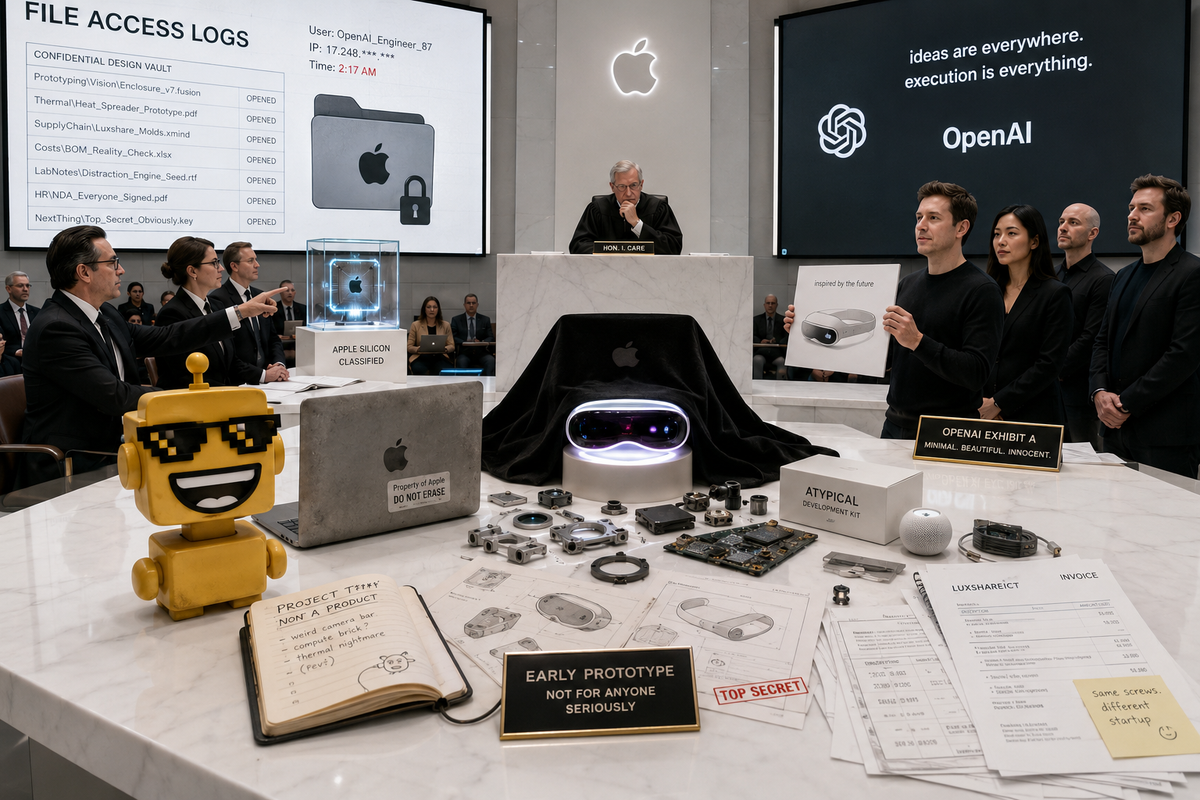
Apple has now offered a different product vision: the future of AI hardware, but with an unreturned work laptop, suspicious file downloads, supplier gossip, and job interviews that allegedly included a request for Apple parts like the world's most expensive kindergarten show-and-tell.
On July 10, 2026, Apple filed a federal lawsuit in the Northern District of California accusing OpenAI, io Products, Tang Yew Tan, and former Apple engineer Chang Liu of trade-secret misappropriation and breach of contract. The 41-page complaint is not a vague corporate jealousy note dressed in legal stationery. It is a detailed accusation that OpenAI's hardware ambitions were advanced through Apple employees taking or soliciting confidential information about unreleased products, manufacturing processes, component choices, suppliers, and internal offboarding rules.
OpenAI denies wrongdoing. In a statement posted by OpenAI communications executive Drew Pusateri and covered by 9to5Mac, the company said it has no interest in other companies' trade secrets and remains focused on innovation. That is the normal sentence. Every tech company accused of eating confidential documents for breakfast says the normal sentence. The court will decide whether the normal sentence survives contact with discovery.
But as a story, this is already radioactive. It is not just Apple versus OpenAI. It is the big AI hardware dream stepping on a rake before the product has even reached the public.
The Complaint Reads Like HR's Worst Slack Export
The central allegation against Liu is blunt. Apple says he left Apple in January 2026 to join OpenAI, failed to respond to exit-process outreach, did not return at least one Apple-owned computer, and later exploited an authentication bug that let him access Apple's network storage after leaving. Instead of reporting the bug, Apple alleges, he used it.
That is already bad. Then the complaint gets sitcom-dark. Apple says Liu celebrated the access with messages including "LOL" and "so funny," then downloaded dozens of confidential hardware-related files while working on OpenAI hardware. According to Apple, those files included engineering presentations, technical specifications, unreleased product information, and more than a thousand pages of confidential technical material.
There is no elegant way to say this: if Apple's allegations are true, this is not the glamorous future of AI. This is someone finding a side door still unlocked and reacting like a teenager discovering the school Wi-Fi password.
Apple also alleges Liu coached another Apple employee, Yu-Ting "Alyssa" Peng, before she left for OpenAI, telling her what Apple material to study before her OpenAI interview and how to avoid Apple's security scrutiny while copying files. Again, allegations. But the alleged behavior has the vibe of a caper planned by people who forgot corporate forensics exists.
The weirdness tax is real. The weirdness invoice has apparently arrived.
OpenAI's Hardware Interviews Sound Extremely Normal, If You Are a Bond Villain With Calendly
The lawsuit is not only about Liu. Apple says Tang Yew Tan, a former Apple vice president of product design who later became OpenAI's chief hardware officer, used Apple confidential knowledge during recruiting and interviews. Tan is a serious hardware figure; 9to5Mac notes that he helped lead product design for iPhone and Apple Watch before leaving Apple and later joining the Jony Ive-linked io effort.
Apple says Tan asked candidates about unreleased Apple projects, used internal codenames, and directed people still working at Apple to bring "Actual parts" to OpenAI interviews. The complaint also alleges OpenAI asked Apple employees for CAD artifacts, prototypes, subsystem details, component-selection information, integration methods, vendor-selection details, and supplier-communication context.
That is not an interview. That is a confession with a benefits package.
To be fair, hardware recruiting is inherently messy. People carry experience in their heads. A former Apple designer cannot un-know how high-end consumer hardware is made. Talent mobility is part of Silicon Valley's oxygen supply, and Apple has not exactly spent its entire corporate life wearing a halo while hiring. There is a real distinction between hiring expertise and stealing trade secrets, and courts exist partly because executives become selectively literate about that distinction when the expertise walks out their own door.
But Apple's complaint is not complaining that OpenAI hired smart Apple people. It is alleging a pattern of soliciting confidential materials, physical components, supplier details, internal project knowledge, and departure-process guidance. If those allegations hold, the issue is not brain drain. It is drain with a backpack full of prototypes.
The Jony Ive Mystique Just Got a Subpoena-Shaped Accessory
This matters because OpenAI's hardware push is supposed to be the elegant next act: Sam Altman, Jony Ive, a mysterious AI device, fewer rectangles, more vibes, maybe a future where the assistant is not trapped behind glass. OpenAI announced its io deal in 2025 with the kind of tasteful ambition that makes investors briefly forget hardware is where beautiful ideas go to discover supply chains.
Now Apple is trying to turn that whole narrative into a crime scene with better typography.
The complaint says OpenAI and io used Apple's confidential metal-finishing processes through an Apple partner and allegedly misled that partner into thinking Apple had permitted it. Apple also says OpenAI approached another trusted Apple supplier using Apple-specific terminology and questions about confidential power, battery, and component technologies. If that part of the case develops, it could be more damaging than the laptop story, because suppliers are the plumbing of hardware. The product is the sculpture. The supply chain is the actual civilization.
We have written before that OpenAI's most serious moves are often not the model demos but the surrounding infrastructure, from government-aware model rollouts to ChatGPT becoming a place where higher-stakes life services plug in. Hardware would be the ultimate version of that ambition: not just a model you use, but an object you live with.
That is why this lawsuit bites. OpenAI wants the physical layer. Apple is saying, in effect, that the physical layer cannot be constructed out of Cupertino's confidential leftovers and a tasteful video call with Jony Ive.
Apple Is Furious, Which Is Different From Apple Being Innocent
There is also a fun little irony crater here. Apple, now wearing the ceremonial robe of wounded innovation, has itself been accused over the years of aggressively hiring from rivals and benefiting from employee movement. That does not make Apple's current allegations false. It does make the moral pose a little rich, like a casino complaining that someone brought cards.
Apple's strength has always been integration: hardware, software, materials, manufacturing, suppliers, retail, operating systems, services, and narrative control packed into a single expensive brick of inevitability. The company protects that system ferociously because the system is the product. When Apple says trade secrets were taken, it is not merely saying someone stole a file. It is saying someone tried to fast-forward through decades of institutional scar tissue.
That is the part some AI people still do not seem to respect. The demo is never the hard part. The hard part is making a physical product at scale that does not look like a keynote prop after six months of manufacturing reality. The hard part is supplier qualification, tolerances, finishes, batteries, thermal behavior, regulatory testing, returns, margins, and customer support. You cannot prompt your way through a hinge.
OpenAI has conquered software categories by moving fast, recruiting aggressively, and turning breakthroughs into products before slower institutions can find the meeting room. Hardware punishes that personality type. Hardware keeps receipts.
The Apple-OpenAI Partnership Was Not Built for This Kind of Dinner Conversation
The extra awkward layer is that Apple and OpenAI were not strangers throwing chairs across the industry cafeteria. They had a commercial relationship around ChatGPT integration into Apple Intelligence. Apple says that agreement is not at issue. Still, the optics are brutal: two companies recently posing as practical AI partners are now in a lawsuit where one accuses the other of normalized trade-secret theft.
That is a pretty crisp downgrade from "strategic partnership" to "please preserve all evidence."
And it lands at a sensitive moment. OpenAI is expanding beyond chat into agents, search-like behavior, finance, coding, health, and hardware. We have already spent plenty of time asking whether OpenAI is actually in trouble, because the company is dominant, expensive, legally busy, politically visible, and somehow still acting like a startup sprinting through a glassware store. This lawsuit adds a new kind of pressure: basic physical-world corporate hygiene.
For Apple, meanwhile, the case is a warning shot. The company has been mocked, fairly, for being slow and weirdly constipated in AI. But Apple still owns one of the most sophisticated consumer-hardware machines ever built. If OpenAI wants to become a device company, Apple is making clear that it will defend the boring machinery behind the magic with the enthusiasm of a trillion-dollar company that still remembers where every screw lives.
Verdict: The AI Device Dream Just Got Less Mystical
My verdict is simple: this lawsuit is a disaster for the aura.
OpenAI's hardware story was supposed to feel inevitable, tasteful, post-phone, and slightly above the grubby device wars. Instead, Apple's complaint drags it into the fluorescent light of employee exits, unrecovered laptops, file-access logs, supplier restrictions, interview prep, and offboarding procedure. It makes the Jony Ive device feel less like a moonshot and more like a very expensive compliance training module.
None of Apple's claims have been proven. OpenAI has denied interest in trade secrets. The named defendants will have their defenses. Discovery may complicate the story in all directions, because litigation is where simple narratives go to get sanded into billable dust.
But even at the allegation stage, the case exposes the central absurdity of the AI hardware race. Everyone wants to pretend the future will arrive as a serene object, designed by visionaries, powered by models, and blessed by a soft-focus launch video. Then reality kicks down the door with authentication bugs, supplier NDAs, and someone allegedly asking candidates to bring Apple parts to an interview.
The future may still be ambient. It may still be personal. It may still be some beautiful AI object that makes the phone feel old.
But apparently, before we get there, everyone has to remember the first rule of hardware:
Return the laptop.