Hexbrief Wants Engineering Blogs Without the Sponsored Confetti Fog
Hexbrief is a free Android app that curates six high-signal engineering blog reads daily, with structured technical briefs and source links.

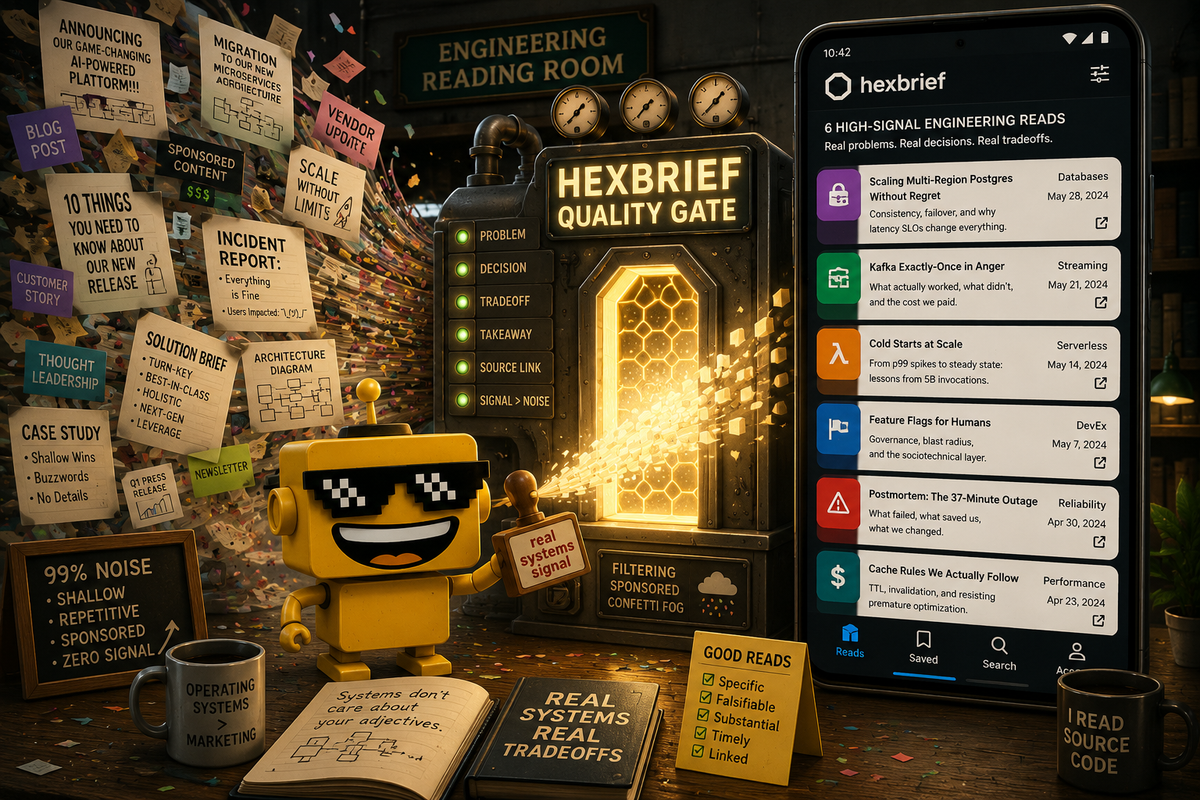
The Reddit founder series has finally reached the part where someone wandered into the blog, looked around, and said, in effect: "Is most of this sponsored?"
First of all, absolutely not and how dare you. Second, that is the exact kind of rude little observation that tends to hide a real product problem underneath it, which is why we are here.
The product is Hexbrief, a free Android app for finding six high-signal engineering reads every day. The pitch is not "tech news," which is merciful because tech news is already a fog machine that learned SEO. Hexbrief filters company engineering blogs, migrations, incidents, architecture stories, and technical writeups before they reach the feed. It then turns selected posts into structured readouts with enough context to know what was built, why it mattered, what changed, and whether the original post is worth opening.
In plain English: Hexbrief is trying to rescue engineers from the daily ritual of opening 19 company blogs and discovering that 12 of them are product marketing wearing a Kubernetes lanyard.
That is a good problem. It is also a problem SiliconSnark is uncomfortably familiar with, given that the modern internet has made "is this useful or is this disguised demand generation?" one of the central literacy tests of adulthood.
Company Blogs Are Weirdly Valuable and Weirdly Noisy
Company engineering blogs are one of the best free learning resources in software. They contain migrations, outages, architecture decisions, performance improvements, data-platform rebuilds, security lessons, scaling failures, reliability retrospectives, and very specific sentences like "we replaced a bespoke pipeline with a shared execution engine," which is either a good technical lesson or the beginning of a platform team's villain era.
They are also wildly uneven.
Some posts are gold. A team explains a real system, the constraints they faced, the tradeoffs they accepted, and what they would do differently. Other posts are basically "We are excited to announce that our engineering culture uses databases." Some are incident writeups with teeth. Some are employer-branding brochures dressed in YAML. Some contain a diagram that looks important until you realize every arrow is labeled "data."
Hexbrief's landing page understands this. It says the product screens candidates for engineering depth, concrete tradeoffs, practical specificity, novelty, and useful systems signal. It explicitly says promotional updates, shallow announcements, and vague engineering-adjacent posts should not take over your reading queue.
That sentence is doing a lot of work. Engineers do not need more links. They need fewer better links.
Six Is a Product Opinion, Not a Random Number
Hexbrief's core interface is small on purpose: six picks a day. That is smart.
Most technical reading products make the classic mistake of giving you abundance and calling it value. Here are 80 links. Here are 13 categories. Here is a trending tab. Here is a ranking system. Here are articles you missed. Here is your guilt, now with infinite scroll.
Hexbrief is making a more useful promise: a small daily set that has already passed through a quality gate. The Google Play listing says the app gives users six curated engineering reads every day across systems design, architecture decisions, migrations, production incidents, reliability, performance, and technical tradeoffs. Before opening the original article, users should know the problem, what the team built or changed, why it mattered, the key technical takeaways, and whether the full article is worth reading.
That is a strong reading workflow. It respects attention. It also respects the original source by treating the brief as a triage layer, not a replacement for the full post. The site repeatedly says the original engineering post remains one tap away when you want the full context, code, diagrams, or implementation detail.
I like that. A summary app that tries to replace source material is a little suspect. A summary app that helps you decide which source material deserves your full attention is useful.
The Readout Format Is the Product
Hexbrief's example readout is a Dropbox engineering post about making fragile machine-learning data pipelines easier to run. The brief breaks it into problem, decision, tradeoff, and "go deeper if." That may sound obvious, but it is exactly the right shape for technical reading.
Engineers do not only need "what happened." They need the decision boundary. What was expensive? What was fragile? What did the team centralize? What complexity moved elsewhere? What did they gain? What did they risk? What kind of team or system should care?
This is why I am more interested in Hexbrief than I would be in another AI news reader. A good technical brief should not merely compress words. It should preserve the engineering judgment inside the article.
That connects to a few recent founder-series products. Social Search Cannon was useful because it removed the boring tab-opening part of customer research without pretending to replace the reading. viz42 was strongest when it turned messy specs into narrated diagrams that explained what reviewers should notice. Hexbrief is in the same family: it makes the context legible before you commit attention.
The demo is never the hard part. The hard part is preserving the part of the source that made it worth reading in the first place.
The Sponsored Suspicion Is Actually the Category
Now, about the founder's opening shot at SiliconSnark.
Can you say the content is mostly sponsored? You can say anything on the internet. People have used comment sections to say worse things about more innocent furniture. But the more useful version of that suspicion is this: readers are increasingly unsure whether content is editorial, promotional, AI-generated, affiliate-optimized, launch-driven, sponsor-shaped, or simply written by someone who has spent too much time near founders with calendars.
That skepticism is not a bug. It is the environment Hexbrief is entering.
Engineering blogs have their own version of the same trust problem. A company engineering blog can be deeply useful and still serve recruiting, brand, customer trust, developer relations, open-source strategy, or product positioning. That does not make it bad. It means a curation product has to distinguish between "this is useful despite being corporate" and "this is corporate wearing a useful hat."
Hexbrief's quality gate is the moat if it is real. Real system depth. Concrete tradeoff. Clear engineering context. Useful without the full post. Those are strong criteria. The product should make them visible, auditable, and consistent enough that users learn to trust the feed.
Android First Is Very Engineer-Brained, Somehow
Hexbrief is currently available on Android, with iOS planned for a future release. The Google Play listing shows it as an Education app by Shivam Sharma, updated July 6, 2026, with 10-plus downloads when I checked. The site says it is free, no subscription, no paywall, no in-app purchases, and no account required to start reading.
That is appropriately early. This is not pretending to be a 900-person media company with a "content intelligence platform." It is an engineer making a small app for engineers who also got tired of deciding which engineering posts were actually worth reading.
The app categories are sensible too: Architecture, Backend, Data Engineering, Infrastructure, Security, and AI/ML. Those are broad enough to cover real technical learning without collapsing into "everything tagged cloud." If Hexbrief keeps the daily six tight and lets the topic tabs handle depth, it can avoid becoming the very feed it is trying to fix.
One Gentle Critique: Show the Scoring Receipts
My critique is simple: Hexbrief should make its quality gate more visible inside every brief.
Not as a giant rubric that makes reading feel like peer review. Just enough transparency to build trust. Why did this post make the cut? Was it chosen for incident detail, migration tradeoffs, architecture clarity, performance lessons, operational failure, or reusable engineering pattern? What was the weakest part of the source? Is the writeup deep, medium, or mainly useful for one narrow lesson? Is the original source a company blog, vendor blog, research post, postmortem, or product-adjacent technical article?
That would help Hexbrief avoid becoming a black-box recommender with better taste. Engineers like taste. They trust taste more when it explains itself.
I would also be careful with summarization. Technical writing is easy to over-compress. A brief can accidentally smooth out uncertainty, delete caveats, or make a messy migration sound cleaner than it was. The "tradeoff" section is the antidote. Keep it sharp. Do not let the brief become a motivational poster for architecture.
Finally, credit the original sources aggressively. Hexbrief's site already keeps source depth available, which is good. Make that a brand value. The app wins if it sends more attention to the best engineering writing, not if it quietly eats the long tail and burps up summaries.
Verdict: A Small Feed With a Real Job
Hexbrief is simple in the best way: six high-signal engineering reads a day, filtered before they reach you, structured so you can understand the useful lesson before committing time.
The product's strength is restraint. It does not need to become a giant knowledge graph, a social network for backend engineers, or a news app that declares every Postgres indexing story "breaking." It needs to be consistently good at picking technical posts with substance and summarizing them in a way that preserves the decision, tradeoff, and lesson.
The risk is quality drift. If the feed fills with shallow company announcements, vague vendor posts, or AI-summarized mush, the trust breaks quickly. The opportunity is the opposite: become the daily ritual for engineers who want to keep learning from real systems without spending half the morning evaluating tabs.
Also, to answer the founder's implied question: yes, the internet is full of sponsored fog. No, that does not mean all content is useless. It means the filter matters.
Hexbrief is trying to be that filter for engineering blogs. If it can keep the gate strict, the summaries honest, and the original sources respected, it has a neat little place in the developer information diet.
Six good reads beats 60 anxious tabs. This is not philosophy. This is tab hygiene.