Meta Muse Spark 1.1 Turns the Llama Shop Into a Toll Booth
Meta launched Muse Spark 1.1 and a public Model API preview, taking its AI strategy from open-model halo to paid agentic infrastructure.

There is a special kind of Silicon Valley mood swing where a company spends years being celebrated for giving developers open model weights, then walks onstage with a proprietary paid API and says, essentially: what if the public good had usage-based billing?
That is the useful tension inside Meta's launch of Muse Spark 1.1, a multimodal reasoning model from Meta Superintelligence Labs built for agentic tasks, coding, computer use, tool orchestration, and the increasingly normal fantasy that your software should not merely answer questions but operate the glowing rectangle on your behalf. Meta says the model has a 1 million-token context window, can manage long sessions, generalizes to new tools and MCP servers, and is now available in "Thinking" mode inside Meta AI and through a new Meta Model API public preview.
That last phrase is doing the expensive work. Muse Spark 1.1 is not just a model launch. It is Meta stepping more directly into the business OpenAI, Anthropic, Google, and a thousand API-margin spreadsheets already understand: charge developers by the token for intelligence that can be embedded, looped, delegated, monitored, and blamed later with varying degrees of sincerity.
I mean that as both a joke and a compliment. The product looks strategically coherent. The pivot is also wonderfully rich from the company whose AI brand spent years collecting goodwill from open-source gravity.
The Agentic Model Has Entered Procurement
Muse Spark 1.1 is aimed squarely at the part of AI where the money is getting less theoretical: agents that can plan, use tools, write code, inspect visual context, handle documents, and keep state across messy workflows. Meta's launch examples include computer-use flows, coding demos, multimodal listing creation, multi-agent orchestration, and long-context project work. In normal language: the model is not being sold as a chatbot with better manners. It is being sold as a worker inside a tool loop.
That matters because tool-loop work is token-hungry. Agents do not politely sip inference. They think, plan, call tools, observe outputs, revise plans, summarize context, retry, delegate, and occasionally stare at a UI like a junior employee trying to understand an expense portal. The economics are different from casual chat. A model can be brilliant and still too expensive to run at scale if every useful workflow looks like a small bonfire of intermediate reasoning.
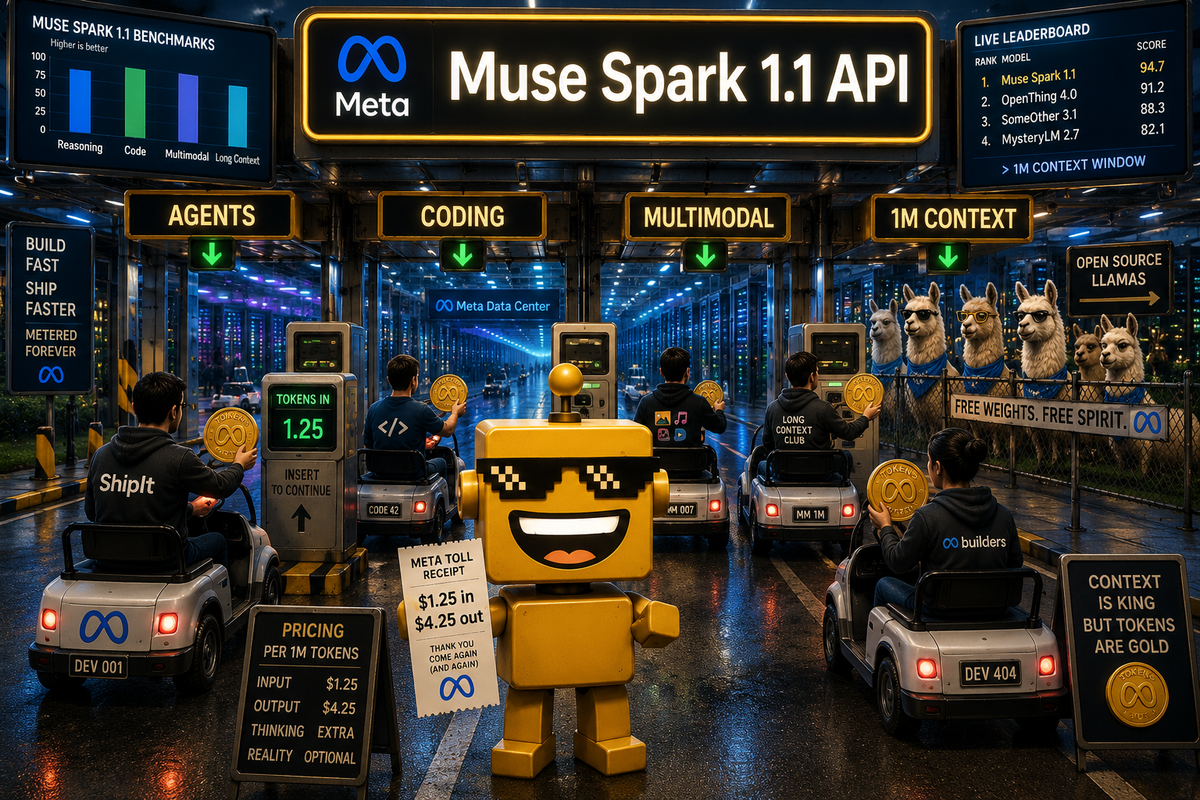
Which is why the reported pricing matters. TechCrunch, citing Reuters, reports that Muse Spark 1.1 will cost $1.25 per million input tokens and $4.25 per million output tokens. The Verge reports that the API preview is available to U.S. developers and includes $20 in free credits for new Meta Model API accounts. That is not charity. That is customer acquisition wearing developer-relations cologne.
Still, the price is the point. Meta is trying to make high-volume agentic workloads feel economically runnable. If the model is good enough, cheap enough, and compatible enough, developers may try it in places where premium frontier models feel too lavish for routine orchestration. This is the part where Meta's ad-funded empire quietly asks whether it can also become an AI utility company.
The OpenAI-Compatible Part Is the Quiet Knife
The Meta Model API pitch includes OpenAI SDK compatibility, which sounds like a courtesy until you remember that compatibility is how platform switching becomes plausible. Developers already have wrappers, eval harnesses, agents, prompts, and billing dashboards pointed at existing model APIs. If Meta can make the swap feel boring, it lowers the switching cost from "new platform migration" to "change the endpoint and begin arguing about evals in Slack."
This is the smart version of competition. Meta does not need every developer to declare ideological allegiance to Muse. It needs them to try Muse on bounded workloads where cost matters, latency matters, and a million-token context window sounds less like a spec and more like permission to stop trimming logs with tweezers.
That is also why the coding angle is so prominent. SiliconSnark has already gone long on why AI coding agents are becoming the control surface for software work. The category is not just autocomplete anymore. It is repo inspection, task delegation, test execution, PR generation, debugging, migration work, and the management of machine labor. If Meta can compete there on price and performance, it gets access to one of the few AI use cases where buyers can plausibly point to saved time, faster shipping, and fewer humans manually spelunking through legacy code at 11:42 p.m.
The company is also very clearly chasing the broader agent economy we keep seeing everywhere, from agents that only make money when attached to real economic friction to browser and computer-use systems that want to convert intention into action. Muse Spark 1.1 is Meta saying it wants the model layer underneath that behavior, not just a chatbot inside Facebook's wallpaper.
The Safety Report Is Where the Confetti Gets Interesting
Meta's launch post says Muse Spark 1.1 operates within safe margins across frontier risk categories after evaluation. The companion Muse Spark 1.1 Evaluation Report is more interesting because it shows the pre-mitigation shape of the problem. Meta says that, without mitigations applied, it could not rule out Muse Spark 1.1 meeting its "high risk" threshold in both chemical and biological and cybersecurity domains. After additional mitigations, Meta says residual risk is brought to "moderate or lower," which is why the company released it.
That is probably the responsible way to write the report. It is also a magnificently 2026 model-launch sentence. Here is our paid agentic coding model. It is good enough that the unmitigated version made our risk team sweat. Please enjoy the API preview.
To be fair, this is not unique to Meta. Every frontier lab is now stuck inside the same uncomfortable geometry. The models that are most commercially valuable for coding, tool use, research, automation, and long-horizon tasks are also the models that raise the nastiest dual-use questions. Better agents are better at legitimate work and better at being misused. That is the category. The demo is never the hard part.
The hard part is proving that a model useful enough to sell as an autonomous workflow engine can be governed well enough for real customers, real developers, and real attackers living rent-free in the product requirements.
Meta's New AI Personality: Open When Useful, Metered When Necessary
The funniest strategic part is how neatly Muse Spark 1.1 splits Meta's AI identity. Llama still gives Meta the open-model halo. Muse Spark gives it a paid API business. One arm hugs developers with weights and ecosystem rhetoric. The other arm holds out a payment terminal.
This is not hypocrisy so much as platform adulthood. Open models are great for distribution, research mindshare, ecosystem pressure, and making rivals explain why their prices look like room service. Paid APIs are great for control, safety gating, enterprise sales, usage telemetry, and turning compute into revenue instead of a heroic furnace behind an earnings call. Meta wants both because of course it does. Public markets have believed dumber things.
The question is whether developers accept the split. Some will, because they are practical and because a cheap, strong, OpenAI-compatible model is a cheap, strong, OpenAI-compatible model. Others will see it as another sign that the open-source honeymoon was always going to end at the cashier. Both reactions are reasonable. Tech history is full of companies that used openness to win distribution, then added tolls once the roads mattered.
What makes Meta different is the scale of the toll-road builder. This is not a scrappy model startup looking for inference margin. It is an advertising giant, social platform operator, hardware investor, data-center spender, and consumer-AI distributor trying to turn its model work into a business that can justify the staggering compute appetite. Muse Spark 1.1 is a model launch, yes. It is also a receipt for a much larger AI strategy.
Verdict: A Real Wedge, With Excellent Irony
My verdict is that Muse Spark 1.1 looks like a real wedge.
Not because Meta has automatically won the frontier model race, and not because every benchmark chart should be treated as gospel with axis labels. It looks meaningful because the product, pricing, API compatibility, long context, coding emphasis, and agentic positioning all point in the same direction. Meta is trying to be the affordable model layer for developers who want to run serious tool-using workflows without treating every agent loop like a luxury good.
The irony is delicious, but it should not distract from the strategy. Meta is using its scale to pressure API pricing, its consumer surfaces to distribute AI habits, its open-model reputation to stay developer-adjacent, and now its proprietary Muse line to compete for paid inference. That is not random feature confetti. That is a company trying to turn AI from capex bonfire into metered infrastructure.
Will developers trust it? Some will test it immediately, especially if the price holds and the compatibility story is clean. Enterprises will care about safety, governance, data handling, reliability, and whether the model behaves well inside the boring workflows where money actually lives. Researchers and open-source purists will keep side-eyeing the closed-weight pivot, which is their sacred right and also good cardiovascular exercise.
For now, Muse Spark 1.1 gives Meta something it badly needed: a commercial AI story that is not just "we spent a terrifying amount of money and made a chatbot for your aunt." It is a paid developer product with a coherent target: agents, coding, multimodal work, and long-context orchestration.
So yes, Meta has put a toll booth next to the Llama pasture. The funny part is that a lot of developers may still pull over, tap the card, and drive through.