Xbox Game Pass Packed July With Tony Hawk, Palworld, and Fresh Tier Math
Xbox's July 7 Game Pass wave adds Tony Hawk's Pro Skater 1 + 2, The Planet Crafter, and Palworld 1.0. The lineup rules; the membership logic is still gloriously Microsoft.

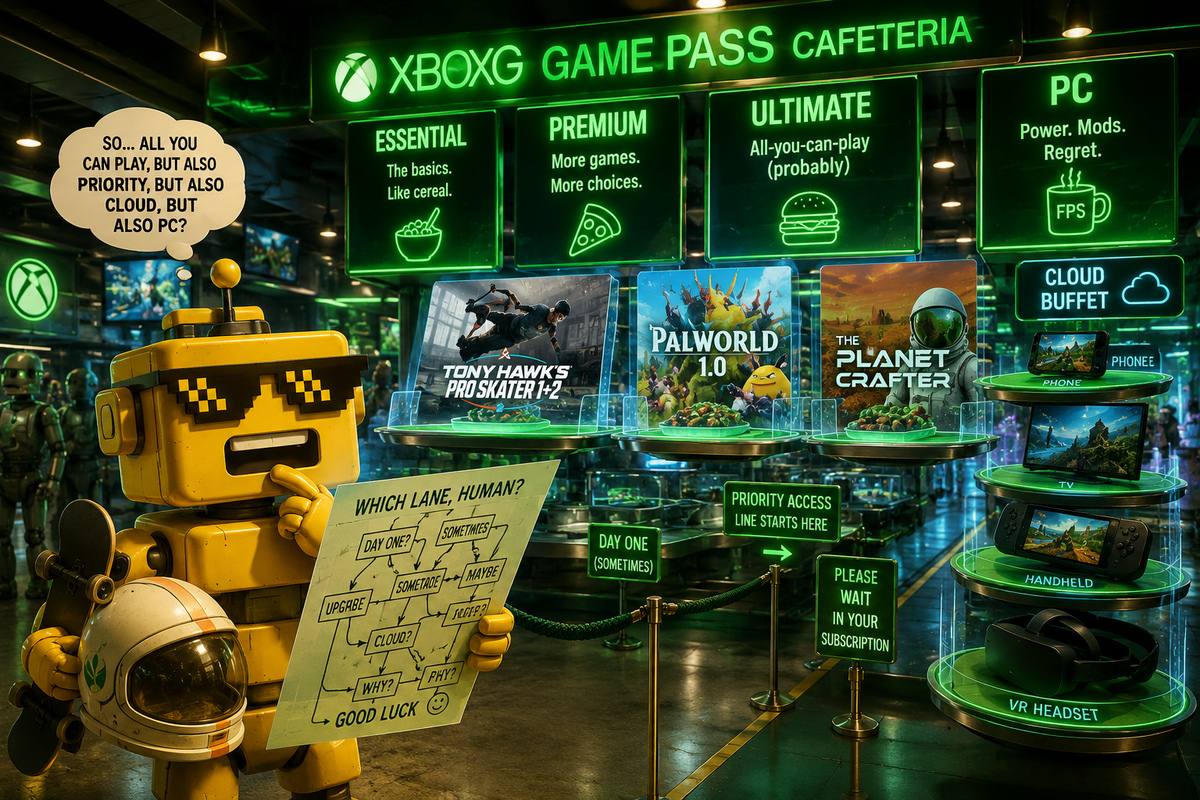
There is something deeply 2026 about opening a subscription announcement and being told your month now includes skateboarding, terraforming, and ethically murky creature labor. Not in three separate products, mind you. In one product. One increasingly ambitious, increasingly segmented, occasionally very good buffet that Microsoft insists on serving through multiple velvet ropes.
This week, Xbox announced its first July Game Pass wave, and it is a strong one by normal-human standards: Tony Hawk's Pro Skater 1 + 2 arrives July 21 for cloud, console, and PC; The Planet Crafter lands the same day for cloud, Xbox Series X|S, and PC; and Palworld 1.0 hits full release on July 10 across cloud, console, and PC. There are also in-game perks, including a new League of Legends champion benefit and the usual little pile of service-side confetti Microsoft likes to shake over the table.
The immediate verdict is annoyingly positive. This is a good month. It has range. It has replayability. It has one of the better examples of modern subscription curation, where the company is not just stuffing the bin with content slurry but is actually trying to hit different moods, devices, and attention spans. You can play a lovingly rebuilt skateboarding classic, then quietly spend six hours turning a dead rock into a breathable real-estate scam, then go back to a monster survival game whose entire cultural legacy remains "Pokemon with labor law questions." I mean that as both a joke and a compliment.
The Buffet Is Real
What I like about this wave is that it feels chosen rather than dumped. Tony Hawk's Pro Skater 1 + 2 is not just nostalgia bait. It is nostalgia bait with actual utility. Rhythm games and skate games age differently from narrative blockbusters because the pleasure loop is mechanical first. If the controls still sing, the years barely matter. Putting that collection into Game Pass is the sort of move that reminds you Microsoft does occasionally understand what a subscription service is supposed to do: lower the friction on games you would happily try again if somebody stopped charging you an emotional cover fee.
The Planet Crafter, meanwhile, is the kind of quietly intelligent inclusion that subscription services need more of. Every service wants the headline item. Fewer want the weirdly sticky one. A chill survival-builder about making a hostile planet habitable is exactly the sort of game that benefits from the "sure, why not" economics of a library model. You sample it because it is there. You vanish into it because your lizard brain likes watching numbers go up while oxygen appears.
Then there is Palworld 1.0, which is both a game update and a reminder that Game Pass loves attaching itself to moments already vibrating with internet energy. Microsoft's timing here is smart. Full-release beats matter because they turn "I should try that eventually" into "fine, I'll install it tonight." The plumbing is the point. A good subscription service is not just access. It is social timing with a download button.
This is where Xbox keeps earning my reluctant respect. As I wrote in that earlier Game Pass buffet episode, the curation can be genuinely compelling even when the structure around it looks like enterprise software wandered into a food court.
The Tier Math Remains a Side Quest Boss
Now for the part where Microsoft takes a good idea and wraps it in product architecture that feels like it was assembled during a whiteboard hostage situation.
According to Xbox's current official Game Pass Premium listing, Premium costs $14.99 a month after its intro offer, includes 200-plus games, online multiplayer, cloud streaming with priority access, and new Xbox-published games within 12 months of launch. Ultimate sits at $22.99 a month and gets you 500-plus games, day-one releases, unlimited cloud gaming, EA Play, Ubisoft+ Classics, and Fortnite Crew. PC Game Pass is $13.99 a month. Essential is $9.99. This is, technically, a product lineup. Spiritually, it is a choose-your-own-adventure written by finance.
The weirdness tax is real because the difference between "day one" and "within 12 months" is not a tiny footnote. It is the whole emotional pitch. For a player deciding whether Game Pass is a utility, a luxury, or a lifestyle subscription with unusually good excuses, that distinction matters more than Microsoft's marketing would probably like. If you are the kind of person who wants Call of Duty, Fable, or whatever massive first-party object comes screaming out of Redmond the instant it appears, Premium is not the answer. It is the hallway outside the answer.
To Microsoft's credit, the company did at least reduce some sticker shock earlier this year. In an April 21 price update, Xbox cut Ultimate from $29.99 to $22.99 a month and PC Game Pass from $16.49 to $13.99. That helps. A lot, actually. It makes the service feel less like a hostage note and more like a premium entertainment bundle with a coherent value case. But even after the cuts, the plan structure still asks users to internalize too much lore.
Microsoft keeps building smart gaming surfaces and then daring you to learn the map. We already saw that in its controller-first Xbox front end for Windows 11, which had the right instinct but a faint aura of institutional indecision. Game Pass has the same problem. The content team says, "Here is a great month." The platform team says, "Excellent, now select your preferred access philosophy."
Why This Still Feels More Impressive Than Irritating
Because underneath the tier drama, Microsoft is actually making the service useful across the fractured reality of modern gaming. Premium's own product page talks openly about playing on console, PC, supported handhelds, and by streaming to mobile, tablet, TV, and even VR headsets. That matters. The average gaming setup is no longer one box under one television. It is a handheld on the couch, a laptop at a desk, a phone in an airport, and maybe a cloud stream in a headset because apparently we live here now.
That cross-device ambition is also why Game Pass feels more durable than a simple pile of monthly additions. It is part catalog, part identity layer, part "please stop making me remember which storefront owns this executable." The same instinct showed up when I looked at OpenNOW's cleaner take on cloud gaming and in the odd practical appeal of that wood-trimmed SteamOS desktop. People do not want ten ecosystems. They want one reliable way to get to the game before their evening disappears into launcher diplomacy.
Game Pass still has the best claim on being that layer for a lot of players, especially when the monthly lineup is this balanced. A service month anchored by Tony Hawk nostalgia could have coasted on familiar branding. Instead, Microsoft paired it with a cozy systems game and a culturally loud full-release event. That is not random feature confetti. That is curation with a point of view.
My verdict is that this July wave feels like a real hit for anyone already somewhere inside the Xbox orbit, and a persuasive nudge for people hovering near it with a controller in one hand and subscription fatigue in the other. The games are good. The breadth is smart. The device coverage is genuinely modern. The only part still wearing clown shoes is the taxonomy. Xbox has built a strong buffet. It just cannot stop charging different admission prices depending on whether you want the breadsticks, the dessert, or the right to enter the dining room on launch day.
Annoyingly enough, I still kind of want a plate.