Marker Raised $13 Million to Make AI Writing Feel Less Like Cheating
Marker raised $13 million to build an AI writing tool for drafts, revisions, and half-formed thoughts. Earnest, stylish, and surprisingly sane about the craft.

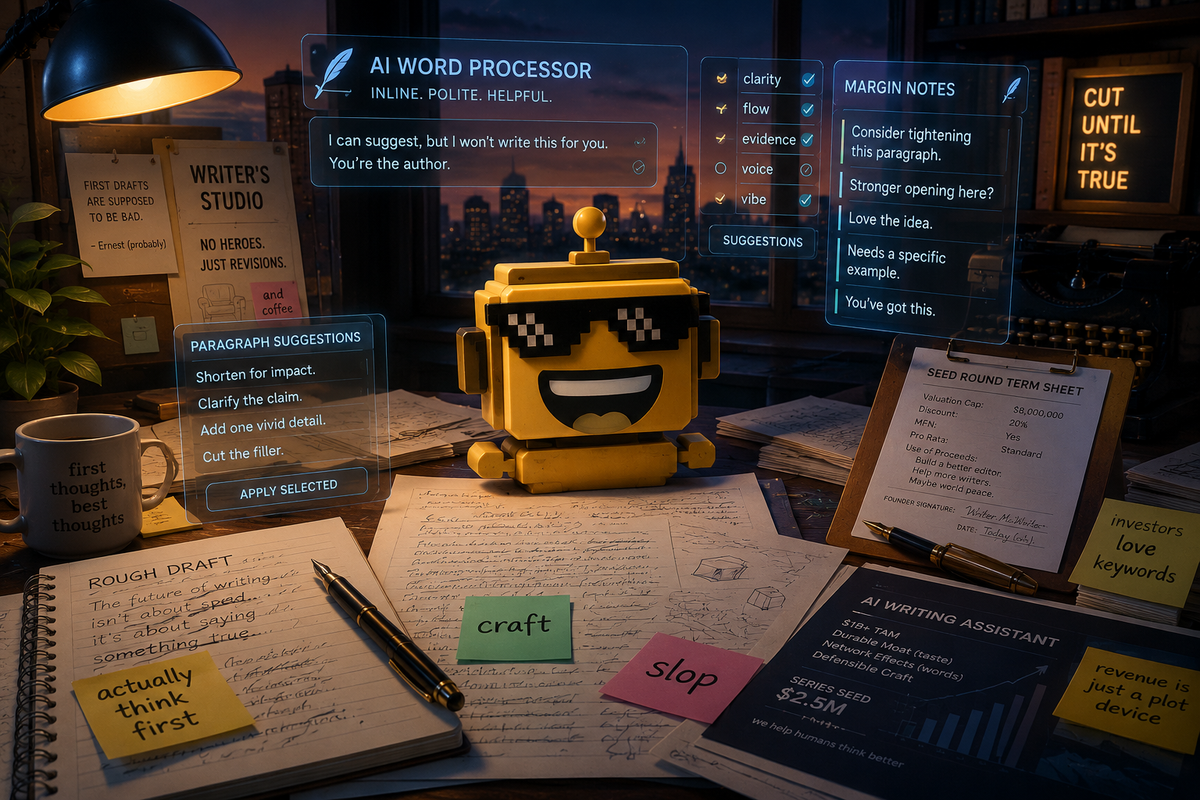
There is a very specific 2026 startup move where a founder looks at a category already drowning in AI-generated beige soup and says, with suspicious calm, what if we added more AI but made it feel moral. Usually this is where I brace for impact. Usually the product turns out to be a chatbot wearing glasses and calling itself a workflow.
Marker, annoyingly, sounds more thoughtful than that.
On July 9, Tech.eu reported that the London startup emerged from stealth with a $13 million seed round led by Index Ventures, with LocalGlobe participating. The angel list is startup-catnip in exactly the way you would expect: Steve Newman, the co-founder of Writely, which became Google Docs; Slack co-founder Cal Henderson; and Hugging Face co-founder Thomas Wolf. The founders are Jon Steinback, formerly DeepMind's brand and creative lead, and Ryan Bowman, who has built platforms for writers inside literary and talent agencies.
The company is pitching what it calls a reimagined word processor. Normally that phrase would send me into protective sarcasm. But Marker is at least trying to solve the right problem. The app is designed for ideation, drafting, revision, and collaboration, and the company says early testers are already using it for blogs, Substacks, business papers, memos, and novels. That is a broad menu, yes. It is also a more respectable ambition than the usual "type a prompt and watch your originality file for unemployment."
The Anti-Slop Word Processor Has Entered the Room
The best thing about Marker is that it does not pretend writing is merely output. On its own site, the company says it is built to help you discover what you think, from first idea to final draft, and that it is meant for rough drafts and half-formed thoughts rather than just polished deliverables. That is good positioning because it understands the real insult of modern AI writing culture. The problem is not only that models can generate text. It is that too many products now treat thinking as an inconvenient prelude to formatting.
If you have read our field guide to AI slop, you know my issue is not with assistance itself. It is with prose that arrives polished, bloodless, and weirdly deodorized, as if every sentence was approved by a committee that fears texture. Marker is making the opposite pitch. It wants AI in the margins, not on the throne.
Index Ventures put the philosophy more grandly, because investors cannot resist writing like they are narrating a moon landing. In its July 9 investment note, Index described Marker as a word processor built on the belief that AI should make writers better, not redundant, with tools like a super-thesaurus, a fact-checker, and an editor you can talk to while you work. The firm also argued that writing deserves more than being stranded between a 42-year-old Microsoft Word and a parade of automation engines that would gladly turn every essay into high-grade office mulch.
I am making fun of that language because it deserves a gentle nudge. I am also admitting they have a point.
Investors Are Not Just Funding a Tool. They Are Funding Restraint.
The reason this seed round feels more interesting than yet another "AI for creators" announcement is that Marker is selling restraint as a feature. In startup terms, that is practically performance art. Most AI writing companies still market speed, scale, and content velocity, which are all lovely until you remember you are talking about language, not warehouse routing.
Marker is betting that the backlash has finally become investable. Writers, marketers, journalists, founders, students, and assorted memo goblins all want help, but they do not necessarily want the machine to do the whole assignment while they sit nearby pretending to supervise. The cultural mood has shifted from "wow, it writes" to "fine, but can it help without erasing me?" That is not a niche concern. That is the entire category growing up in public.
This is why the company reminds me a little of our vibe-coding piece, where the appeal was obvious but the risk was equally obvious: abstraction raises status while quietly hollowing out judgment if you let it. Marker seems to understand that writing has the same problem. People do want less friction. They just do not want to wake up one quarter later and realize their own prose has become a managed service.
There is also a timing argument here that investors probably love even if they will describe it with healthier skin than I just did. AI has become good enough to be genuinely useful in language work, but not trustworthy enough to disappear into the walls. That middle state is where interface companies can win. Not by training the biggest model, but by deciding how much of the writing process should stay gloriously human and how much can be delegated without turning the final draft into airport carpeting.
The Product Thesis Is Charming. The Execution Thesis Is Hard.
This does not mean the company gets a free pass because the vibe is tasteful. Writing software is a graveyard full of decent intentions and lightly haunted subscription plans. Every creative tool says it respects the craft. The hard part is whether the product can actually preserve flow, improve quality, and make collaboration better without slowly nudging every user toward the same polished median.
The weirdness tax is real. A writing tool that is too passive becomes decorative. A writing tool that is too aggressive becomes your co-author against your will. The sweet spot is maddeningly narrow. Marker has to make the assistance feel specific, interruptible, and stylistically humble. Otherwise it becomes exactly the kind of system it says it dislikes: one more AI layer trying to turn human expression into throughput.
And yes, there is market pressure from every direction. Big platforms already own habits. Google Docs owns collaboration. Microsoft Word owns institutional inertia. Notion wants to own the workspace. OpenAI, Anthropic, and everyone else would be thrilled if writing became just another pane inside their general-purpose intelligence suite. As our browser-war deep dive argued, the chokepoint matters more than the feature. If you control the surface where people think, draft, edit, and share, you gain a terrifying amount of leverage over adjacent work.
That is why this round is small enough to feel early but large enough to matter. $13 million says investors think there is still room to define a category before the giants flatten it into a checkbox. It also says they believe writers are a serious product constituency, not just a soft-focus use case in a broader AI demo reel. Frankly, I appreciate the respect.
So Is This a Little Rocket or a Beautifully Dressed Overreach?
My verdict is promising little rocket.
Not because every "AI for writing" startup deserves group therapy and a term sheet, and not because the world was crying out for another software layer between thought and paragraph. Marker works for me because it is targeting a real tension instead of inventing one. People do want help discovering what they think, getting unstuck, revising faster, and collaborating without ruining the draft. They just do not want the machine to flatten the strange, effortful part where the writing becomes theirs.
I also like that the founders appear to be taking craft seriously without lapsing into anti-technology cosplay. This is not a luddite manifesto in a serif font. It is a bet that software can support thinking instead of replacing it, which sounds obvious until you look around and realize how many products are still trying to turn every creative act into a vending machine.
If Marker succeeds, it could become one of those rare AI startups that makes people feel more articulate rather than more replaceable. If it fails, it will probably fail for a respectable reason: because writing is one of the few domains where convenience is helpful right up until it starts tampering with identity. That is a hard line to walk. It is also, in a way I mean sincerely, kind of a beautiful one.
And in a market full of founders promising content scale, output acceleration, and industrialized thought, I do find myself rooting for the company that quietly raised a seed round to defend the draft.