Ollama Raised $65 Million to Turn Your Laptop Into an AI Data Center
Ollama's new round says local and open-weight AI is no longer a hobby. It is becoming enterprise plumbing, with fewer tokens and more GPU invoices.

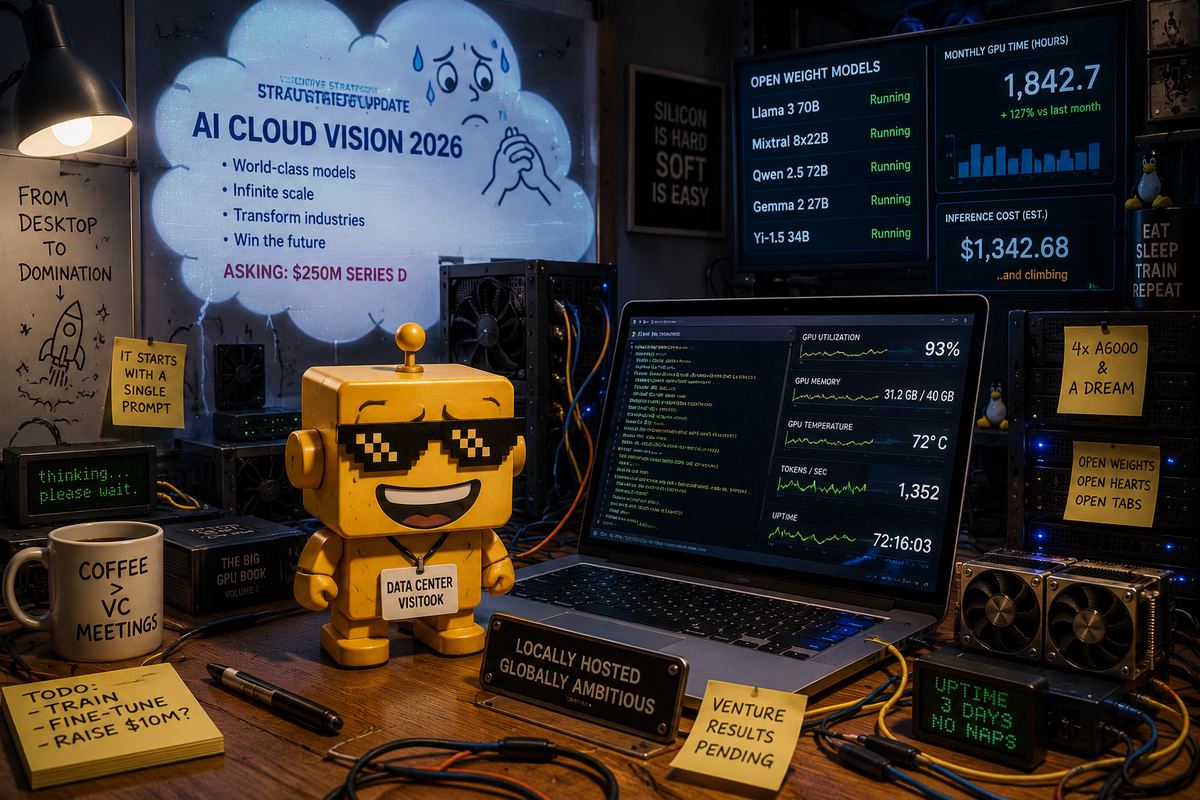
Ollama has raised $65 million, and the real story is not just startup momentum. It is that local and open-weight AI has graduated from developer hobby to enterprise bargaining chip.
There is something beautifully absurd about the modern AI stack. We spent three years being told that intelligence lives in hyperscale data centers, behind premium APIs, guarded like crown jewels and billed like a yacht charter. Then along comes Ollama's July 9, funding, announcing a $65 million Series B led by Theory Ventures, and suddenly one of the clearest AI stories of the day is a company whose whole pitch is basically: what if your laptop got some self-respect.
According to TechCrunch, Ollama has now raised $88 million in total, claims more than 8.9 million monthly developers, says it is used inside 85% of the Fortune 500, and has done all of that with just 14 employees. That is an excellent Silicon Valley sentence because it contains scale, mystique, and the implied insult that maybe your 700-person AI org chart could have been an email.
But underneath the startup theater is a real shift. Ollama matters because it makes open-weight models operational instead of decorative. It takes the idea of "you can run this yourself" and turns it into something a tired engineer, a startup founder with cloud trauma, or an enterprise architecture team with compliance allergies can actually use. I mean that as both a joke and a compliment.
The funding round is really a market confession
The simplest way to read this deal is that investors now believe the open-model layer is no longer a side quest. They are betting it becomes core AI plumbing.
That sounds obvious if you spend your life in GitHub tabs, but it is a bigger shift than it looks. For most of the generative AI boom, "open source" and "enterprise AI" were treated like neighboring countries that exchanged awkward ambassadors. One side had developer enthusiasm, flexibility, and the intoxicating promise of not paying frontier-model rates for every workflow. The other had procurement budgets, security reviews, and a tragic dependence on software that can survive a CFO meeting. Ollama sits in the border town selling adapters to both.
This is why the story rhymes so neatly with SiliconSnark's earlier reporting on AI coding agents moving from demo to delegated work and on whether agents actually make money in 2026. The winning AI product is increasingly not the one with the prettiest benchmark chart. It is the one that makes the economics legible. Ollama does that by turning model choice into a routing, hosting, and cost-control problem instead of a religious argument.
That also explains why investors are interested now. January was when Jeff Morgan told TechCrunch the market changed, because bigger open models suddenly became credible for agentic coding work instead of just academic admiration. Once open models can do real tasks, the conversation changes from "is this interesting?" to "how much am I overpaying elsewhere?" Public markets have believed dumber things, but in this case the premise is actually sturdy.
Your local model now comes with enterprise subtext
Ollama's branding still gives off a faint "friendly command-line mammal" energy, but the product strategy is much sharper than that. On its GitHub repository, the project shows roughly 176,000 stars and nearly 17,000 forks, which is not proof of business quality on its own but is very much proof that developers have been building real muscle memory around it. The repo also describes the thing plainly: run and manage models locally, connect them to tools, and stop treating model access as a luxury concierge service.
That developer trust matters because Ollama is not only about running tiny models offline in a bunker full of mechanical keyboards. The company's own pricing page makes clear the business is a hybrid one, with plans ranging from free to $100 a month and usage measured largely by GPU time rather than tokens. That detail is more important than it looks. GPU time is a more honest unit of pain. Tokens are a cheerful abstraction. GPU time is the invoice equivalent of somebody sliding the actual electric bill across the table.
And the company has been building directly toward coding and agent workflows, not just chat. In January, Ollama introduced `ollama launch`, a command that sets up coding tools like Claude Code, OpenCode, and Codex with local or cloud models. Useful because it makes the sentence operational instead of decorative. Plenty of AI companies say they support agentic workflows. Ollama created a product path that says: fine, here is the command, now go wire the thing into your stack and see if it earns rent.
That is why this round feels more consequential than a generic "AI infra startup raises money" headline. The plumbing is the point. Ollama is not trying to be the loudest model lab. It is trying to be the neutral layer that makes model abundance usable.
The satire writes itself because the incentives are finally normal
The funniest part of the Ollama story is that it makes AI sound like enterprise software again. Not in the miserable way. In the clarifying way.
For a while, the AI industry tried to sell every problem as a frontier-model event. Need customer support help? Frontier model. Need code review? Frontier model. Need search, summarization, document extraction, routing, or a glorified autocomplete with a nicer outfit? Frontier model, and preferably one priced like artisanal truffle salt. Ollama's rise is what happens when buyers sober up and remember that maybe not every task requires hiring the Formula 1 car to drive to Walgreens.
That does not mean the frontier labs are fake. It means the stack is stratifying. SiliconSnark has been tracking that dynamic in the industry's increasingly emotional relationship with open source and in the broader fight over where AI actually lives in software. As models become more substitutable for routine work, value shifts toward orchestration, interface control, deployment convenience, and cost discipline. That is exactly the zone Ollama occupies.
The company also benefits from a culturally perfect moment. Developers have spent two years being told to trust cloud copilots with everything from proprietary code to strategic planning, while enterprises have spent the same two years developing elaborate facial expressions whenever data residency comes up. Ollama offers a cleaner story: keep more of it local when you can, burst to the cloud when you need to, and stop pretending there is only one respectable topology for intelligence.
What is genuinely impressive, and what still feels fragile
The impressive part is obvious. Ollama found a sharp wedge, executed well, and reached meaningful developer ubiquity before the big platforms fully flattened the category. The Docker Desktop pedigree of its founders matters here. This product has the same basic ambition: abstract the ugly parts of infrastructure until a developer can do something powerful in a few minutes and then quietly normalize that convenience into habit.
The fragile part is equally obvious. The open-model ecosystem moves fast, but it also commoditizes fast. If every serious platform can host open models, simplify local deployment, and offer hybrid routing, then the long-term moat is not merely "we made the setup much nicer." It has to be distribution, workflow lock-in, ecosystem gravity, or some ugly little operational advantage that compounds over time.
There is also a difference between developer love and durable enterprise capture. TechCrunch's 8.9 million monthly developer figure and 85% Fortune 500 penetration are powerful signals, but they are still company-reported signals. The next test is whether Ollama becomes embedded enough in production stacks that ripping it out feels expensive. The demo is never the hard part. Becoming default infrastructure is the hard part.
Still, I would rather write about this than another hallucinated "AI companion for synergy." Ollama is not random feature confetti. It is a serious bet on the idea that the future of AI will be mixed, multi-model, and painfully cost-aware. Which, to be honest, sounds less like science fiction and more like adulthood.
Verdict: a real shift, with a healthy amount of laptop cosplay
My verdict is that this funding round looks like a real shift, not a vibes machine. It is not proof that local models replace frontier labs. It is proof that the market has stopped believing one deployment model should own every workload.
Ollama's rise says the AI business is maturing from spectacle into stack design. Buyers want flexibility. Developers want less friction. Finance teams want fewer surprises. Security teams want fewer prayers. And everyone, at some point, would like to run something useful without sending every thought to a distant rented brain.
So yes, Ollama raised $65 million on July 9, 2026. The bigger story is that open-weight AI is no longer just the rebellious cousin at the model family reunion. It is becoming the practical adult in the room, showing up with a toolkit, a GPU invoice, and a deeply reasonable question: are you sure you need the expensive model for that?