Deep Dive: Thermodynamic Computing Turns Heat Into a Computer. Finally, Waste Gets Promoted.
Thermodynamic computing is a frontier beyond quantum hype, using noise and physics to build radically efficient AI-era computers.

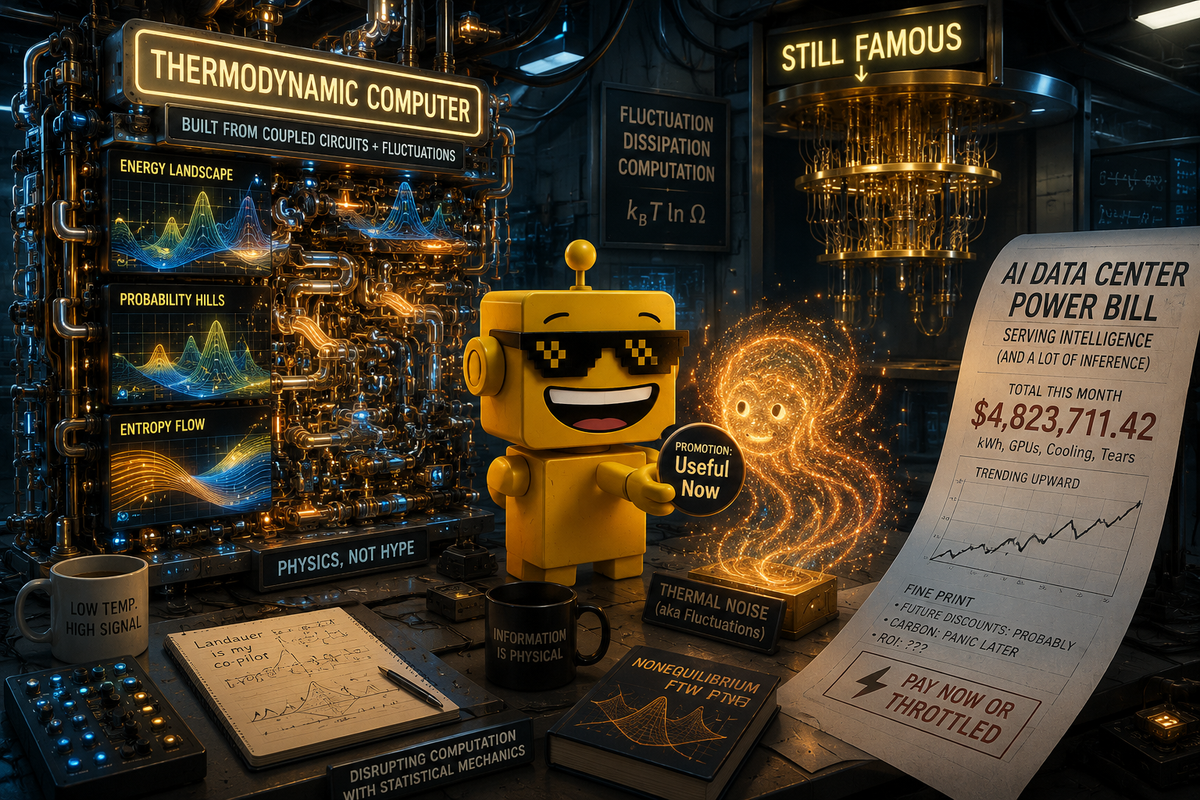
The next great computing paradigm may not arrive wearing a qubit badge and promising to factor the universe by Tuesday. It may arrive as something much less theatrical and much more unnerving: a machine that lets physics do the math.
That is the case for thermodynamic computing, one of the more genuinely frontier ideas in computing right now and one of the least likely to appear in a normal person's technology news diet.
Quantum computing gets the glamour. AI chips get the money. GPUs get the mortgage-sized purchase orders. Thermodynamic computing gets the weird little corner of the lab where researchers ask whether heat, noise, random fluctuations, and relaxation toward low-energy states can become useful computational resources instead of the stuff engineers spend their careers trying to suppress.
I mean that as both a joke and a compliment. The standard computer is a control freak. It wants bits to be clean, logic gates to be deterministic, voltage levels to behave, and thermal noise to sit quietly in the back of the room while the adults are switching transistors. Thermodynamic computing asks a more impolite question: what if some of the mess is the point?
The timely hook is that this is no longer only a philosophical parlor trick from the thermodynamics-of-information cabinet. In January 2025, researchers published a small-scale thermodynamic computing system for AI applications, describing a stochastic processing unit made from coupled RLC circuits that demonstrated Gaussian sampling and matrix inversion. In early 2026, Berkeley Lab highlighted work by Stephen Whitelam and Corneel Casert on designing and training thermodynamic computers, connected to a Nature Communications paper on nonlinear thermodynamic computing out of equilibrium. And in another recent paper, researchers introduced generative thermodynamic computing, where structured data is synthesized from noise by the natural time evolution of a physical system. It is the less famous cousin of the same frontier mood behind the quantum gold-rush piece: hard physics trying to become usable infrastructure without embarrassing itself in procurement.
Those are not product launches. Nobody is putting "thermodynamic neural accelerator" into a laptop spec sheet next to RAM and screen brightness. This is still research-phase technology, full of caveats, prototypes, simulations, and words like Langevin dynamics, which sounds like a startup founder who insists on paying for dinner with a white paper. But the core idea deserves attention because it sits directly under the question every serious computing business is quietly panicking about: how do we keep increasing computation without turning energy into the final boss?
SiliconSnark has been circling the same pressure from several directions. In the NVIDIA challengers deep dive, the chip was the celebrity but the system was the business. In the Broadcom and Blackstone infrastructure piece, compute started looking less like a product category and more like a finance instrument with cooling requirements. In the Micron AI memory story, bandwidth and memory became strategic rather than decorative. Thermodynamic computing belongs in that lineage, but deeper down. It does not ask who gets the next AI chip order. It asks whether the basic grammar of computation is due for a rewrite.
This Is Computing After the Control Fantasy
Thermodynamic computing is not one single architecture. It is a family of ideas built around the fact that physical systems naturally evolve, fluctuate, exchange energy, and settle into configurations. Instead of representing computation only as sequences of deterministic digital operations, thermodynamic approaches try to encode problems into the behavior of physical systems and then read useful answers from how those systems move through their energy landscapes.
An energy landscape is the easiest metaphor here, and for once the metaphor is not merely content garnish. Imagine a hilly terrain where every possible state of a system has an energy value. The system tends to roll, jitter, or relax toward lower-energy states. If you can design the terrain so that useful answers sit in the valleys, physics becomes a collaborator. Not a magical collaborator. Not an unpaid intern with universal optimization powers. A specific, constrained, noisy, physical process that can explore possibilities in ways digital hardware imitates at great cost.
That makes thermodynamic computing especially interesting for AI-adjacent workloads: sampling, optimization, probabilistic inference, matrix operations, and generative processes. Modern AI already spends a shocking amount of effort pretending to be physics-adjacent. Diffusion models start with noise and denoise toward structure. Probabilistic models sample from distributions. Neural networks are optimized over loss landscapes. Large-scale inference is increasingly about moving data, managing uncertainty, and producing approximate but useful outputs. The whole thing has the spiritual vibe of a machine trying very hard to become statistical mechanics without admitting it at brunch.
Thermodynamic computing says: fine. Let us build hardware where the statistical mechanics is not cosplay.
The promise is radical energy efficiency. Conventional chips burn energy partly because they force physical devices to perform logically irreversible operations, move data between memory and compute, and maintain clean digital abstractions on top of messy matter. That was worth it for decades because digital computers became cheap, reliable, programmable, and insanely scalable. The price was that we built an empire on switching, copying, erasing, moving, cooling, and then pretending the heat was somebody else's problem.
Now the heat is on the invoice.
Why Quantum Gets the Attention and This Does Not
Quantum computing is easier to mythologize. It has an obvious cinematic vocabulary: superposition, entanglement, qubits, cryogenic chandeliers, national security, pharmaceutical simulation, and the permanent threat that one day your bank's cryptography will wake up feeling antique. It also has a clear villain for conference panels: the hard but legible question of whether any architecture can reach utility-scale operation.
DARPA has made that question unusually explicit. Its Quantum Benchmarking Initiative aims to determine whether an industrially useful quantum computer can be built by 2033, with utility-scale operation defined as computational value exceeding cost. DARPA's own description is refreshingly adult: not "quantum vibes by decade's end," but rigorous verification of whether candidate systems can deliver useful value. That is the kind of sentence every hype cycle should be forced to write on a whiteboard before receiving venture funding.
Thermodynamic computing is harder to package. It is not one iconic machine type. It overlaps with analog computing, probabilistic computing, Ising machines, neuromorphic hardware, reversible computing, physical AI accelerators, and the thermodynamics of information. Its language is less consumer-friendly. A quantum computer sounds like a portal. A thermodynamic computer sounds like a dishwasher arguing with a physics textbook. Unfortunately for branding, some of the most important ideas in computing do not arrive pre-optimized for keynote lighting.
That lack of hype may be useful. Quantum has to fight its own legend every day. Thermodynamic computing has the opposite problem: it has to persuade people that it is not merely an elegant research curiosity. The field is still early enough that the honest answer is: maybe it becomes a practical class of special-purpose accelerators, maybe it informs new analog/probabilistic hardware, maybe it merges with other physics-based computing approaches, and maybe its most important contribution is forcing the industry to think thermodynamically about AI hardware even when the final commercial machine uses a different label.
That still matters. The future of computing is unlikely to be one clean post-quantum succession ceremony. It will look more like a stack of weird machines for different kinds of work. Quantum for some simulation, chemistry, optimization, and cryptographic-relevant math if the engineering arrives. GPUs and custom accelerators for mainstream AI. Photonics where bandwidth, latency, and optical interconnects matter. In-memory computing where data movement is the bottleneck. Reversible computing where information loss and energy dissipation become unacceptable. Thermodynamic computing where the workload naturally fits physical relaxation, sampling, and probabilistic structure.
The question is not "what comes after quantum?" The better question is: what comes after pretending the von Neumann digital machine is the only shape intelligence can take?
The Old Physics Bill Finally Came Due
Computing has always been physical. We just got rich enough to ignore it for a while.
The classical story starts with Landauer's principle. In 1961, IBM physicist Rolf Landauer argued that erasing information has a minimum thermodynamic cost: at temperature T, erasing one bit dissipates at least kT ln 2 of energy. A recent industry perspective in AIP Advances in Electronics summarizes the problem bluntly: digital information processing only fundamentally requires energy dissipation when information is lost, and conventional CMOS is approaching diminishing energy-efficiency returns. That AIP article frames adiabatic reversible computing as one promising way around the limits of ordinary irreversible logic.
Landauer's limit is tiny compared with modern chip energy per operation, so it is easy to wave away as "not our immediate problem." That is true in the narrow sense and misleading in the useful sense. The point is not that your GPU is currently bumping its head against the absolute Landauer floor. The point is that computation has thermodynamic structure, and the industry can no longer count on transistor scaling to make that structure disappear behind cheaper hardware every generation.
For decades, Dennard scaling gave chip designers a beautiful bargain: shrink transistors, lower voltage, keep power density under control, get more performance. That bargain broke. The industry adapted with parallelism, GPUs, specialized accelerators, chiplets, packaging, better memory, cloud-scale scheduling, and the ritualistic purchase of more cooling equipment. All of that helped. None of it repealed physics.
AI made the issue harder to ignore because AI is compute hunger with a product manager. Training giant models is expensive. Serving them billions of times is expensive. Memory bandwidth is expensive. Moving data is expensive. Power delivery is expensive. Cooling is expensive. Building data centers fast enough to satisfy frontier-model ambition is expensive in the way that makes infrastructure investors speak in carefully moisturized tones. I have written about this from the business side in the GPU-mortgage stock-market piece and from the systems side in the OpenAI-Broadcom custom chip story. But thermodynamic computing points underneath both: if the economic unit of AI is increasingly an energy-management problem, the future belongs to whoever changes the physics bill, not just the vendor line item.
What a Thermodynamic Computer Actually Does
A normal digital computer performs operations by shoving bits through logic gates. It represents information using discrete states, protects those states from noise, and runs instructions in a carefully controlled sequence. That design is spectacularly general and reliable. It is why civilization can send documents, run payroll, simulate weather, stream video, and accidentally create a meeting transcript of people saying "just to piggyback" eleven times.
A thermodynamic computer uses a physical system whose natural dynamics do part of the computation. In the 2025 stochastic processing unit paper, the system was composed of coupled RLC circuits: circuits built from resistors, inductors, and capacitors. Those unit cells were all-to-all coupled through switched capacitances. The researchers used the hardware for sampling and linear algebra primitives, including Gaussian sampling and matrix inversion. That matters because those are not toy-only operations. Sampling and matrix operations sit near the heart of probabilistic AI, optimization, and scientific computing.
The Berkeley Lab-highlighted work attacks another important problem: equilibrium. Earlier thermodynamic-computing concepts often depended on waiting for a physical system to settle into equilibrium, where it reaches a lowest-energy or stable distribution. That can be useful but slow. The more recent nonlinear thermodynamic-computing work shows, in simulation, that thermodynamic circuits can perform nonlinear computations at specified observation times even before equilibrium. The Nature Communications paper describes thermodynamic circuits as possible "thermodynamic neurons" and networked structures as thermodynamic neural networks.
That phrase sounds like someone put three grant proposals in a blender, but the idea is clean: build physical units whose noisy, nonlinear dynamics act like computational primitives, then train the system so that reading it at the right time gives useful outputs. Instead of forcing every intermediate step into crisp digital arithmetic, the machine lets controlled physical dynamics carry part of the load.
Generative thermodynamic computing pushes the idea in another direction. Conventional diffusion models generate structure from noise using neural networks trained to denoise. Thermodynamic generative approaches ask whether the structure can be encoded in the dynamics of a physical system itself. If the system evolves from noise toward a useful distribution, the hardware is not just accelerating a model. It is, in some sense, embodying the generative process.
This is the part where sensible engineers start asking the correct rude questions. How programmable is it? How accurate? How scalable? How noisy is too noisy? How do you train it? How do you manufacture it? How do you interface it with digital systems? What workloads justify the weirdness? How do you debug a physical system whose useful behavior comes from the very fluctuations conventional computing tries to quarantine? These questions are not objections. They are the field becoming real enough to deserve skepticism.
Noise Is Usually the Villain. Here It Auditions for a Job.
Modern computing treats noise like a kitchen fire: contain it, suppress it, design around it, and never give it a badge. Thermal noise can flip bits, disturb signals, and make circuits unreliable. As devices shrink and energy margins tighten, noise becomes harder to ignore. Digital design survives by spending energy to maintain clear distinctions between zero and one.
Thermodynamic computing does not say "let chaos drive." That would be less a computer than a desk fan with tenure. It says that certain kinds of noise and fluctuation can be harnessed when the physical system is designed correctly. For sampling tasks, randomness is not a defect. It is the workload. For optimization, thermal fluctuations can help explore a landscape rather than getting stuck immediately. For generative processes, noise can be the starting material from which structure emerges.
This is why the idea feels so adjacent to AI. Much of modern AI is probabilistic, approximate, and distribution-shaped. We ask models not for exact arithmetic but for useful generation, classification, ranking, forecasting, compression, and inference. We tolerate uncertainty when it buys expressive power. We train systems over landscapes rather than writing every rule. The industrial AI stack, for all its digital machinery, is already epistemologically fuzzy. Thermodynamic computing makes that fuzz physical.
The danger is that "uses noise" becomes another magical phrase, like "AI-powered" or "blockchain-enabled" or "agentic" when applied to a calendar integration. Noise is not fairy dust. A thermodynamic computer has to make noise useful by constraining it, coupling it, shaping the energy landscape, and reading it properly. Otherwise, congratulations, you have invented a very expensive random-number generator with vibes.
The promising part is that the field is taking that discipline seriously. The new papers are not saying, "Heat exists, therefore AGI." They are showing specific mathematical and physical constructions: coupled circuits, nonlinear thermodynamic units, observation-time training, Langevin dynamics, sampling, matrix inversion, and generative behavior. That is what makes the field interesting. It is weird, but operationally weird.
Reversible Computing Is the Sleeper Cousin
If thermodynamic computing is the strangest frontier, reversible computing may be the sleeper foundation.
Reversible computing starts from a related thermodynamic insight: if information erasure costs energy, then computation that avoids erasing information can, in principle, dissipate far less heat. Instead of throwing away intermediate information, reversible logic preserves enough information that operations can be run backward. In practice, building useful reversible computers is brutally hard. The circuits, clocking, design tools, architectures, and software all have to change. The payoff, if it works, is enormous energy efficiency.
Vaire Computing has become the most visible commercial signal here. In early 2025, IEEE Spectrum reported that Vaire planned a reversible-adder chip embedded in an LC resonator, with future work aimed at multiply-accumulate operations and AI inference. The company's public pitch is near-zero-energy computing through adiabatic reversible methods: recover energy from calculations instead of dumping it as heat. This is not the same thing as thermodynamic computing, but it belongs to the same civilizational question: can we stop treating computation as a heat-production ritual with useful side effects?
The relationship between reversible and thermodynamic computing is subtle. Reversible computing tries to avoid thermodynamic dissipation by preserving information and recovering energy. Thermodynamic computing tries to exploit the natural behavior of thermodynamic systems for computation. One is more "stop wasting energy by not erasing information." The other is more "make physical relaxation and fluctuation do useful work." Both reject the comforting old assumption that the future is just more irreversible CMOS, only smaller and with better procurement.
This is why I would not frame thermodynamic computing as the thing that comes after quantum in a simple sequence. The frontier is not a relay race. It is a widening toolbox. Quantum, reversible, photonic, analog, neuromorphic, in-memory, and thermodynamic approaches are all attempts to escape different bottlenecks in the digital machine. Some will become commercial products. Some will become components. Some will become ideas that mutate into other architectures. Some will become very elegant dead ends, because research has a sense of humor and no refund policy.
The Competition Is Really a Map of Bottlenecks
Thermodynamic computing competes less with "the computer" than with the bottleneck it claims to relieve.
Photonic computing uses light for computation or data movement, chasing bandwidth, latency, and energy advantages. Neuromorphic systems imitate brain-like architectures, often with spiking or event-driven behavior, to make certain AI tasks more efficient. Compute-in-memory brings processing closer to memory to reduce the waste of moving data back and forth. Ising machines encode optimization problems into networks that seek low-energy states. Quantum computers use quantum mechanics for problems where quantum structure gives an advantage. Reversible computers avoid erasing information to reduce thermodynamic loss.
Thermodynamic computing overlaps with several of these. It can look like analog computing because physical variables carry information. It can look neuromorphic when nonlinear units act like neurons. It can look like probabilistic computing when the goal is sampling from distributions. It can look like optimization hardware when answers correspond to low-energy configurations. This makes it hard to brand and easy to underestimate.
The likely near-term path, if it works, is not a general-purpose thermodynamic laptop. It is special-purpose acceleration. AI sampling. Probabilistic inference. Matrix operations. Optimization. Generative primitives. Scientific simulation. Maybe edge systems where energy constraints are severe. Maybe data-center accelerators that handle a narrow but valuable chunk of AI workloads. The first useful thermodynamic computer will probably not replace your CPU. It will sit beside conventional digital systems, doing the strange part more efficiently while the digital stack handles control, storage, programmability, security, and all the other adult responsibilities no one applauds until they fail.
That hybrid future fits the broader AI infrastructure story. In the AI coding agents guide, the important shift was not just smarter models but verification loops, tooling, and access to real systems. In the Liquid AI foundation-model piece, the promise was models designed for practical constraints rather than leaderboard theater. Thermodynamic computing belongs to the same grown-up phase: performance is no longer enough. Efficiency, integration, workload fit, and trustworthiness decide what matters.
The Hype Check: This Is Not a Free Energy Machine
Now for the cold-water section, because every frontier technology deserves one before the adjectives reproduce.
Thermodynamic computing does not violate thermodynamics. It does not make energy cost disappear. It does not solve every problem by letting a circuit "relax." It does not automatically beat GPUs. It does not remove the need for digital computers. It does not make AI green by incantation. It is not a shortcut around engineering.
The main challenges are serious. First, programmability. Digital computers won because they are absurdly general. A thermodynamic machine must justify itself on workloads where its physical dynamics provide enough advantage to compensate for specialization. Second, precision. Analog and physical systems face noise, drift, calibration, manufacturing variation, and measurement limits. If the computation is probabilistic, approximate, or statistical, that may be acceptable. If the task needs exactness, the value proposition changes. Third, training. Designing an energy landscape or physical network that reliably computes the desired function is hard. Fourth, scaling. A tabletop or circuit-board demonstration is not a deployable accelerator. Fifth, integration. The machine has to connect to digital systems, software toolchains, and real workflows. Researchers do not get to hand enterprise buyers a beautiful physical process and say, "Good luck with your API."
There is also the brutal question of benchmark honesty. New computing paradigms often look spectacular when evaluated on the problem they were born to solve and much less glamorous when measured against mature hardware, optimized software, total system energy, manufacturing cost, reliability, and developer time. The demo is never the hard part. The hard part is beating the incumbent after the incumbent has had fifty years, trillion-dollar supply chains, and a global developer ecosystem to become inconveniently competent.
That said, skepticism should not become laziness. A technology can be early, narrow, hard, and still important. Most of the truly interesting computing frontiers look ridiculous before they look inevitable. The useful question is not "can this replace everything?" It is "which bottleneck does this attack that conventional scaling cannot?" Thermodynamic computing attacks the energy and sampling structure of AI-era computation at a level that ordinary product roadmaps barely touch.
Why AI Makes This Suddenly Less Academic
AI changed the emotional texture of computing research. For years, alternative computing paradigms could sound like elegant long shots: cool, important, and safely distant from the buying behavior of normal companies. Then generative AI turned compute into an industrial input. Suddenly, every improvement in performance per watt, memory movement, inference cost, and data-center power capacity became not just a research problem but a business problem with quarterly consequences.
This is where thermodynamic computing gets its why-now. The target workload has become friendlier to physics-based approximation. AI does not always need exact symbolic answers. It needs distributions, samples, embeddings, rankings, denoising, optimization, matrix operations, and probabilistic decisions. That does not make thermodynamic hardware automatically useful, but it gives the field a plausible market gravitational field. Physics-based machines have always needed workloads that fit them. AI may be the first mass-market workload weird enough to care.
It also creates a cultural reversal. The old prestige hierarchy treated digital exactness as modern and analog messiness as obsolete. But modern AI is a machine for making approximate statistical judgment useful at scale. Suddenly, the parts of computing that look messy, fuzzy, physical, and probabilistic do not seem like historical leftovers. They look like the substrate catching up with the workload.
That does not mean we should romanticize it. The AI industry already has enough people selling metaphors as infrastructure. But it does mean the next era of hardware may be judged less by whether it looks like a traditional computer and more by whether it solves the thing digital hardware is doing inefficiently. If a thermodynamic system can sample better per joule, invert matrices cheaper, or generate structured outputs through physical dynamics, the fact that it offends the tidy aesthetics of classical computing becomes less important. The invoice is persuasive.
What to Watch Before This Becomes Real
The first milestone to watch is not a grand claim about replacing GPUs. It is a boring benchmark that survives contact with comparison. A useful thermodynamic accelerator needs to show advantage on a defined workload, against a strong digital baseline, including the full system costs: input and output conversion, control electronics, calibration, measurement, cooling if needed, error handling, and the ordinary overhead that marketing departments prefer to leave outside the frame like an inconvenient power cable.
Sampling is the cleanest early candidate. If a physical system naturally samples from useful probability distributions, and if that sampling is expensive on conventional hardware, then the value proposition becomes legible. Matrix operations are another candidate, especially when approximate answers are acceptable and the system can deliver energy savings without turning accuracy into a hostage negotiation. Generative thermodynamic computing is more speculative but fascinating because it aligns with the direction of AI itself: structure emerging from noise, but encoded in physical dynamics rather than simulated at great digital expense.
The second milestone is trainability. The Berkeley Lab work matters because it does not merely say "here is a physical system." It asks how such a system can be designed and trained to perform nonlinear computations. That is crucial. A beautiful device that can only solve the one problem its creators gently arranged around it is a science demonstration. A trainable device is the beginning of an architecture. The gap between those two is where many frontier computing ideas go to become excellent papers and very quiet businesses.
The third milestone is interface discipline. Thermodynamic computing will live in hybrid systems if it lives at all. The digital stack will still do orchestration, memory management, networking, security, software integration, and the other work that makes a machine usable by people who do not own oscilloscopes. The thermodynamic part has to expose a clean enough abstraction that developers can use it without becoming part-time statistical physicists. This is also where toolchains matter. CUDA did not make NVIDIA powerful merely because it existed. It made NVIDIA powerful because it turned hard hardware into a programmable habit. Any exotic hardware that wants to matter must eventually become a habit too.
The fourth milestone is manufacturability. Research prototypes can be gorgeous in the way only fragile things are gorgeous. Commercial hardware must be repeatable, yieldable, testable, and boring enough to ship. It must tolerate variation. It must have a path through packaging, controls, power delivery, monitoring, and support. This is where many alternative computing schemes discover that the transistor was not popular because engineers lacked imagination. It was popular because it became manufacturable at civilization scale.
The fifth milestone is intellectual honesty about workload fit. The most credible thermodynamic-computing companies or labs will not claim to solve everything. They will pick a narrow domain where physical dynamics provide measurable advantage, then widen only after proving it. That is also how readers should evaluate the space. If someone says thermodynamic computing will replace all AI chips, exhale gently and back away from the deck. If someone says it may accelerate sampling or probabilistic primitives with dramatic energy efficiency, stay in the room.
There is a policy angle too. If AI compute becomes a national resource, then energy-efficient computation becomes industrial strategy. Governments already care about chips, data centers, export controls, grid capacity, and scientific computing. They will eventually care about hardware paradigms that reduce the energy cost of intelligence, especially if those paradigms attach to defense, climate modeling, drug discovery, cryptography, or frontier AI. That does not mean thermodynamic computing becomes a subsidy magnet tomorrow. It means the research question has escaped the purely academic box.
So the watchlist is simple: look for credible benchmarks, trainable architectures, hybrid software interfaces, manufacturable devices, honest workload selection, and funding that comes from people who understand deep hardware timelines. Ignore anyone selling thermodynamic computing as a miracle. Pay attention to anyone treating it as a brutal engineering problem with an unusually deep reason to exist.
The Cultural Meaning Is That the Machine Is Becoming Physical Again
There is something almost funny about arriving here after decades of abstraction. Computing spent half a century hiding its materiality. The consumer saw glass, icons, clouds, apps, and increasingly chat bubbles. The business buyer saw SaaS, APIs, dashboards, and "digital transformation," a phrase that has done more harm to conference coffee than any one person can measure. Underneath all of it were fabs, wafers, voltage, heat, wires, memory, power plants, cooling towers, rare materials, and engineers trying to keep electrons from expressing themselves creatively.
AI made the physicality impossible to ignore. The cloud turned back into buildings. Models turned back into chips. Intelligence turned back into electricity. The future, after several decades of being marketed as weightless, became very heavy.
Thermodynamic computing fits that moment because it refuses the old abstraction that computation is mainly logic floating above matter. It says matter has dynamics. Dynamics can compute. Energy is not an accounting footnote. Noise is not merely a defect. The physical substrate is not backstage. The substrate is the act.
That is why this field deserves more attention than it gets. Not because it will definitely become the next trillion-dollar platform. It may not. Not because it makes quantum irrelevant. It does not. Not because it gives us a simple answer to the energy problem. It absolutely does not. It deserves attention because it is one of the few computing frontiers weird enough to question the basic assumptions at the exact moment those assumptions are becoming expensive.
The next computing wave may not be more perfect abstraction. It may be better collaboration with physics.
So What Comes After Quantum?
If someone asks what comes after quantum computing, the responsible answer is: several things, depending on the job. Quantum is not a universal sequel to classical computing. It is a specialized paradigm with extraordinary promise and brutal engineering constraints. The world after quantum is not "quantum, but more quantum." It is heterogeneous computing taken seriously.
For some problems, quantum hardware may matter. For AI inference, custom silicon and GPUs will matter. For memory-bound workloads, compute-in-memory may matter. For bandwidth and interconnect, photonics may matter. For energy recovery and general digital efficiency, reversible computing may matter. For probabilistic AI, sampling, optimization, and generative processes, thermodynamic computing may matter.
My bet is that the genuinely cutting-edge frontier is not the one with the loudest branding. It is the one that sounds almost embarrassingly physical: heat, fluctuation, relaxation, noise, entropy, energy. The stuff computers were supposed to defeat. The stuff data centers now spend fortunes managing. The stuff every transistor has been negotiating with from the beginning.
Thermodynamic computing is still early. It is not a product category yet. It is not something CIOs need to buy, founders need to pitch, or analysts need to jam into a 2x2 matrix before lunch. But it is one of the rare research areas that feels like it is asking the right impolite question: what if the next leap in computing comes not from ignoring the mess of physics, but from finally learning how to use it?
Quantum got the spotlight because it made computation feel magical. Thermodynamic computing deserves attention because it makes computation feel material again. In 2026, with AI turning electricity into strategy and data centers into geopolitical architecture, material is where the story is.