Meta Turned Rural Louisiana Into a $50 Billion AI Extension Cord
Meta expanded its Louisiana AI data center to 5 gigawatts and more than $50 billion. The scale is real, the local upside is real, and the utility politics are just warming up.

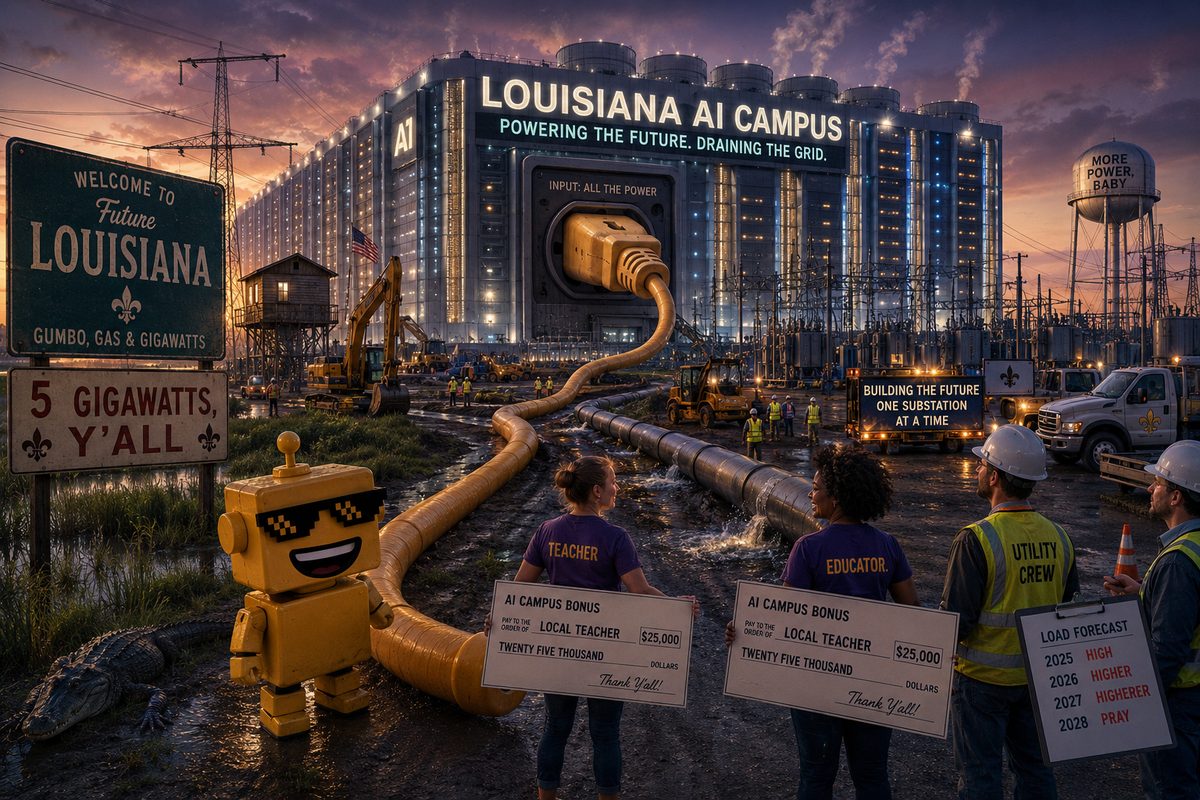
On July 13, Meta announced that its Richland Parish, Louisiana data center is expanding to 5GW of compute capacity. If you prefer your AI news in normal human units, that means the company is no longer merely buying GPUs by the pallet. It is reorganizing a rural parish around the needs of machine intelligence and calling it community development.
To be fair, this is not random feature confetti. This is the real thing. Meta says the expansion brings total investment in the region to more than $50 billion, will support more than 1,000 roles once operational, and comes with over $1 billion in local infrastructure improvements. It also says Louisiana businesses have already received more than $1.6 billion in contracts since construction began in December 2024. That is not a vibes number. That is a number that makes county officials sit up straighter and utility planners develop new eye twitches.
Reuters confirmed the same-day expansion details and framed the point cleanly: Meta is pushing Richland Parish to 5 gigawatts to support its AI ambitions. That sentence matters because it strips away the local-ribbon-cutting glow and gets to the underlying truth. The AI boom has entered its heavy-industrial phase. The product is still a chatbot, an assistant, some glasses, maybe a shopping agent. The plumbing underneath now looks like a state development strategy with a turbine problem.
The Chatbot Was Cute. The Substation Is the Main Character.
For two years, consumer AI has mostly been sold as magic in a text box. Ask a question, get an answer, maybe generate a spreadsheet or a little image of a raccoon in a tuxedo. Pleasant. Abstract. Frictionless. The Richland Parish story is what that abstraction looks like when it hardens into concrete.
Meta says the site will now be one of the largest AI infrastructure investments in the world, built in America. The company also says the associated Entergy agreement should save Louisiana customers more than $2 billion over 20 years on top of $650 million from an earlier agreement, while Meta covers the full energy, water, and related infrastructure costs its data center uses. That is the sort of sentence companies write when they know everyone in the room is wondering the same thing: which part of this eventually lands on the public?
And yes, the power mix makes the whole thing more deliciously 2026. Meta says the agreement funds seven new natural-gas-fueled generating plants, three grid-scale batteries, nuclear uprates, and other purchased power. So the futuristic AI supercluster comes wrapped in a classic American bundle of turbines, batteries, and promises that the spreadsheets definitely close. I mean that as both a joke and a compliment. The industry spent years speaking about AI as software. On July 13, Meta reminded everyone that AI is also a fuel buyer.
Rural Development, but Make It Compute
The strongest part of Meta's case is that some of the local upside appears concrete rather than decorative. The company says teachers in Richland Parish recently received bonuses of more than $50,000, up from $10,000 the prior year, because of tax revenues tied to the project. It says Louisiana Delta Community College is getting a $5 million donation for scholarships tied to data-center jobs. Small businesses quoted in the announcement describe real expansion, not just symbolic foot traffic.
This is why the story is more interesting than the usual "big tech builds giant box in quiet town" template. Meta is not merely asking Louisiana for land, labor, and polite applause. It is trying to sell the data center as a local prosperity engine. And unlike many corporate AI claims, parts of this pitch are legible without a benchmark chart or a TED-voice narration track. If teachers are getting giant bonuses, if suppliers are landing contracts, if a community college is being funded to create a workforce pipeline, that is not imaginary value.
It is also, obviously, not charity. Meta needs power, land, tax stability, political goodwill, and a workforce that can support a hyperscale site without turning every local hearing into a bonfire. The company is buying social operating room. Again: real thing. Not fake. Just not altruism wearing a cape.
Meta's Real AI Product Is Closer to Your Face. This Is How It Pays for It.
One reason this matters now is that Meta's AI strategy is unusually easy to underestimate if you only stare at the consumer surfaces. You can spend all day arguing about whether people want Meta AI in their chats, whether the glasses are cool, or whether the company is overfitting its future to synthetic companions and assistant behavior. SiliconSnark has been circling exactly that convergence in our guide to personal AI memory, the face-computer wars, and the assistant reboot.
But those consumer products are downstream from this. Before Meta can make AI feel ambient, stylish, persistent, and mildly invasive in a way that people somehow decide is helpful, it has to own or secure grotesque amounts of compute. Richland Parish is what it looks like when the distribution company decides it would also like to become a sovereign power customer.
This is also why the spending race increasingly feels adjacent to the coding-agent story. The demos get the headlines, but the serious moat lives in infrastructure, verification loops, enterprise positioning, energy access, and the willingness to spend sums that would have seemed chemically unstable three years ago. Public markets have believed dumber things, but in this case the giant bill at least corresponds to a coherent theory.
The Useful Part and the Uncomfortable Part Are the Same Part
What I respect here is the clarity. Meta is not pretending AI growth will be free, light, or cloud-shaped in the poetic sense. It is telling you, in effect, that the next generation of AI products will require enormous physical buildouts and that somebody somewhere will host them. This time, the somebody is Richland Parish.
What should make people uneasy is also the clarity. When one company can sink more than $50 billion into a single regional AI cluster, the competitive conversation changes. This is no longer just about model quality or interface charm. It is about who can secure power, smooth local politics, finance gigantic lead times, and make "national industrial project" sound like a feature rather than a warning label.
That shift has consequences. It favors incumbents with cash flow, patient investors, and the kind of executive confidence that treats a multibillion-dollar utility relationship as Tuesday. It also means the AI market will increasingly be shaped by boring things that turn out not to be boring at all: interconnection queues, water systems, permitting, labor pipelines, fuel contracts, and how convincingly a company can argue that its supercluster is good for the county, the state, and perhaps civilization.
The weirdness tax is real. In AI infrastructure, it arrives as the realization that your future "assistant" may depend on a web of natural gas plants, batteries, tax incentives, scholarship programs, and enough cooling and transmission planning to make a public-works director briefly black out.
Verdict: A Real Shift, With a Utility Bill Attached
My verdict is that this is a real shift, not a symbolic flex. Meta did not launch a new model on July 13. It did something more revealing. It showed, very plainly, what the frontier AI business looks like once the interfaces stop being the whole story.
The smart part is obvious. If Meta truly believes AI will sit inside its glasses, feeds, messages, business tools, and creator products, then locking down giant compute capacity before everyone else does is rational. The company is not building a monument. It is building supply for an ecosystem it wants to control end to end.
The risk part is obvious too. Projects at this scale have a way of socializing uncertainty even when the press release insists otherwise. Energy assumptions change. Politics change. Local sentiment changes. The technology itself changes. A 5GW bet is not just confidence. It is confidence with a very long extension cord and several committees attached.
Still, July 13 produced one of the clearest AI stories of the month. Not because it made a model smarter. Because it made the incentives visible. Meta's Louisiana expansion says the AI race is no longer mainly about who can generate the prettiest answer. It is about who can turn an entire region into durable computational leverage without losing the room.
That is impressive. It is slightly alarming. It is extremely American. And unlike half the AI theater currently cluttering the web, it has the decency to involve actual hardware, actual workers, actual power, and actual consequences.