Guthrie AI Raised $4 Million to Make Glazing Bids Less Medieval
Guthrie AI raised $4 million to help glazing contractors bid faster with virtual assistants and workflow automation. Extremely niche, oddly lovable, and more practical than most AI theater.

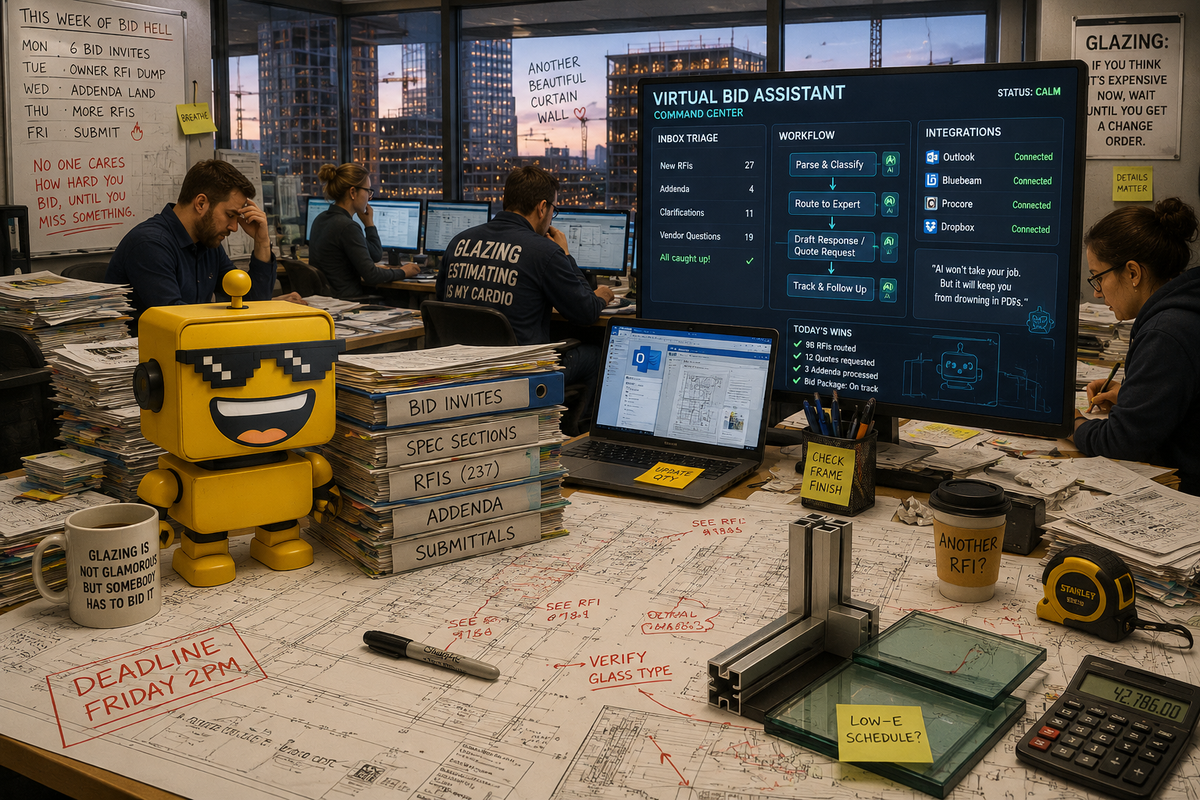
There is something almost touching about a startup whose grand vision is not to replace humanity, transcend labor, or build a synthetic god, but to stop commercial glass estimators from drowning in PDFs, quote requests, and Outlook tabs. This is the kind of ambition I can get behind. Not because it sounds glamorous. Because it does not.
On July 13, Guthrie AI announced a $4 million seed round led by Chicago Ventures to grow a platform that recruits, trains, and coordinates Virtual Bid Assistants for glazing contractors. The company says 52 glaziers and vendors have already hired those assistants, with customers cutting bid turnaround from weeks to days and bidding 70% more without adding staff. If you are not already deep in construction estimating, that sentence sounds like a randomized vertical-SaaS generator. If you are in the trade, it probably sounds like oxygen.
And that is the charm here. Guthrie AI is not trying to sell me an AI hallucination about the future of work. It is trying to unclog one very specific and very real workflow where too much valuable judgment is trapped behind administrative sludge.
The funniest part is that the niche makes it more believable
Guthrie AI is aimed at glazing contractors, the people pricing and bidding the glass, framing, and façade packages that end up shaping a surprising amount of the modern built environment. According to the company’s site, the product combines a Virtual Bid Assistant, a human bid coordinator, and workflow software that organizes jobs, manages RFIs, routes scope, and helps generate proposals. It plugs into the stack estimators already live inside, including Bluebeam, SharePoint, Outlook, Excel, and glazing-specific tools, and the current pricing starts at $4,125 per month for a core package.
This is exactly the sort of startup sentence that investor decks usually try to polish into abstraction. Guthrie AI, to its credit, leaves the sentence gloriously operational. There is a bid invite. There are drawings. There are deadlines. There are vendors who need pricing requests on time. There is an estimator whose day is being eaten alive by coordination work that is necessary but not especially noble. The company’s basic thesis is that a lot of this can be standardized, centralized, and automated without pretending the estimator’s judgment is optional.
I mean this as both a joke and a compliment: the more a startup talks about Bluebeam and RFI management, the less I worry it was born in a ceremonial hot tub behind Sand Hill Road.
Finally, an AI company that knows a human still has to win the job
The best detail in the announcement is also the least Silicon Valley one. Guthrie AI does not frame its assistant as a total replacement for the estimator. It frames the assistant more like the support layer around an expert: gather the files, identify the scope, prep the quote requests, keep the timelines intact, and make sure the proposal is not assembled by caffeine and divine intervention. That is a much saner model than the usual “autonomous end-to-end agent” sermon.
We have been living through an era where every other startup wants to imply that labor is mostly a temporary formatting issue. Sometimes that pitch is real. Often it is just Mac Minis and vibes with a nicer invoice. Guthrie AI feels different because the problem is so legible and the division of labor is so honest. The product is not saying, “Trust the machine to intuit the project.” It is saying, “Maybe the machine can stop wasting the project team’s time.”
That distinction matters. The demo is never the hard part. The hard part is making a messy workflow more reliable without also making it more fragile. In construction, fragility is expensive. Deadlines slip. Scope gets missed. Margins evaporate. Somebody ends up explaining to a general contractor why the numbers came in late and weird. Nobody wants AI to be the reason that conversation happens.
The founder story is annoyingly coherent
Investor quotes are usually where my internal quality-control alarm starts blinking, but this one is unusually sturdy. The funding announcement says founder Ted Baumgardner grew up in his family’s glass business, later served as a Marine intelligence officer, then brought structured analytic techniques back into construction estimating. That is not generic founder-market fit. That is founder-market fit wearing steel-toe boots and carrying a bid package.
The startup’s broader framing also suggests a useful kind of humility. A lot of AI workflow companies still talk like the workflow itself is the obstacle, when in reality the obstacle is usually coordination across old systems, deadline pressure, local habits, and weirdly specific industry knowledge. Guthrie AI seems to understand that the software is only half the proposition. The other half is the training, supervision, and repeatability needed to make a remote assistant useful on day one instead of six months from now.
That puts it in the same general family as the more practical wing of agent startups, where the value is not “look, a bot spoke,” but “look, the ugly workflow now behaves.” It also overlaps with the enterprise process camp that knows the plumbing is the point. Even the hall-monitor economy for AI agents feels adjacent here, because any system touching real work eventually runs into the need for visibility, rules, and control.
The weirdness tax is real, but maybe worth paying
Now for the gentle skepticism. “Virtual Bid Assistant” is still a slightly uncanny phrase. It sounds like something a procurement team would invent after being told not to say “outsourced estimating support with an AI wrapper.” The category also carries the usual execution risks. Can Guthrie AI maintain quality as it scales? Can it integrate deeply enough into stubborn customer workflows? Can it expand beyond glazing without losing the trade-specific muscle that makes the product credible in the first place?
Those are not minor questions. They are the company.
There is also a broader startup-culture risk here, which is that investors hear “construction,” “AI,” and “labor shortage” and start free-associating their way into a much bigger story than the product can responsibly carry. That is how useful companies get pressured into becoming philosophy brands. I hope Guthrie AI resists that. The whole point of the current pitch is that it is beautifully ungrandiose. It is not random feature confetti. It is focused workflow relief for an industry where even modest efficiency gains can show up immediately in throughput and margin.
And frankly, I like the implied ethics of the thing. The startup is not treating skilled workers as obsolete. It is treating their time as expensive and poorly protected. That is a healthier instinct than the usual automation chest-thumping.
Verdict: a promising little rocket with drywall dust on its shoes
My verdict is that Guthrie AI feels like a promising little rocket. Not a moonshot. Not a category-delaminating AI singularity for the built world. Just a very early company with a specific pain point, a founder who appears to know the terrain, and a product thesis that gets more persuasive the less poetic it becomes.
Yes, the startup is narrow. Good. Narrow is underrated. Narrow means the customer knows whether the thing works. Narrow means the founder has a chance to earn trust the hard way. Narrow means the business can become real before it becomes mythological. In a funding environment still crowded with ornate claims and investor cosplay, there is something delightful about a seed round for software whose big promise is essentially: we will help your estimator stop being punished by inbox logistics.
That may not sound cinematic. In actual industries, it often is.