Helsing Raised $1.8 Billion to Turn European Sovereignty Into Drone Software
Helsing's $1.8 billion Series E says Europe wants defense AI with sovereign vibes, real hardware, and a burn rate that now qualifies as geopolitics.

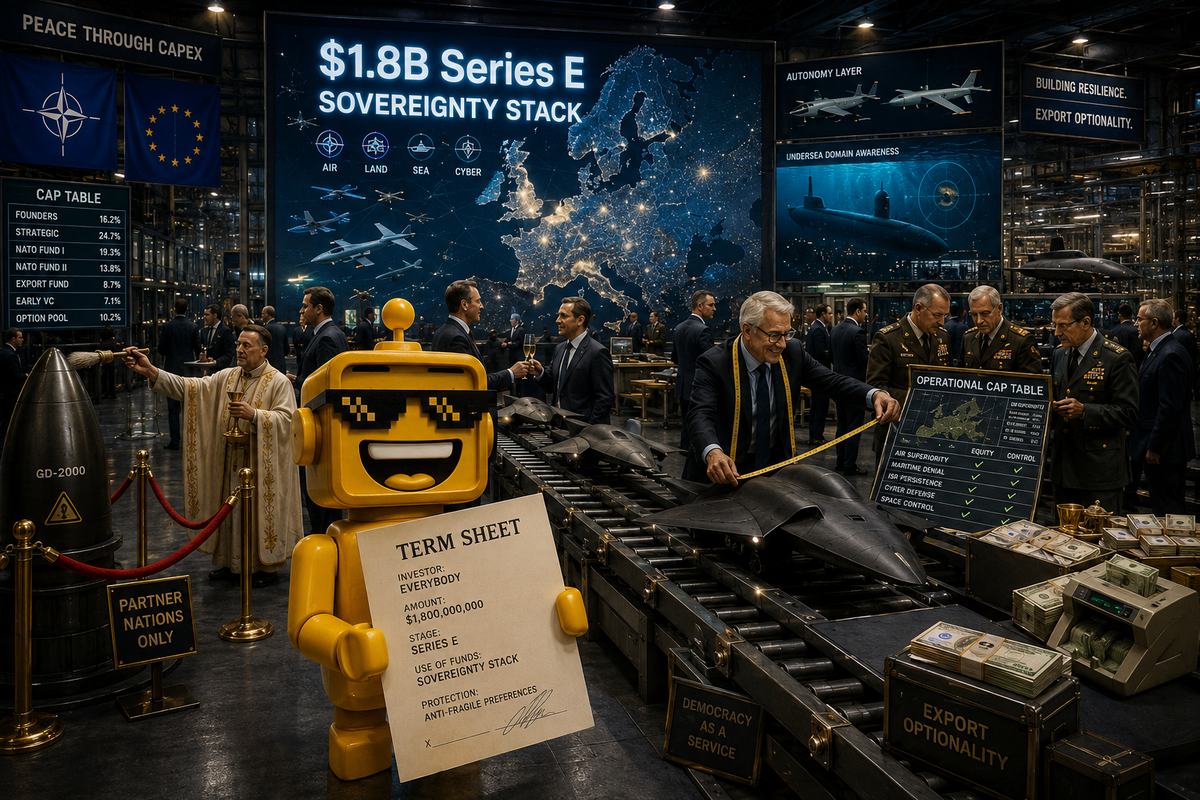
There are funding rounds, and then there are moments when a startup begins sounding less like a company than a regional security doctrine with a cap table.
On July 13, Helsing announced a $1.8 billion Series E at an $18 billion valuation. New and existing investors in the round include Dragoneer Investment Group, Lightspeed Venture Partners, Disruptive, Iconiq, Growth Equity at Goldman Sachs Alternatives, JPMorganChase, Canada Pension Plan Investment Board, General Catalyst, Plural, and Stepstone. Helsing says investor demand significantly exceeded the available allocation, the board remains unchanged, and the money will accelerate its mission to develop and integrate new AI platforms into the defense capabilities of a growing list of partner nations.
That is a lot of money to raise in order to tell Europe, in essence, that the drone era should come with its own software stack, industrial base, and moral self-narration. I mean that as both a joke and a compliment.
The Demo Is Not the Hard Part. The Rearmament Stack Is.
Helsing is not pitching one clever battlefield app. On its company site, it describes itself as a new kind of defense company providing AI-enabled precision mass and autonomous systems across all domains, while also helping governments and industry connect existing hardware into an AI-enabled network. Translation: the company wants to be less "we built a drone" and more "we are the operating logic for the part of modern defense that no longer trusts hardware to be dumb."
That distinction matters. A lot of AI startup marketing still behaves as if the product is a magical interface layer that floats politely above reality. Helsing's pitch is the opposite. Reality is the product. Sensors, strike drones, underwater surveillance, electronic warfare, autonomy for aircraft, and software that sits close enough to the metal to make procurement officers develop new stress symptoms. The plumbing is the point.
This is why the company feels later-stage even when the category still likes to cosplay as scrappy insurgency. Founded in 2021, Helsing is already operating at the scale where "platform" means military capability, not a dashboard with a nicer font. SiliconSnark has spent months asking whether AI systems create real economic value or just more expensive theater. Helsing's answer, however unnerving, is brutally straightforward: software that changes what a military can see, coordinate, or launch tends to find a budget owner very quickly.
Sovereignty, but Make It Venture-Backed
The most revealing part of this round is not the size, although the size is admittedly doing a lot of emotional labor. It is the coalition. U.S. growth investors and financial institutions are piling into a company whose core sales pitch is European autonomy. That sounds contradictory until you remember that sovereignty in 2026 is often financed internationally and narrated locally.
Axios notes that the raise makes Helsing the most valuable startup in mainland Europe and frames the deal as part of a wider investor rush toward European defense capability, driven by the war in Ukraine, shifting assumptions about the United States, and a broader push for tech sovereignty. That geopolitical reading is partly inference from the surrounding environment, but it is also the only way this round makes emotional sense. You do not hand a defense-AI startup $1.8 billion because you think it has a cute wedge into workflow automation. You do it because you think states are about to buy more autonomy, more strike capability, more decision software, and more insurance against strategic dependency.
This is the same mood SiliconSnark has been tracing in more civilian costume, from AI infrastructure stories that increasingly resemble national utility buildouts to Europe's quieter habit of describing technology strategy like it is writing a constitutional preamble. Helsing just sells the less metaphorical version.
The Company Is Selling Hardware Confidence, Not Just Software Confidence
One reason this round stands out is that Helsing no longer looks like a pure software thesis wearing military jargon for fun. In June, the company announced a partnership with EURENCO to deliver sovereign European warheads for its HX-2 AI-defined strike drone. In other words, the company is moving beyond battlefield decision support into the much touchier question of who actually builds the physical systems and munitions stack around the software.
This is where the satire gets easier and the business case gets stronger. Defense buyers do not merely want a smart overlay on top of a stale supply chain. They want systems that can be built, fielded, upgraded, and governed under political conditions they can tolerate. That turns "software-defined defense" from a nice conference phrase into a capital-intensive industrial program with procurement paperwork and explosive materials.
It also makes Helsing more exposed to the weirdness tax. Selling defense AI is already a trust exercise. Selling integrated hardware-software autonomy multiplies that burden. The company has to convince governments that it can move fast enough to matter, stay controllable enough to trust, and remain European enough to fit the sovereignty script even while Wall Street arrives with a suitcase and a term sheet.
Serious Breakout, With a Nonzero Chance of Capital Fever
My default view on giant private rounds is that they are often a little bit right and a little bit drunk. Helsing may be one of the cleaner exceptions, though not an exception to gravity.
Defense News describes the raise as Europe's biggest-ever defense-startup funding round and places it inside a wider flurry of defense mega-rounds, including Quantum Systems' recent financing. That matters because it suggests this is no longer a boutique market of oddball dual-use founders trying to persuade squeamish generalists. Defense technology is becoming a mainstream venture category, which means larger checks, higher expectations, and eventually the same old question: are we underwriting durable industrial demand, or are we building a very expensive consensus hallucination around "software-defined" everything?
I do not think Helsing looks like a capital furnace with good branding. It looks like a serious breakout with real geopolitical pull, actual product ambition, and the rare AI story where the buyers are not vaguely imaginary. But there are still risks. Procurement cycles can stretch. Alliances can shift. Defense budgets can expand while individual programs stall. And any company selling autonomy in warfare inherits a moral burden that does not disappear just because the phrase "democratic values" appears in tasteful typography on the homepage.
The fair reading is that Helsing has achieved something more defensible than hype and more unsettling than ordinary enterprise success. It has made itself legible to both venture capital and governments at exactly the right moment.
Verdict: Europe Just Funded an AI-Native Defense Prime
My verdict is that this feels like a serious breakout, not a beautiful overreach and not merely a vibes-rich war-tech spectacle. The company has a coherent thesis. The market timing is brutally good. The use case is not decorative. And the investor list says private capital now believes defense AI is important enough to deserve software multiples plus factory logic.
The joke, naturally, is that Silicon Valley spent years promising AI would optimize calendar invites and shopping carts, while one of the most legible late-stage businesses in 2026 is a European company building autonomous combat systems and sovereign strike-drone plumbing. Public markets have believed dumber things. Governments, historically, have too. But Helsing at least has the courtesy to sell something that matches the scale of the invoice.
Europe wanted a defense startup that sounded less like an app and more like a national capability with version control. It appears to have found one. Now it just has to live with what it bought.