
Biogen Got an At-Home Leqembi Start Approved, and Cambridge Just Shortened the Infusion Pilgrimage
FDA approved Leqembi IQLIK's at-home starting dose on July 13, giving Cambridge-based Biogen a meaningful Alzheimer's access and workflow win.

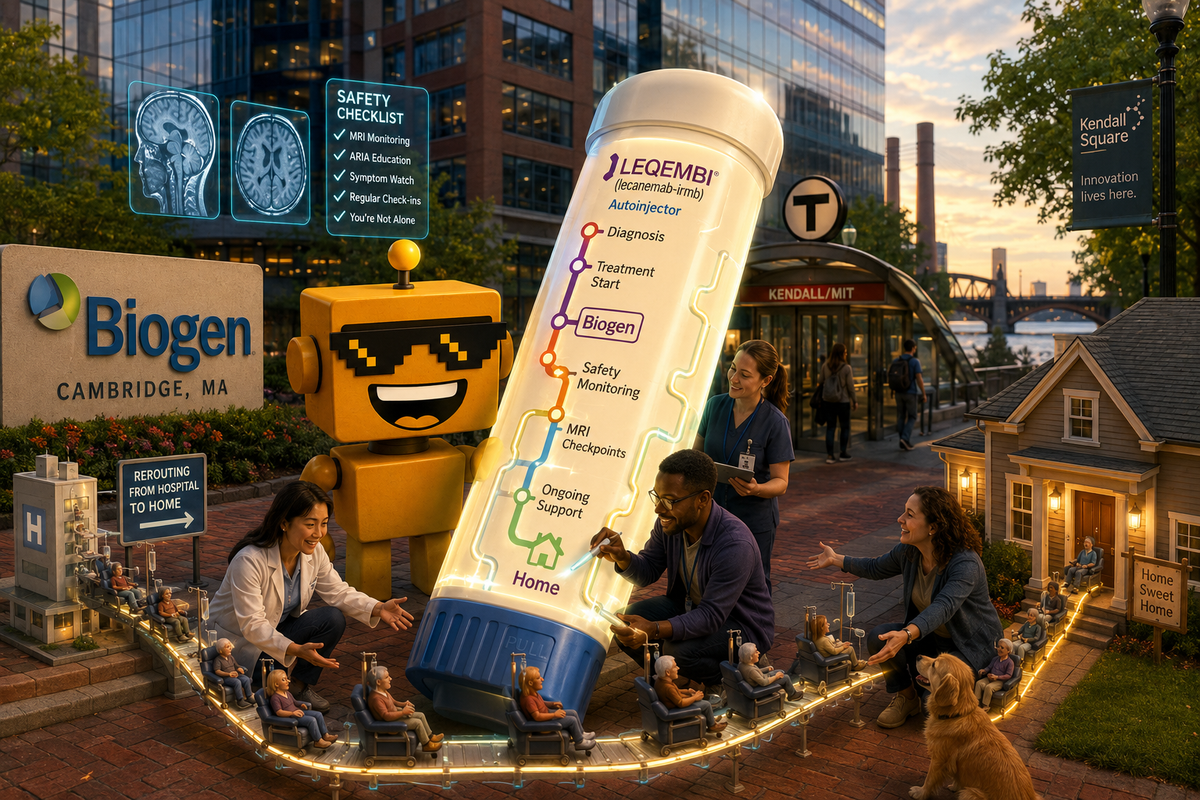
There are few more Boston biotech sentences than, "We have improved the care pathway by changing the route of administration, but everyone still needs MRI monitoring and a careful conversation about brain swelling."
That is the polite, clinically literate version of what happened on July 13, when the FDA approved a new starting dosage regimen for the subcutaneous formulation of Leqembi. The approval lets patients with early Alzheimer's disease begin treatment at home, by themselves or with a caregiver, rather than starting with clinic-based IV infusions. The drug is approved for adults with Alzheimer's disease who are in the mild cognitive impairment or mild dementia stage, the same early-disease population studied in the clinical program.
That may sound like a packaging tweak. It is not. It is a real change to the operating system around one of the most debated categories in neurology: anti-amyloid therapy that can slow decline, carry meaningful risk, and ask families to become part-time logistics coordinators. If you can remove a recurring infusion-center pilgrimage from the front end of treatment, you are not solving Alzheimer's, but you are absolutely changing the sentence from "specialist drug" to "specialist drug with fewer parking tickets."
The Boston connection is load-bearing here. Biogen's partner Eisai and Biogen positioned the filing last November as a way to offer at-home injection from the start of therapy, and Biogen remains one of Cambridge's foundational biotech companies, the kind of Kendall-area institution that keeps turning dense neurology homework into global regulatory events. This is the same regional pattern SiliconSnark has tracked in the Boston tech "collapse" argument: outsiders keep waiting for a cleaner, shinier startup story, while Greater Boston keeps manufacturing very consequential progress in fields that require MRI machines, reimbursement codes, and people who know what a supplementary biologics filing is.
The convenience is real. So is the fine print.
The most important nuance in the FDA's approval notice is that the new subcutaneous starting regimen was not proven in its own giant stand-alone clinical outcomes program. The agency says the evidence rests on two things: first, the proven efficacy of IV Leqembi in prior trials; second, evidence that the subcutaneous formulation produced equivalent exposure in the body and similar amyloid-plaque reduction. That is a legitimate regulatory path, but it is not the same as saying a fresh outcomes trial separately established every clinical detail for the at-home version.
That nuance lines up with the new data Biogen and Eisai presented one day earlier at the Alzheimer's Association International Conference. In that July 12 update, the companies said a once-weekly 500 mg subcutaneous autoinjector achieved exposure comparable to the approved IV initiation regimen, with a 104% exposure ratio and a generally similar safety expectation. They also highlighted early real-world and treatment-center experience suggesting high patient and caregiver satisfaction, which is exactly the kind of evidence you show when your core pitch is not "new molecule" but "same therapy, less infrastructure theater."
And yes, infrastructure theater is a major part of this market. Anti-amyloid treatment is not just a drug. It is diagnosis, neurology access, imaging schedules, counseling, caregiver bandwidth, and a health system that has to act like it has finally accepted that dementia care cannot run on vibes and clipboards forever. Boston understands this better than most places because the local ecosystem is full of companies and institutions trying to convert hard medicine into slightly less punishing workflows. You can see the same civic-house-style instinct in SiliconSnark's earlier coverage of PathAI's digital pathology exit to Roche, where the software mattered because the workflow mattered.
At-home does not mean low-stakes
The warm, useful joke here is that Cambridge has made Alzheimer's treatment a little more Massachusetts: still medically intimidating, but now with more homework shifted from the infusion suite to the kitchen counter.
The less jokey point is that Leqembi remains a serious drug with a boxed warning. The FDA says the most common side effects include headache, infusion-related reactions, and amyloid-related imaging abnormalities, or ARIA, which can involve brain swelling or bleeding seen on imaging. The label also says patients who are homozygous for the ApoE epsilon-4 allele face higher ARIA risk, and it recommends testing before treatment begins to inform that risk discussion. The agency further warns about intracerebral hemorrhage risk, especially when anticoagulants or other risk factors are involved.
So no, this is not some magical consumerization of neurology where a difficult therapy becomes a wellness subscription with better packaging. Patients still need specialist supervision. They still need MRI monitoring. Families still need to understand the benefit-risk tradeoff. What changed is the transport layer. The plumbing is the point.
That is also why the story matters outside Massachusetts. If anti-amyloid therapy is going to become a stable, durable part of Alzheimer's care, it cannot remain operationally dependent on endless infusion-chair time. The category has to get more administratively survivable. Convenience is not a side quest in diseases that already consume family schedules, clinic capacity, and emotional reserves by the truckload. Sometimes the innovation is not a bigger claim. Sometimes it is a smaller bottleneck.
Why this feels extremely Cambridge
Biogen has had a complicated Alzheimer's saga, because of course it has. This is the company whose previous generation of Alzheimer's drama turned Cambridge into a global referendum on evidence standards, surrogate endpoints, and what happens when a desperate field meets a regulator willing to take a controversial swing. That history is exactly why this approval lands differently. It is not a moonshot claim about curing dementia. It is a narrower, more operational win built on an already approved therapy with known constraints. Frankly, that feels healthier.
It also fits the local pattern better than any amount of startup cosplay. Boston biotech is strongest when it does the unglamorous work of making very hard treatments more usable in the real world. We saw that same disposition when Moderna tried to make CAR-T feel less bespoke and more manufacturable, and when Flare Therapeutics raised fresh money to attack one of oncology's least cooperative target classes. This region loves a difficult technical sentence, especially if it can later convert that sentence into a supply chain.
My verdict is that this is a meaningful Boston tech win, but a very specific one. Not "Biogen solved Alzheimer's." Not "home injection saves the day." More like: Cambridge helped remove one of the stupidest frictions from an important but burdensome treatment category, and did it in a way that makes the therapy more accessible without pretending the risk profile vanished.
That is useful progress. It is also classic local progress: not a parade, not a lifestyle brand, just a quieter kind of ambition in which the breakthrough is that the impossible thing now requires one less building.