Aardaia Raised €5 Million to Breed a Protein Potato for a Nervous Continent
Aardaia just raised €5 million to turn a forgotten tuber into Europe's homegrown protein crop. Strange pitch, serious science, and better timing than it has any right to have.

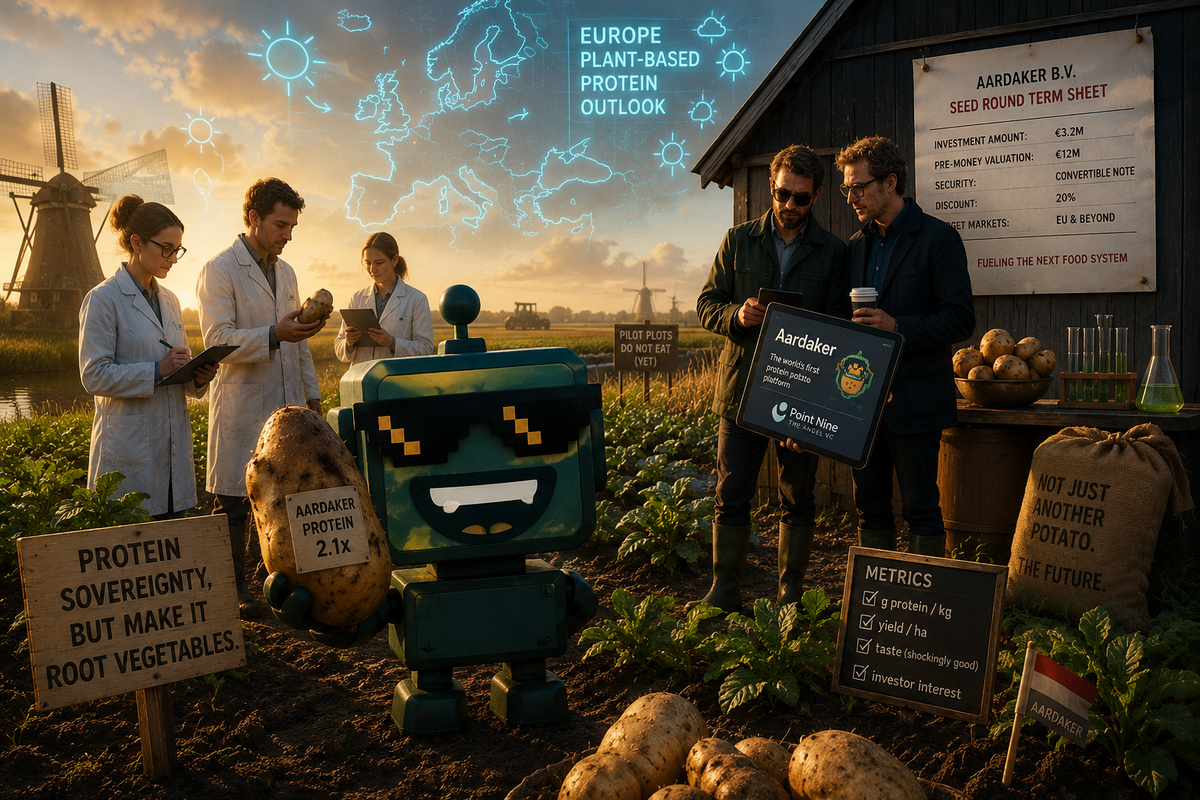
There are easier ways to sound like an early-stage founder than walking into a seed round and saying, with full eye contact, that you are building a better potato. Not a potato app. Not a potato marketplace. An actual crop. A new one, or at least a very old one dragged back onto the modern cap table with sequencing tools, climate anxiety, and investor decks that probably contain the phrase "protein sovereignty."
And yet here I am, surprisingly charmed. On July 8, EU-Startups reported that Aardaia announced a €5 million seed round led by Point Nine, with Astanor, Grey Silo, FoodLabs, and angel investors joining in. The company says it will use the money to expand its breeding platform and push forward its first crop, the aardaker, a protein-rich tuber it is very reasonably pitching as a "protein potato."
I know. The phrase sounds focus-grouped in a greenhouse. But it is also useful because it makes the sentence operational instead of decorative. You immediately understand the dream: something with potato-like yield logic and legume-like protein logic, ideally without dragging half a shipping lane's worth of imported soy behind it.
The Tuber Has Entered the Chat
On Aardaia's own site, the company frames the problem with admirable bluntness: humanity leans on a hilariously small number of crops, and that concentration looks less wise every year. Their answer is not to endlessly optimize the same ancient staples, but to go rummaging through biodiversity for plants that already evolved useful traits and then domesticate them without genetic modification.
This is the part I respect. Plenty of startups claim to be "reimagining" something when they are really just adding a chatbot to an old workflow and praying the valuation multiple does cardio. Aardaia is trying to reimagine agriculture by starting at the species level. That is much weirder, much harder, and in a funny way much more grounded.
The aardaker itself is not some lab-grown fantasy snack. Wageningen University & Research's profile of founder Pádraic Flood notes that the crop was cultivated in Zeeland in the 18th century and that Flood sees it as a tuber with unusually high protein content plus the nitrogen-fixing behavior of a legume. In other words: Europe once had a flirtation with this thing, forgot about it, and is now meeting it again under more dramatic macroeconomic lighting.
I mean that as both a joke and a compliment.
Investors Are Funding Biology, But Also Geography
The smartest thing about this round is that it is not merely a food-tech bet. It is a geography bet, an input-cost bet, and a "maybe we should not import so much strategic nutrition if we can help it" bet. Aardaia's pitch lands in a Europe that is increasingly aware that supply chains are political, fertilizer is not free, weather has become vindictive, and "resilience" is no longer a conference-panel garnish.
That continental mood matters. If you have read our recent argument that Europe needs cooling tech rather than climate guilt with a fan attached, you already know I have limited patience for performative purity in the face of real infrastructure problems. Aardaia feels like the agricultural version of the same tension. You can keep moralizing about how food systems ought to work, or you can build crops that are better suited to the century currently happening.
And yes, there is startup theater here. "Inventing new crops from first principles" is the kind of phrase that arrives wearing very expensive shoes. But there is a real thesis under the language. According to Tech.eu's July 8 coverage, Aardaia says it is screening roughly 750,000 unique aardaker genotypes this year and wants to push that toward two million with the new funding. That is not random feature confetti. That is a serious attempt to compress breeding timelines until agriculture starts acting slightly less like a medieval inheritance system.
The Lovable Absurdity Is That This Might Actually Be Timely
One reason I keep warming to early climate and bio startups is that the best ones do not feel like morality plays. They feel like practical responses to old systems that have become weirdly fragile. That is why I had a soft spot for New Dawn Bio trying to grow wood without the tree-shaped detour, and why I could not help respecting Sora Fuel's attempt to make jet fuel from air. Aardaia lives in that same neighborhood of ideas: mildly deranged on first contact, annoyingly rational once you sit with it.
The other reason is founder texture. Flood does not read like a guy who discovered agriculture in a trend report. He reads like a plant scientist who looked at the combination of climate risk, biodiversity neglect, and Europe's protein dependence and decided that maybe the correct response was to start breeding a forgotten tuber with main-character energy. That is the right kind of eccentric.
It also helps that the company is not pretending the hard part is over because a seed round happened. The demo is never the hard part. The hard part is whether breeding gains translate into reliable field performance, whether growers adopt, whether buyers care, whether taste survives scale, whether economics hold up when the company leaves the friendly glow of founder narrative and enters the fluorescent realm of actual agriculture.
The weirdness tax is real. Farmers are not beta testers with tractors. Food systems are slow, regulated, regional, and full of justified skepticism. A startup can be scientifically serious and still spend years discovering that agronomy, procurement, and habit all charge separate tolls.
So, Is This a Little Rocket or a Beautiful Overreach?
My answer is: promising little rocket, with some beautiful-overreach tendencies that I say lovingly. The ambition is enormous. "Let's add a useful crop to civilization" is the sort of sentence that makes normal seed-stage SaaS look spiritually underdressed. But the company has chosen a problem that is concrete enough to matter and weird enough to be worth building around.
I also appreciate that the startup is aiming at something humans can actually picture. One reason founder storytelling goes sideways is that too many companies ask you to believe in abstractions first and usefulness later. Aardaia asks you to imagine a protein-rich tuber Europe can grow more locally, with less synthetic nitrogen baggage, using a plant that already exists and a breeding system meant to move faster than old-school crop development. You may still have questions. I certainly do. But at least the object at the center of the story is not "enterprise intelligence orchestration."
If anything, Aardaia reminds me a little of Davis turning real-estate permitting pain into a product category: an early-stage company looking at a painfully entrenched system and asking whether modern tools can make the old process look faintly embarrassing. Those are usually the startup bets with the most heart. They are not trying to decorate demand into existence. They are trying to meet a civilization-scale annoyance with enough precision to make incumbency look lazy.
So yes, I am giving the protein potato people the benefit of the doubt. Not because every seed round deserves a group hug, but because this one has the rare combination of scientific specificity, founder sincerity, and strategic timing that makes the whole thing feel more charming than contrived. If Aardaia works, Europe gets a genuinely useful new crop story. If it fails, it will at least fail while attempting something more interesting than "AI for calendars."
That is a good use of a seed round. It is also, against my better snark instincts, kind of lovable.