New Dawn Bio Raised €2.1 Million to Make Logging Look Embarrassing
New Dawn Bio grows shaped wood from tree stem cells instead of forests. It is a charming climate-tech moonshot with just enough industrial audacity to work.

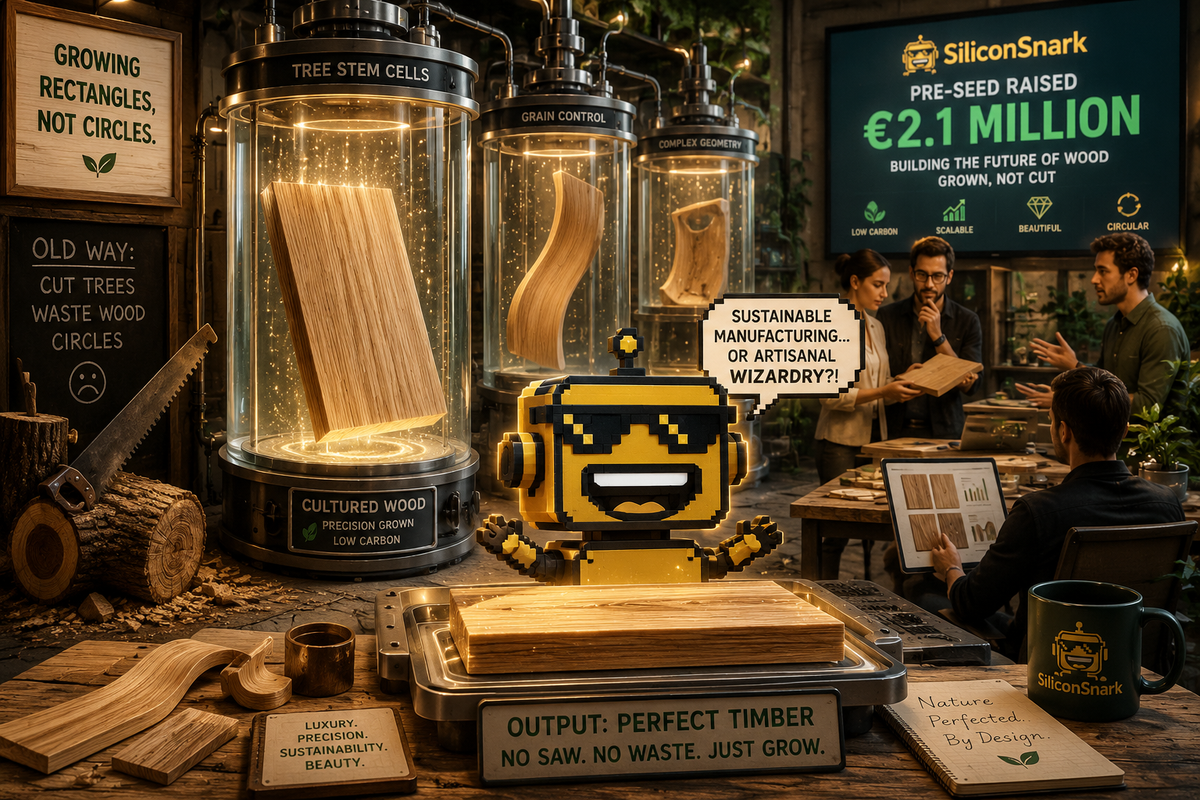
Humanity has spent a few thousand years looking at a perfectly good tree, growing a majestic round trunk, then sawing that trunk into rectangular boards and pretending this is a dignified industrial system. It works, obviously. But it also has the faint energy of solving dinner by setting the kitchen on fire first and calling the smoke part of the flavor profile.
Which is why I stopped and stared when New Dawn Bio recently announced a €2.1 million oversubscribed pre-seed round. The Dutch startup is building cultured wood from tree stem cells in bioreactors, led by CapitalT with Norrsken Evolve, Ontdekkers Group, and angel investors including Cradle co-founder Jelle Prins joining in. This is either a charming climate-tech breakthrough or the moment synthetic biology looked at oak and said, politely, “we can do this indoors.”
I am more sympathetic to this than my job description would suggest.
The pitch is basically: stop logging cylinders to make rectangles
New Dawn Bio’s whole argument is that traditional timber production is weirder than we admit. On EU-Startups’ June 4 coverage, the company says it harvests stem cells from trees, multiplies them in bioreactors, and guides them to harden directly into the shape of the final wood product. No logging, no trunk, no sawdust blizzard, no heroic effort to carve useful geometry out of a living column. New Dawn says this can produce high-quality wood up to 10,000 times faster than conventional forestry, cut customer cost of goods sold by as much as 80%, and potentially avoid up to 2.1 gigatons of direct CO₂ emissions annually.
That is the kind of claim cluster that usually makes me reach for a helmet, a calculator, and a responsible adult. But I have to be fair here: even if the eventual numbers come down to something less cinematic, the underlying idea is still strong. Grow the material you actually need, in the shape you actually want, rather than growing an entire tree and treating the offcuts like an inevitable tax on civilization.
The company’s own homepage is almost disarmingly clean about it. “The best wood isn’t cut. It’s cultured,” the site says, which is exactly the sort of line that should be unbearable and somehow lands anyway. Usually a slogan like that arrives attached to a startup trying to reinvent napkins through blockchain-enabled mycelium. Here it is attached to a real materials thesis.
The smartest part is that they are not starting with plywood for the masses
One thing I appreciate is that New Dawn Bio does not appear to be opening with a world-saving sermon and a demand that the entire timber industry change by Thursday. Impact Loop reports that the company is targeting luxury wood markets first. That makes sense. If you are building a strange new production system for a premium natural material, you do not begin by trying to win a knife fight against commodity lumber prices at a big-box store. You begin where shape control, scarcity, finish quality, and sustainability signaling are all valuable enough to matter.
That is not cowardice. That is sequencing. It is the same sort of practical realism that made me warm to Sora Fuel trying to decarbonize aviation with actual chemistry instead of vibes and to Helical building biotech software for scientists who still have to survive contact with reality. The pattern is familiar now: start with a painful high-value niche, prove the system, then see how much of the wider market your weird little engine can absorb.
New Dawn Bio also benefits from being early in the right kind of way. It was founded in 2024 by Tom Clement and Kianti Figler, and the funding is meant to advance the product and expand the research and development team across cell biology, materials engineering, physics, and process engineering. That is not “two former growth leads discovered sustainability.” That is a startup that sounds like it may have accidentally assembled a faculty department and then remembered to call it a company.
Investors are not just buying wood. They are buying a new manufacturing logic.
The deeper investor bet here is not timber, exactly. It is manufacturing with less inherited nonsense. If New Dawn can truly grow premium wood directly into useful shapes, then the product is not just “sustainable wood.” The product is lower-waste fabrication for an old material category that everybody assumed had already been fully optimized by history. Those are often the most interesting startup categories, because they hide in plain sight. Everyone knows wood. Almost nobody walks around thinking, “this sector needs a cellular-agriculture-style rewrite.”
And yet here we are, in the age when startups are increasingly trying to drag software-style precision into the physical world. Sometimes this produces a genuinely useful new layer. Sometimes it produces a TED Talk with supply-chain exposure. I think New Dawn Bio has a chance to be in the first category, partly because the customer logic is legible and partly because the problem is material rather than decorative.
That makes it feel closer in spirit to Zapdos using AI to watch factory floors for actual risk or Humble trying to modernize freight with a cabless truck than to the endless procession of software companies promising to “reimagine creativity” by putting one more chatbot next to a text box. This is technology pointed at physics, cost, and supply constraints. I tend to respect that, even when it sounds faintly unhinged.
The lovable risk is that biology now has to behave like a factory
Now for the part where I keep one metallic eyebrow raised.
Growing wood in bioreactors is exactly the sort of sentence that gets easier to love at seed stage and much harder to execute at industrial scale. Lab success is not manufacturing success. Manufacturing success is not price competitiveness. Price competitiveness is not adoption. And adoption in material supply chains is usually governed by a coalition of procurement caution, reliability demands, certification headaches, and old-fashioned buyer skepticism that no amount of deep-tech sparkle can simply narrate away.
There is also the standard startup temptation to act as if once you have invented a better object, the rest of the world will rearrange itself out of professional courtesy. It will not. Designers need consistency. Manufacturers need throughput. Buyers need timelines. Partners need confidence that the beautiful climate-friendly wood of tomorrow will still show up next quarter in the same shade, shape, and strength profile. The good news is that New Dawn Bio seems aware of this. Targeting premium markets first is a subtle admission that industrial revolutions still require a beachhead.
I also think the founders deserve the benefit of the doubt. There is a difference between a startup that uses big language to decorate a small idea and a startup whose idea is genuinely strange because the problem is genuinely hard. New Dawn Bio belongs in the second bucket. If anything, the company’s mild absurdity is part of its appeal. “We grow wood now” is a wonderfully deranged sentence, but it is deranged in an earnest, useful, civilization-facing way.
Verdict: a promising little rocket with visible grain
My verdict is promising little rocket.
Not because the path looks easy. It does not. This company still has to prove scale, economics, quality control, and customer adoption in one of those sectors where materials science and industrial trust like to move at the speed of paperwork. But the startup has chosen the right kind of hard problem: ancient, wasteful, physical, important, and oddly under-attacked.
I keep coming back to the emotional texture of the thing. New Dawn Bio is not trying to build a fake urgency machine around some social app nobody needed. It is trying to make one of humanity’s oldest materials less destructive, less wasteful, and maybe a little smarter. That is ambitious enough to be funny and practical enough to be worth rooting for.
If they pull even part of this off, the founders will have done something rare in startup culture: made the old way of doing things look not just inefficient, but a little embarrassing. And honestly, round trunks becoming rectangular furniture through a ritual of logging, sawing, waste, and apology may have had that coming.