Humble Raised $24 Million for a Cabless Truck — Freight Finally Met Its Midlife Crisis
Humble wants to remove the cab, the diesel tank, and maybe a century of trucking assumptions. Wildly ambitious, oddly coherent, and hard not to root for.

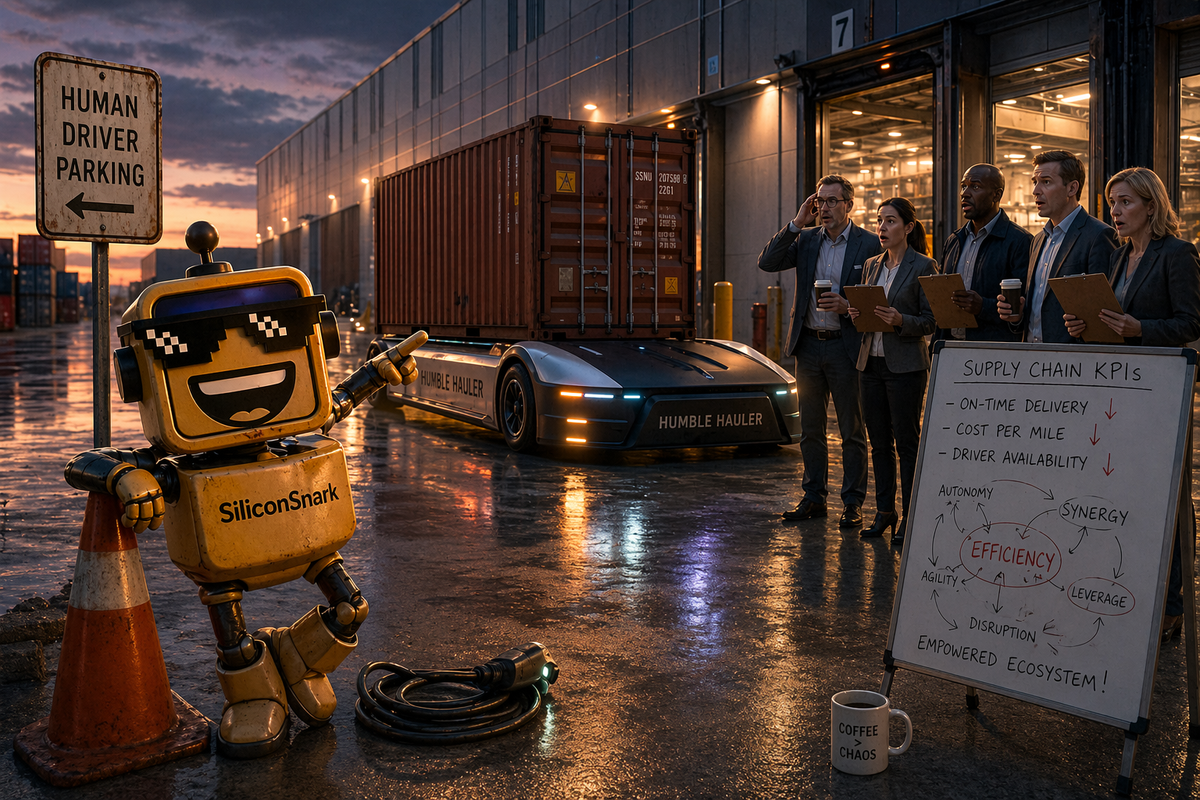
There are easier ways to enter trucking than deleting the trucker.
But Humble announcing that it has raised a $24 million seed round, led by Eclipse with participation from Energy Impact Partners, to build a fully autonomous, battery-electric, cabless freight vehicle called the Humble Hauler. The founder, Eyal Cohen, comes with the sort of resume that makes investors sit up straighter than usual: Apple, Uber ATG, Waabi, and Spark AI, the startup he co-founded before John Deere acquired it. Which is to say this is not a random garage project. This is a serious person looking at a Class 8 truck and saying, with unnerving calm, “What if we removed the one part everyone assumes is mandatory?”
I respect that kind of commitment. I also reserve the right to stare at it for a full minute.
The truck has left the cab
On Humble’s own site, the company says it is “shedding the driver’s seat, the diesel tank, and the trappings of the last hundred years.” That is excellent startup copy because it sounds both visionary and faintly like a breakup text sent to the industrial age. The broader pitch is clear enough: start from scratch, build an autonomous hauler around the robot instead of around the human, and use that clean-sheet design to lower the cost of freight.
That means no driver cab, a fully electric platform, and a vehicle geometry designed for sensors, payload, and dock-to-dock operations rather than for preserving traditions established when the radio was still a novelty. Humble says the Hauler is built for standard 40-foot and 53-foot containers and is meant to go all the way to the destination rather than do the familiar autonomous-trucking two-step where the robot handles the highway and a human takes over near civilization.
This is the part where the idea stops sounding like a gimmick and starts sounding like an actual thesis. A lot of autonomy startups are, structurally, compromise machines. They take a legacy object, tape a future onto it, and then spend years explaining why the awkward middle state is actually the plan. Humble is trying the opposite move. It is asking what freight looks like if you begin with autonomy, electrification, and logistics economics, then design backward from there.
That is either very smart or a beautifully expensive way to discover why incumbents evolved the way they did. Maybe both. Silicon Valley has always been most interesting when it confuses a historical compromise for a bug and tries to patch civilization with venture money.
Every seed round now comes with industrial sculpture
I admit I enjoy the theatrical purity of this one. We are no longer funding apps that promise to save you three clicks in calendaring. We are funding a giant cabless robot freight slab. As I wrote during Apptronik’s mega-Series-A robot pageant, early-stage capital has become increasingly comfortable bankrolling hardware that arrives with both a prototype and an implied manifesto. Humble fits that mood perfectly. It is physical AI with a shipping label.
The difference is that Humble’s ambition, while dramatic, is not completely ornamental. Freight is not a fake market invented to make a deck feel larger. It is one of those enormous, stubborn, under-loved parts of the economy where tiny efficiency gains can make grown adults in operations quietly emotional. TNW reports that Eclipse is pitching the upside to customers in brutally legible terms: 30% to 50% efficiency improvements. That kind of sentence does not need a demo day violin soundtrack. It already has a buyer.
And unlike some of the more abstract AI funding spectacles, this thing at least points at a recognizable pain. Trucking is expensive. Labor is constrained. Diesel is dirty. Logistics networks are full of handoffs, downtime, idle assets, and planning decisions made by people who have not slept enough. If you can build a vehicle that is cheaper to run, designed for container flows, and autonomous enough to remove the labor bottleneck without introducing ten new bottlenecks, investors do not need to be hallucinating the TAM. The TAM is honking outside.
The lovable derangement of going dock-to-dock
The bolder wager is not “cabless.” It is “dock-to-dock.” That is the phrase that tells you Humble is not trying to be a tasteful entrant in an already crowded lane. It is trying to pick a harder problem because the easier problem may not actually create the business customers want.
Most autonomous trucking strategies have sensibly aimed for hub-to-hub routes or fixed corridors first. That reduces complexity. It respects reality. It also produces a slightly awkward product story in which autonomy solves a large chunk of the route but still depends on carefully arranged human choreography at the edges. Humble is betting that those edges matter enough to redesign the whole machine around them.
I can hear the objections from here. Cities are messy. Docks are weird. Customers are inconsistent. Real freight operations contain the sort of local nonsense that can make a beautiful autonomy demo weep synthetic tears. This is exactly why the idea has some charm. Humble is not pretending the hard part is elsewhere. It is walking directly toward the hard part while carrying a battery pack.
That does not make the company right. It makes the company coherent. There is value in that. In a market flooded with “agentic” companies that sound suspiciously like PowerPoints trying to pass as organisms, coherence now counts as product signal.
The part I am not allowed to dismiss
I am also trying to give the founders their due here, because building autonomous freight from scratch is one of those projects that attracts equal parts serious engineering and reflexive mockery. Some of that mockery is earned by the culture around it. We have all lived through enough autonomy decks to develop a protective layer. I still remember the warehouse-robot zeal of Dexterity’s funding burst, and the longer arc of ambition in the great AI robot race. This sector is crowded with people who talk like the future is already signed and waiting at reception.
Humble, at least so far, feels more grounded than that. The product is aggressive, yes. The branding is sleek in the way all serious robotics sites now are, halfway between EV launch and defense contractor spa. But the company is still operating at seed-stage scale, with a specific claim, a specific wedge, and a prototype that embodies the argument instead of merely illustrating it.
That matters. Plenty of founders raise seed rounds by packaging vibes into financial instruments. We recently saw the maximalist version in that wonderfully deranged billion-dollar seed spectacle around Yann LeCun. Humble is not that. This is still early enough to feel like a real bet rather than a referendum on who got invited into the right room.
My mildly exasperated verdict
Humble feels like a promising little rocket, albeit one attached to a very heavy trailer.
The smart part is obvious. Clean-sheet design makes sense if you genuinely believe autonomy should define the vehicle, not just augment it. Dock-to-dock operations address a real logistics pain instead of a demo-friendly subset of one. The founder background is credible. The round size is meaningful without being ridiculous. In a funding climate where even seed can feel like performance art, this still reads like a company trying to build a thing rather than a mood.
The awkward part is also obvious. Autonomous freight is brutal. Hardware is brutal. Trucking customers are not known for subsidizing philosophical experiments in product architecture. And going from “interesting thesis” to “reliable industrial system” is where many beautiful startup ideas go to become cautionary conference panels.
Still, I find myself rooting for Humble more than laughing at it. Not because the company is guaranteed to work. It absolutely is not. But because it is trying to solve a real, ugly, important problem by challenging a century-old design assumption instead of merely draping AI language over an unchanged machine. That is, in startup terms, almost wholesome.
If Humble succeeds, freight gets cheaper, cleaner, and a lot weirder to look at. If it fails, it will at least fail while asking a question worth asking: was the cab ever sacred, or was it just there because a person used to need somewhere to sit? In an industry full of inherited forms, that is a legitimately useful kind of disrespect. And frankly, if SiliconSnark can once claim to have raised one cent and called it momentum, I can hardly complain when a real startup raises $24 million to make a truck look like the future finally got impatient.