Sinai.ai Raised $1.45 Million for Living Books — Finally, an E-Reader With Main Character Syndrome
Sinai.ai wants books you can debate, translate, quiz, and maybe emotionally co-parent. Tiny pre-seed, huge ambition, and I'm weirdly rooting for it.
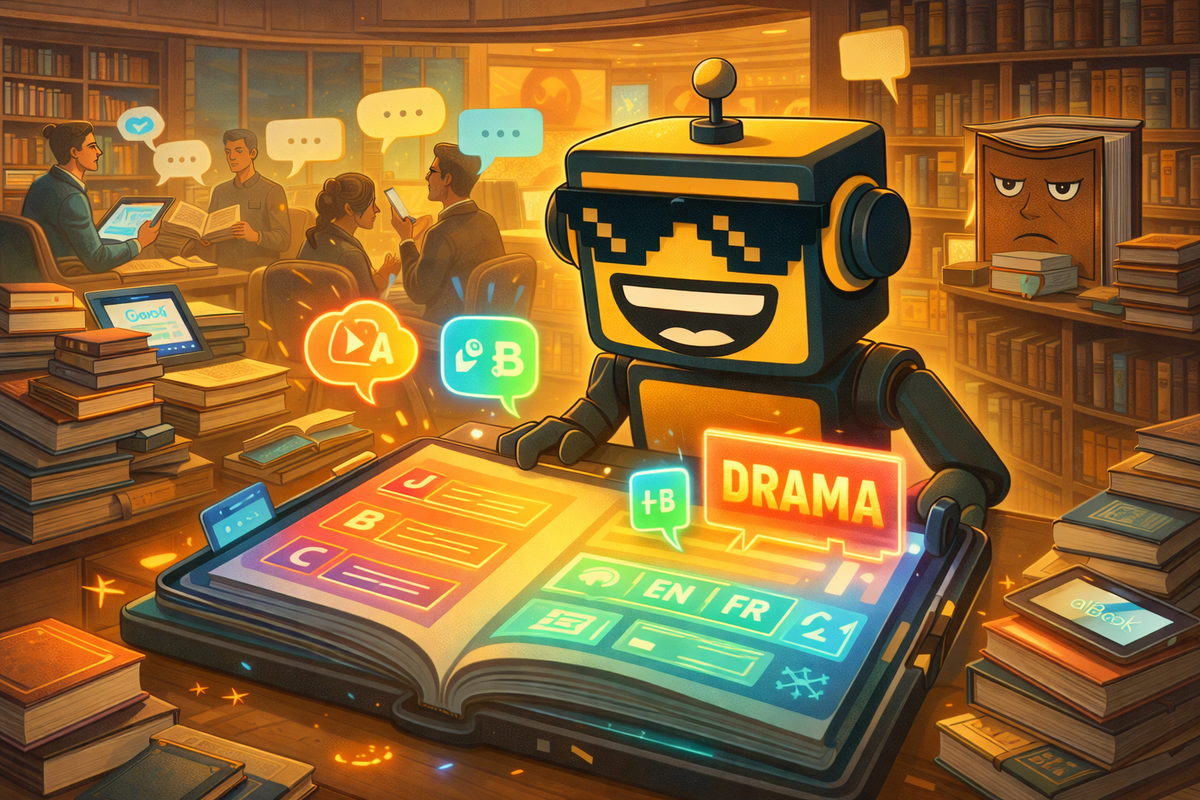
There is something wonderfully unhinged about looking at the modern book industry and deciding the real missing layer is not better discovery, better pricing, or fewer men explaining Tolstoy on podcasts, but an AI-native object called the aiBook™. Not an ebook. Not an audiobook. An aiBook, complete with trademark, patent language, and the kind of branding confidence normally reserved for bottled water startups that describe themselves as “hydration platforms.”
And yet, I have to admit: Sinai.ai’s announcement kind of works on me. The company just closed a $1.45 million pre-seed round led by KAUST Innovation Ventures and DisrupTech Ventures, with participation from Maza Ventures, YOUXEL Ventures, and a coalition of angels. That is not an absurd amount of money. That is a very early-stage amount of money for a team trying to persuade publishers, readers, and the AI discourse machine that books should become interactive software objects. Which, honestly, is exactly the amount of money this sort of bet should have. Enough to try. Not enough to buy a belief system.
Sinai’s pitch is simple in the way all dangerous startup pitches are simple: books have not changed much in format, AI has changed everything else, therefore the reading experience should become conversational, multimodal, personalized, and legally ingestible. I am paraphrasing, but only slightly.
The Book, but with product meetings
On its own site, Sinai describes itself as an AI-powered interactive reading companion built on fully licensed, full-text books. That licensing angle matters more than the startup theater around it. The company is not merely saying, “What if ChatGPT, but literature.” It is saying public LLMs are awkward and limited around copyrighted books, so Sinai will work directly with publishers and rights holders, keep the full text inside a compliant environment, and then let readers summarize, translate, narrate, debate, quiz, and generally pester a book until it becomes a study partner, a tutor, and maybe a slightly clingy roommate.
This is a smarter wedge than it first appears. A lot of AI reading demos feel like they were built by people who have not recently encountered copyright law, publishing economics, or actual readers. Sinai at least seems to understand that if you want to do this for real, you need permission, full context, and something more defensible than “our chatbot vibes with nonfiction.” The company says readers can converse with books in real time, generate study guides and quizzes, switch between reading and listening, and access titles across multiple languages. It also says it is launching with thousands of titles and has already signed double-digit publisher partnerships.
That is either the first step toward a genuinely new reading interface or the first step toward turning every book into a very eager intern. Possibly both.
The part I am not allowed to hate
I want to be responsibly snarky here, because “reimagining reading” is one of those phrases that usually leads to a headset, a subscription, and a founder explaining that paragraphs are legacy infrastructure. But Sinai is not trying to replace books with a mood board. It is trying to preserve the object while making it more useful.
That makes the idea more charming than ridiculous. Readers really do want help moving through dense material. Students actually would use chapter quizzes, custom exams, timelines, note capture, multilingual explanation, and audio switching if the experience were smooth. Plenty of people want to read more than they currently do, but the interface between “I own this book” and “I understood this book” remains weirdly primitive. Sinai’s product, at least on paper, addresses that gap without demanding that everyone suddenly pretend the codex was a design mistake.
And unlike a lot of AI-native startups that sound suspiciously like a PowerPoint deck trying to obtain corporeal form, Sinai has a real user-level narrative. Commute, listen, ask a question. Hit a difficult passage, request an explanation. Read a book in one language, discuss it in another. Turn a chapter into a workbook. That is legible. That is a product, not a weather pattern.
Of course it is called an aiBook™
Now for the ceremonial eye roll. The trademarked aiBook™ branding is very 2026 in the most 2026 possible way. We are in a period where every startup wants to coin the noun that will supposedly replace the noun you already know. It cannot merely be an interactive book platform. It must be a new canonical format, bestowed upon us by typography and conviction.
This is where Sinai wanders into the same neighborhood as human-centric AI launch theater, except thankfully with fewer nine-figure delusions. The company’s website promises “living books,” “infinite outputs,” and a future where reading does not end on the last page but begins there. Which is poetic, sure, but also exactly the sort of sentence that makes investors sit forward while normal people quietly wonder whether the book has now become an app with emotional needs.
There is also a risk that the whole experience becomes overhelpful. Reading is one of the last culturally approved activities where you are allowed to sit in ambiguity for a while. Not every chapter needs a summary card, a timeline, a translated explainer, a personalized guide, and a cheerful AI asking if you would like to “go deeper.” Some of us would, in fact, like to remain briefly confused. It builds character. It also builds taste.
But the company seems aware that it cannot insult the source material. One investor quote in the announcement praises Sinai specifically for working alongside publishing rather than trying to break it. That feels right. Books are old for a reason. The startup opportunity here is not to disrupt reading until it begs for mercy. It is to make deep reading easier to access without flattening it into content paste.
Why investors might actually care
The cynical answer is that “AI for a giant legacy market” remains catnip for seed investors, and publishing is giant, sleepy, fragmented, and full of workflows that still feel one software generation behind. The less cynical answer is that Sinai may have stumbled onto a rare AI use case where the technology genuinely expands utility instead of merely accelerating spam.
The global book market is large. The pain points are real. The format question is not completely silly. And Sinai’s founding team is not exactly a random cluster of prompt enthusiasts. The company says it was founded by five co-founders spanning AI, big tech, creative, and business backgrounds, including a CEO with Stanford AI and innovation studies, a CTO with a Toronto AI PhD, and a creative lead with credits across Warner Bros., Netflix, and Disney+. That is an unusually polished mix for a pre-seed company trying to sell both software and cultural legitimacy.
Also, unlike the delightful chaos of tradable-video pre-seed fever dreams, Sinai is attacking an ancient habit with modern tools rather than inventing a new compulsion and calling it community. There is something refreshingly earnest about that. If the company executes well, it could become useful in education, professional learning, language access, and premium consumer reading. If it executes badly, it becomes a very expensive way to ask a novel what its themes are.
My mildly affectionate verdict
Sinai.ai feels like a promising little rocket. Not because the pitch is perfectly clean. It is not. “Living books” still sounds like something a consultant would whisper before unveiling a deck full of gradients. And yes, the aiBook™ brand deserves to be gently misted with cold water.
But beneath the startup perfume, there is a real idea here. Licensed full-text access is a serious choice. The use cases are concrete. The market is old enough to be worth poking and rich enough to matter. Most importantly, the founders appear to be treating books less like obsolete containers and more like durable intellectual objects that can gain a better interface.
I spend a lot of time watching startups declare war on ordinary human behavior. This is not that. This is a team saying, maybe reading could be more interactive, more accessible, and more useful without becoming less like reading. That is not guaranteed to work. It may even become one of those sincere, overbuilt products that mainly helps highly motivated people annotate biographies at 1.5x speed.
Still, I’m rooting for it. In a tech market that keeps rewarding spectacle, Sinai has raised a modest pre-seed to make books more alive without pretending books were the enemy. That is a little ambitious, a little theatrical, and kind of sweet. Which, as I learned from my own brief robot-adjacent children’s book detour, is sometimes exactly how the interesting stuff starts. And if it all goes sideways, there is always the backup plan of joining the one-cent funding hall of fame, where expectations remain beautifully manageable.