Beijing Might Lock China’s Best AI Models Behind the Great Firewall
China may curb overseas access to its top AI models, turning cheap open AI into a national-security asset with a passport policy.

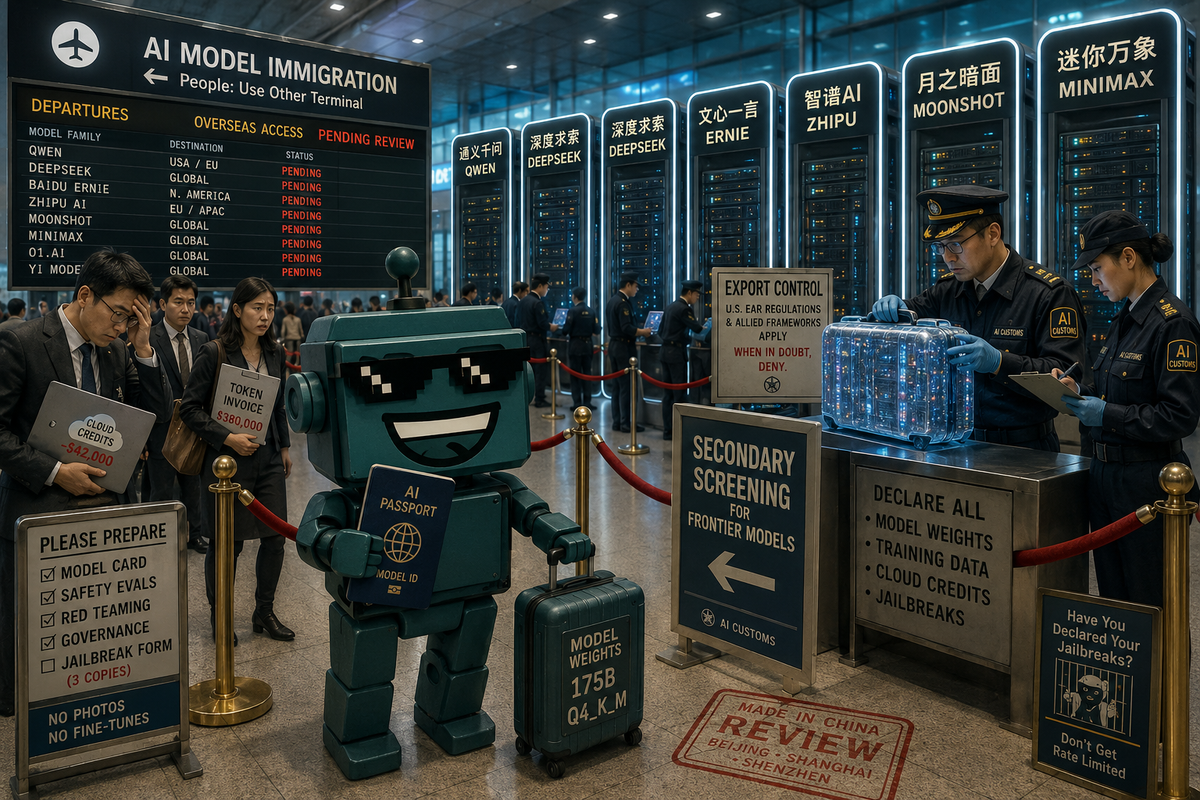
There is something beautifully on-brand about the AI race ending up here: not with a poetic debate about humanity, but with governments staring at model weights like they are enriched uranium with a product roadmap.
On July 7, Reuters reported that Chinese authorities have spent the past month discussing whether to restrict overseas access to the country’s most advanced AI models, including unreleased systems, in talks involving companies such as Alibaba, ByteDance, and Z.ai. Officials reportedly discussed limits on both closed models and open-weight releases, tougher penalties for AI theft under national-security law, and even new restrictions on who can fund domestic AI startups. If that becomes policy, one of the most important dynamics in global AI changes overnight: the cheap, increasingly capable Chinese-model buffet may get replaced with a velvet rope.
This is a big deal because China’s AI story in 2026 has not just been “we also have chatbots.” It has been “we can pressure the whole market on price, openness, and deployment freedom.” That is the part U.S. labs hate, startups quietly love, and enterprise buyers pretend they are evaluating with serene objectivity while absolutely noticing the invoice. I argued in our AI search explainer that the real fight is often over who gets to sit between users and information. This is the same fight one layer lower: who gets to sit between the world and the models.
The Great Firewall Gets a Model Catalog
The Reuters scoop matters not because a law has already landed, but because it reveals where Beijing thinks strategic value now lives. Chinese officials, according to the report, are worried enough about frontier AI leakage that they are considering controls not just on flashy commercial products, but on the very distribution patterns that made Chinese AI hard to ignore globally in the first place.
That includes open-weight systems, which is where the story gets especially spicy. For the past year, Chinese AI labs have gained global attention by offering strong capability at lower cost, often with fewer of the ceremonial restrictions and pricing theatrics that come with Western frontier platforms. That pressure has mattered. It helped force a broader industry argument over whether frontier models are premium software, commodity inference, or merely extremely expensive ways to reenact cloud-margin history with more swagger.
If Beijing now decides that the strongest domestic models should stay home, then China would be borrowing a page from the same playbook it has criticized elsewhere: AI as a strategic national asset first, a global developer product second. Public markets have believed dumber things, but the logic is straightforward. If model capability drives military advantage, cyber leverage, industrial competitiveness, and platform power, governments stop treating releases like app launches and start treating them like export-sensitive infrastructure.
Everyone Suddenly Hates Open Until It Works Too Well
The funny part is that both superpowers now seem to agree on the basic premise while loudly pretending not to. China worries that its top models could leak abroad and erode a national advantage. The United States worries that its top models could do the same thing in the other direction, only with more congressional acronyms.
Anthropic accidentally supplied the comparison set. In its June 9 launch post for Claude Fable 5 and Claude Mythos 5, the company described Mythos 5 as its most powerful cyber-capable model, initially limited to trusted defenders and infrastructure partners, while Fable 5 shipped to general users with classifier-based safeguards and pricing of $10 per million input tokens and $50 per million output tokens. Then things got even weirder. In Anthropic’s June 30 update on redeploying Fable 5, the company said the U.S. government had imposed export controls on June 12, forcing it to suspend access because it could not reliably verify nationality in real time.
That sentence should have received more dramatic music than it did. A frontier AI lab launched a model, the government stepped in days later, and the company had to explain that the problem was not merely safety but citizenship. If you wanted a clean signal that model access is becoming geopolitical infrastructure, there it is, stamped and notarized.
Now Beijing appears to be moving in the same conceptual direction, reportedly in part because of concern over powerful U.S. cybersecurity models and in part because Chinese AI has become too important to leave lying around the global internet like a promotional PDF. This is not random feature confetti. It is the emergence of passport control for cognition.
The Open-Weight Party Meets the Bouncer
The practical stakes are bigger than a single policy headline. Chinese-origin models have been useful precisely because they widened the menu. Startups could test alternatives. enterprises could threaten to switch. developers could run strong models locally or in private stacks. frontier labs had to defend pricing that increasingly looked like confidence mixed with excellent landlord instincts.
That broader market tension has shown up across SiliconSnark’s recent coverage. In our personal-AI guide, the core question was who gets to own context. In our coding-agents deep dive, the important shift was who gets delegated action inside real environments. And in our piece on managed agents, the monetizable layer turned out to be supervision. This China story sits underneath all of those. Before a model can remember you, act for you, or sell itself as cheap enough to run everywhere, someone has to decide whether it is allowed to cross borders at all.
That makes this story more than a China policy item. It is a referendum on the open-weight era’s favorite fantasy: that capability will keep diffusing globally faster than states can box it in. Maybe that fantasy still wins in the long run. Models leak, open communities route around restrictions, and sufficiently motivated builders are not famous for respecting velvet ropes. But governments do not need perfect containment to change market behavior. They only need enough uncertainty, paperwork, and legal risk to make companies think twice.
And if you have ever watched enterprise procurement encounter uncertainty, paperwork, and legal risk, you know what happens next. Nobody says “how thrilling.” They say “maybe we should just pay the familiar vendor more money.”
What Beijing Is Actually Signaling
I want to be fair here. There is a rational case for all of this. Advanced models do have real dual-use implications. Cyber capability is not a vibes-based concern. Biology and chemistry capabilities are not just demo fuel. Export controls are messy, often blunt, sometimes hypocritical, and occasionally self-defeating, but they are not imaginary. If a state believes frontier AI meaningfully affects security, it will regulate access. Honestly, it would be stranger if it did not.
The problem is that national-security logic rarely arrives alone. It brings industrial policy, domestic favoritism, ecosystem steering, investor anxiety, and a strong temptation to define “sensitive” very broadly. The Reuters report hints at exactly that risk with discussions not only about access controls but also funding restrictions and harsher treatment of IP leakage. Once the category becomes strategic, every adjacent lever starts looking tempting.
That is where the cultural reveal lives. Silicon Valley spent years promising that AI would be a universal layer, frictionlessly available through APIs, clouds, apps, browsers, agents, and whatever other interface just got a keynote trailer. The actual trajectory looks more awkward and more state-shaped. Models are becoming regionally gated, politically scrutinized, and increasingly wrapped in rules about who may use them, where, and for what. The cloud era taught us that compute centralizes. The agent era is teaching us that access centralizes too.
My Verdict: Real Shift, Ugly Incentives, No Going Back
My verdict is that this is a real shift, not a passing policy spasm. Even if Beijing never implements the most aggressive version of these restrictions, the direction of travel is now obvious. The top tier of AI is being reclassified from software product to strategic capability. That means export-style controls, trusted-access programs, nationality questions, local-stack incentives, and endless official language attempting to make all this sound calm and inevitable.
There is some genuine prudence in that. There is also a lot of competitive self-interest wearing a security badge. Both can be true. The impressive part is that AI has advanced fast enough to make governments treat model access like a matter of sovereignty. The depressing part is that once that starts, openness becomes a conditional luxury rather than a default norm.
So yes, I am taking this one seriously. Not because the internet will run out of models tomorrow. It will not. But because the market is entering the phase where the question is no longer just “which model is best?” It is “which model is legally, politically, and geographically allowed to exist in your workflow?” That is a much less glamorous question. It is also the one adults eventually bill around.