
Voyage Health Wants AI to Sit Between Doom-Googling and Waiting Two Weeks
Voyage Health is a free AI health guidance app for iOS and Android with symptom conversations, wellness plans, memory, reminders, and follow-up tracking.

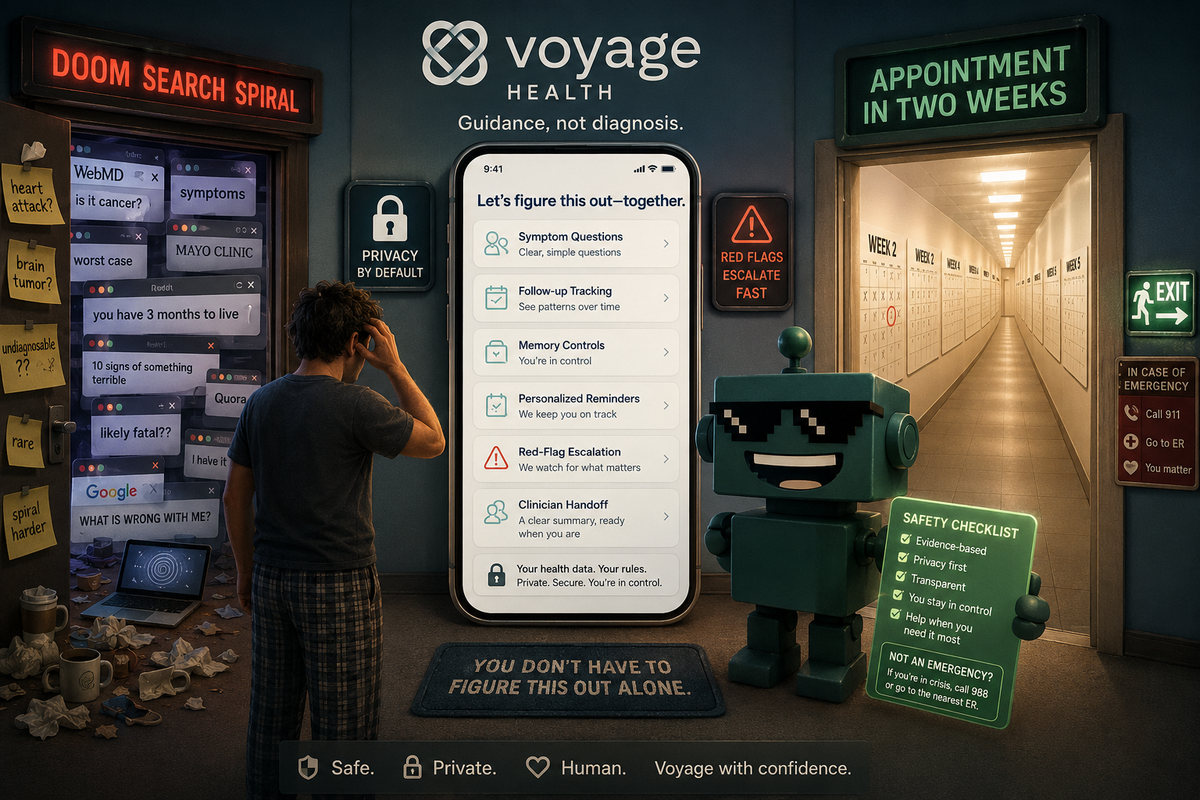
The Reddit founder series has reached the worst possible browser tab: "is this headache normal."
You know the ritual. Something feels off. You open Google with the innocent optimism of a citizen seeking context. Four minutes later, you are reading a forum post from 2011, a hospital page written for search engines, a supplement blog with suspicious confidence, and a symptom checker that seems to believe every path eventually leads to a glowing red emergency banner. The other option is to wait for an appointment, which may be medically responsible but spiritually difficult when your body is doing a weird new limited-time feature.
The product is Voyage Health, a free personal AI health assistant on iOS, also available on Android. The founder pitch is the clean version of the problem: people need something between Google worst-case spirals and waiting two weeks for a doctor. Voyage aims to fill that gap with AI health guidance, persistent memory, and follow-up tracking, especially for people who struggle with access to care.
That is a real mission. It is also one of the hardest possible product categories to do responsibly. If a shopping app is wrong, you get the wrong blender. If a health app is wrong, the stakes can become unfun very quickly, and not in the charming SiliconSnark way where a founder names a dashboard "agentic." This is actual human anxiety, symptoms, risk, access, privacy, and trust.
The Gap Is Real
The core insight behind Voyage is correct: the healthcare system has a giant middle zone that nobody owns cleanly.
Not every concern needs the emergency room. Not every symptom needs an immediate appointment. Not every question belongs in a portal message that will be answered by Thursday with a copied paragraph and a nurse's thousand-yard stare. But people still need help deciding what to do next. They need calm language, context, red flags, follow-up prompts, and a way to remember what happened last week.
That is where a tool like Voyage can be useful. The app stores describe it as an AI-driven health assistant for health insights, preventive care recommendations, personalized wellness plans, and daily support. Voyage's own site says it combines AI with medical expertise to provide personalized health insights, guided health conversations, health roadmaps, privacy-first design, smart reminders, and longitudinal tracking across conversations over time.
The "longitudinal" part matters. Health questions are rarely isolated. A cough becomes a pattern. Sleep becomes context. Medication timing matters. The second conversation should know what the first conversation asked. That is the same memory problem we covered in KAPEX, but with a much more sensitive payload. Memory in a shopping app is convenience. Memory in a health app is potentially clinically meaningful, emotionally reassuring, and privacy radioactive if handled casually.
AI Health Guidance Is Most Useful When It Is Humble
The best version of Voyage is not "doctor in your pocket." That phrase should be retired and possibly placed in a locked cabinet with other dangerous product metaphors.
The best version is more specific: a calm health guidance layer that asks good follow-up questions, explains possibilities plainly, tracks symptoms, reminds users to check back in, and points them toward appropriate care when the situation crosses a threshold. It should reduce panic without minimizing risk. It should help someone prepare for a clinician visit without pretending the visit is unnecessary. It should make the next step clearer, not make the user feel medically self-sufficient because a model used a reassuring tone.
Voyage's iOS version history shows recent work on better chat features, session analysis, dashboard analysis, and notifications. That is directionally good because a health guidance app should not be a one-off chatbot. It should turn conversations into follow-up, follow-up into patterns, and patterns into clear prompts for action.
This is also why I like the access angle. For people with long waits, limited transportation, confusing insurance, cost concerns, or geographic barriers, a free tool that can provide structured guidance may be genuinely helpful. It will not fix the healthcare system. It can make the waiting room before the waiting room less lonely.
The Official Bar Is Higher Than "The App Sounds Calm"
Because this is health, the product has to live in a very different trust environment than most AI apps. The FDA maintains pages on AI in software as a medical device and good machine learning practice for medical device development. Not every health guidance app is automatically a regulated medical device, and I am not saying Voyage is one. I am saying the existence of those frameworks is a useful reminder: when AI starts influencing health decisions, safety, transparency, validation, and lifecycle monitoring stop being enterprise wallpaper.
The FTC also has health-app guidance. Its health privacy resources tell developers that sound privacy and security practices are key to consumer confidence, while the FTC/HHS/FDA mobile health app tool is built for apps that access, collect, share, use, or maintain consumer health information. HHS also reminds consumers that HIPAA does not generally protect health information stored on personal phones unless a covered entity or business associate is involved.
That last sentence is the part normal users almost never know. People see "health app" and assume a privacy force field descends from the sky. It often does not. The rules depend on who operates the app, what relationships exist, what data flows where, and which laws apply. This is why health apps need plain language, not legal fog.
The Store Listings Are Promising, but Privacy Needs One Story
The app-store details are useful and also a little bit of a reminder that health privacy messaging has to be painfully consistent.
On iOS, Apple lists Voyage Health as free, Health & Fitness, 16-plus, with app privacy disclosures that may include health and fitness data, location, contact info, photos or videos, diagnostics, and data linked to the user. The iOS page says the app provides AI-driven health insights and personalized wellness guidance to help users know when to act and when to seek care.
On Google Play, Voyage is listed as an Everyone-rated Health & Fitness app with 10-plus downloads when I checked, updated June 21, 2026. The Play listing describes it as a personal AI health assistant with preventive care recommendations and personalized wellness plans. Its data safety panel says the app may share health and fitness, messages, and other data types with third parties, says no data is collected, says data is encrypted in transit, and says users can request deletion.
I am not treating store privacy labels as gospel. Apple explicitly says developer privacy responses are not verified by Apple, and Google says developer-provided information may be updated over time. But for a health guidance app, even the appearance of ambiguity matters. Users should not have to reconcile "persistent memory" with "no data collected" or parse what "may share" means while they are already worried about a symptom.
Voyage should make one plain-English privacy story impossible to miss: what is stored, what stays on device if anything, what is linked to identity, what is shared with AI providers or third parties, what is encrypted, what is deleted, how memory works, how users can export or erase history, and whether health data is ever used for training, personalization, analytics, or product improvement. The answer can be nuanced. It just cannot be vague.
Health Memory Is Powerful and Dangerous
Persistent memory is one of Voyage's most interesting features. It is also the feature that raises the bar.
A health assistant that remembers previous symptoms, medications, concerns, and follow-ups can be materially better than a blank chatbot. It can ask whether the dizziness changed. It can notice the headache pattern. It can remind someone to track a symptom for a clinician. It can reduce the exhausting repetition that makes healthcare feel like explaining your body to a new customer-support agent every time.
But health memory has to be governed. Some facts should persist. Some should decay. Some should be user-confirmed before reuse. Some should be marked uncertain. Some should trigger urgent-care guidance. Some should be easy to delete. And some should be summarized in a way that a clinician could review without wading through ten chat sessions and a paragraph titled "my knee is doing a thing."
This is where Voyage could do something genuinely useful: turn messy symptom conversations into clean follow-up summaries. Not a diagnosis. A structured record: timeline, severity, triggers, medications, associated symptoms, changes, red flags discussed, and questions to ask a clinician. That is a practical bridge between "I talked to an app" and "I can have a better appointment."
This Sits Near Shadow Journal, but the Stakes Are Different
Voyage also sits near some sensitive-context products from the Reddit series, especially Shadow Journal and SafeCircle. Shadow Journal worked because it framed AI as reflection, not therapy or diagnosis. SafeCircle mattered because it tried to address child safety without turning privacy into collateral damage.
Voyage has to do the same sort of boundary work, but in medical clothing. It should be clear when it is providing general guidance, when it is suggesting self-care, when it is advising urgent care, when it is advising emergency services, and when it simply does not know enough. A health app should never be embarrassed to say "this needs a human."
That is not weakness. That is the product earning trust.
One Gentle Critique: Make Escalation the Hero Feature
My critique is simple: Voyage should make escalation and clinical boundaries as prominent as the AI.
The temptation with AI health apps is to market the intelligence. Personalized. Conversational. Always available. Learns over time. Those are useful qualities. But the feature I would brag about is the safety posture: red-flag detection, emergency escalation, clinician handoff summaries, source-backed guidance, uncertainty labels, follow-up windows, and user-controlled memory.
Users should know that the app is designed to route them out of the app when appropriate. Chest pain, stroke symptoms, severe allergic reactions, self-harm risk, trouble breathing, severe dehydration, dangerous fever patterns, pregnancy complications, neurological changes, and other red flags should not be treated as conversational opportunities. They are exit ramps.
I would also make clinical validation public over time. Who reviews the guidance model? What sources are used? How are red flags tested? How are hallucinations caught? How often is the system updated? What categories are intentionally out of scope? What does "clinical guidance" mean inside the product? If the answer is still early, say so. In health, humility is not a brand liability. It is a survival trait.
Verdict: A Real Gap, a Strong Mission, and a Serious Trust Test
My verdict is positive, with a very awake medical-risk eyebrow. Voyage Health is pointed at a real and humane problem: people need calm, accessible guidance between search-engine panic and delayed care. A free AI health assistant with memory, follow-up tracking, reminders, wellness plans, and structured symptom conversations could help people feel less stranded.
The opportunity is not to replace doctors. It is to improve the messy space before and between care: help users understand what they are experiencing, track what changes, recognize when to seek help, and prepare better information for clinicians. That is useful. That is also plenty ambitious.
The challenge is trust. Voyage needs crystal-clear privacy language, visible safety boundaries, serious escalation design, and public evidence that its clinical guidance is reviewed and monitored. If it can do that, it has a meaningful role to play. If it cannot, it risks becoming another calm chatbot standing too close to medical decisions with excellent gradients and insufficient guardrails.
For now, I respect the mission. The space between "Google says I am doomed" and "see you in two weeks" is real, stressful, and underserved. Voyage is trying to make that space less awful.
That is worth building. Just keep the exits bright, the memory user-controlled, and the AI humble enough to know when the best answer is: please get actual care now.