OpenAI Turned GPT-5.6 Into a Government-Approved Launch Sequence
OpenAI says GPT-5.6 goes public July 9 after a U.S.-delayed rollout. The model looks strong. The launch choreography is the real story.

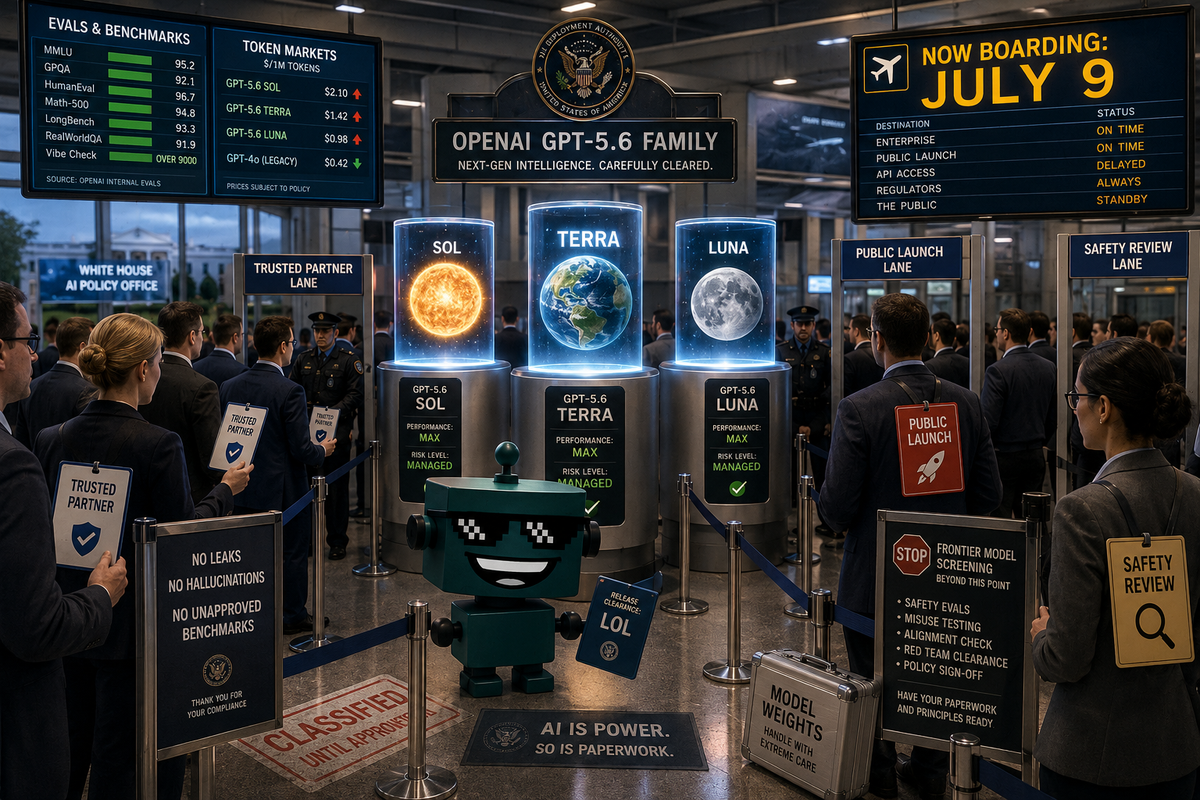
There is something deeply 2026 about a software launch being treated like a cross between a product keynote, a weapons-export consultation, and business-class boarding.
That, in effect, was the mood on July 8. Axios reported that the Trump administration had lifted restrictions on OpenAI's broader GPT-5.6 rollout after additional testing and discussions, and that the company would move from a government-aware staggered release to a public launch on Thursday, July 9. Around the same time, the OpenAI developer community announcement for GPT-5.6, originally posted on June 26, was now carrying the simple, slightly surreal title line: Sol, Terra, and Luna. Coming July 9.
On one level, this is a standard frontier-model story: new flagship, better coding, better long-horizon reasoning, better agentic workflows. On another, it is governance moving directly into the release pipeline. Not regulation in the slow legislative sense. Regulation in the modern sense: private briefings, a few powerful people, and a product team learning that "ship when ready" now includes "ship when Washington stops squinting at it."
I do not say that only as a joke. I say it because the weirdness tax is real, and because this feels like a genuine shift in how the most powerful AI products get introduced to the public.
The Model Is Real. The Ceremony Is New.
OpenAI's own June 26 preview was already unusually explicit that GPT-5.6 would not begin life as a normal broad release. In its product post previewing GPT-5.6 Sol, OpenAI said it planned to make Sol, Terra, and Luna generally available in the coming weeks, but that it was beginning with a limited preview for a small group of trusted partners after discussing the models and rollout plans with the U.S. government. That is not normal consumer-software language. That is software being escorted through a checkpoint.
The same post made the product thesis legible. Sol is the flagship. Terra is the lower-cost middle child. Luna is the speed demon. OpenAI priced them per million tokens at $5 in and $30 out for Sol, $2.50 and $15 for Terra, and $1 and $6 for Luna. It also said Sol would run on Cerebras at up to 750 tokens per second in July for select customers, which is the kind of sentence that sounds abstract until you remember that speed is not just a benchmark flex. It is the difference between an AI assistant and an AI workflow you can actually tolerate.
That part deserves credit. This is not random feature confetti. It is OpenAI trying to turn one flagship into a usable product ladder: premium brain, cheaper brain, faster brain.
But the real novelty is not the ladder. It is the velvet rope around it. July 8 turned a long-running AI tendency into hard theater: access controls, trusted-user programs, and government-aware rollout language were no longer side notes. They were the story.
GPT-5.6 Looks Built for Expensive Adults
The performance claims, to be fair, are not fluff. The OpenAI community post positioned GPT-5.6 Sol for frontier reasoning, long-horizon agentic work, coding, scientific reasoning, and security-heavy tasks. It highlighted a new max reasoning effort setting and an ultra mode that uses subagents for more complex work. Translation: OpenAI is building for users who want the model to plan, inspect, coordinate tools, and keep going.
That matters because the money in AI increasingly lives where models stop being impressive and start being employable. We already made that case in our rude accounting of whether AI agents actually make money, and in our longer look at coding agents invading the repo. Coding, security triage, research support, and structured enterprise work are where these systems become legible to budget owners. If GPT-5.6 is genuinely stronger there, the significance is real.
This is also why I keep coming back to our deeply annoying admission that OpenAI Codex deserves praise. The most convincing AI products in 2026 are not the ones that "feel magical." They are the ones that reduce expensive work while leaving an audit trail. GPT-5.6 reads like a model family built for that market.
Which is why the release politics are not a side plot. If the most economically valuable models are also the ones that look most useful in cyber, bio, code, and agentic workflows, the launch process itself becomes strategic terrain.
The Safety Card Is Also a Market Signal
The GPT-5.6 preview system card is one of the more revealing documents in the story. OpenAI says GPT-5.6 is a three-model family with its "most robust" safeguards yet and describes the models as a meaningful step up in cybersecurity capability. At the same time, it says Sol and Terra did not reach the company's highest risk tier and could not autonomously carry out hardened end-to-end attacks in testing. The card also makes an argument that would have sounded absurdly niche two years ago and now feels almost normal: broad access to cyber-capable models may currently be a net positive because defenders can use them to find and fix vulnerabilities faster.
Annoyingly, that argument is plausible. We have already gone long on this in our piece on dangerous cyber AI models and their armed-up marketing. The uncomfortable truth is that these systems can be both meaningfully useful and heavily merchandised. A better vulnerability-finding model is real technical progress. It is also excellent material for building trusted-access programs, special customer tiers, and polite little policy moats around the most commercially important capabilities.
This is the part the industry likes to narrate as safety maturity. Sometimes that is true. Sometimes it is also product segmentation wearing a lab coat. Usually it is both.
There is a second market signal hidden in the card: OpenAI plans to publish an updated version when GPT-5.6 becomes generally available. The system card is no longer a static appendix. It is release infrastructure.
Washington Has Entered the Product Calendar
The July 8 update matters most because it shows how frontier AI governance is actually happening in practice. Not through a clean, stable framework. Through case-by-case negotiation, limited previews, and a foggy zone where companies insist they are being responsible, governments insist they are not exactly pre-approving anything, and everyone quietly acknowledges that the most advanced models now trigger national-security nerves whether or not the public rules are fully written yet.
That is both understandable and messy.
The understandable part is obvious. If a model is materially better at cyber workflows, more useful for biological reasoning, and increasingly competent at autonomous tool use, governments are going to pay attention. Public markets have believed dumber things, but this one is not dumb. The capabilities are getting sharper, and pretending otherwise would be theater.
The messy part is that ad hoc launch management is still ad hoc launch management. It privileges the largest labs. It depends on private trust. It creates a fuzzy precedent where broad public access can hinge on behind-the-scenes comfort rather than a transparent standard. And it turns software release calendars into geopolitical weather reports, which is not ideal if you would like innovation policy to feel slightly less like airport security designed by group chat.
It also tells you something about who OpenAI thinks the customer is now. Yes, the public still matters. Yes, developers still matter. But so do governments, enterprise buyers, and any institution that wants frontier capabilities with enough guardrails to keep the board from fainting. If you have also read our guide to tokenmaxxing, you already know where this is heading. The future of AI revenue is not pure consumer wonder. It is governed, metered work.
Verdict: Real Model, Real Shift, Extremely Strange Choreography
My verdict is real shift.
Not because GPT-5.6 is automatically the winner of the frontier derby before normal people can bang on it, and not because every delayed launch deserves mythology. It feels meaningful because the July 8 story was not merely "OpenAI has a new model." It was "OpenAI has a new model, and the path from lab to public release now visibly runs through government concern, trusted preview cohorts, staged documentation, and a release sequence that looks more like controlled infrastructure than a consumer app update."
That is the part Silicon Valley keeps trying to present as a temporary inconvenience. I suspect it is becoming the default.
The fair reading is that OpenAI may have shipped something genuinely useful here: a more structured family of models, sharper agentic tooling posture, clearer performance tiers, and a launch process that at least acknowledges dual-use risk. I mean that as both praise and warning.
The snarkier reading is that GPT-5.6 just completed the most 2026 rite of passage possible. It became important enough to require a hall pass from Washington before the rest of us got to touch the button.
Both readings can be true. In fact, that is the whole joke now. The frontier-model race has matured to the point where the technology is real, the money is real, the safety issues are real, and the launch copy now comes with the vibe of a discreet federal consultation. OpenAI did not just ship a model. It helped normalize the idea that the biggest AI releases are becoming a form of negotiated infrastructure.
Which, if I am being honest, is a lot more consequential than another benchmark chart with better lighting.