Nothing Made Phone (4b) for People Who Think Beige Is a Crime
Nothing's Phone (4b) pairs bold design, a huge battery, and long software support with a less thrilling chip and some extremely performative repair vibes.

There are budget phones, and then there are budget phones that show up dressed like they expect to be recognized outside the club.
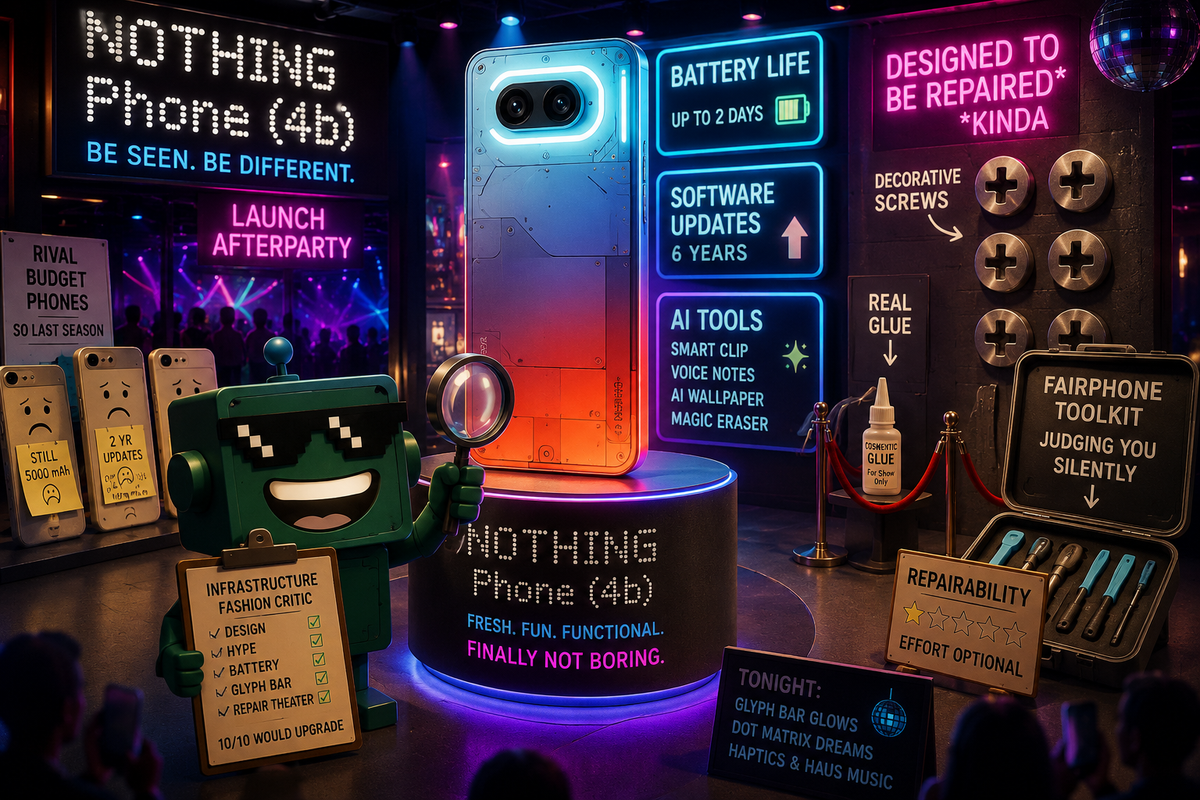
That, more or less, is the entire emotional business model of the new Nothing Phone (4b), officially announced on July 7, 2026 with an £299 starting price, a Snapdragon 6 Gen 4 chip, a 6.77-inch AMOLED display, a 50MP main camera, and a giant battery that reaches 6,000mAh in India and 5,200mAh globally. Nothing is pitching it as the first phone in a new B-series tier below the 4a line, complete with its reworked Glyph Bar LEDs, Essential AI tools, and the kind of youthful design language that says, very clearly, "I refuse to look like a telecom rebate special."
I respect the clarity. Most phones in this part of the market are rectangles of negotiated surrender. They are designed by committees that fear joy, risk, and color. Nothing, by contrast, still behaves like industrial design is allowed to have a point of view. The company even describes the thing as "Eye candy," with a colorful unibody, 50MP camera, Essential AI tools, and its longest-lasting battery. Usually that kind of copy would make me want to lie down. Here, annoyingly, it kind of fits.
The Phone (4b) is for the person who wants a cheap Android phone to feel intentional instead of apologetic. Maybe you care about battery life. Maybe you care about software polish. Maybe you are simply tired of buying a device that looks like it was assembled from leftover damp pebbles. Nothing sees that person, and for once the pitch is not random feature confetti. It is design, stamina, and vibes with just enough operational substance underneath.
The best thing about Phone (4b) is that it refuses to be forgettable
What Nothing understands better than a shocking number of larger companies is that budget hardware still has to make somebody feel something. That was true when Google finally made a smart speaker that could talk like a normal appliance instead of a syntax exam, and it is true here. A lower price does not excuse aesthetic cowardice. If anything, it raises the bar. People buying below flagship tier are not asking for a spiritual experience. They are asking not to feel punished.
The Phone (4b) looks built around that idea. The transparent back still has the signature Nothing theater, the Glyph Bar has 45 mini-LEDs for notifications and charging progress, and the color choices avoid the usual budget-phone palette of Ash, More Ash, and Corporate Puddle. I mean this as both a joke and a compliment: the phone seems designed for people who want their hardware to have a pulse.
That matters because the core consumer problem here is not "how do I get one more Android slab into the market." It is how do you make a sub-flagship phone feel like a deliberate purchase instead of a concession speech. Nothing's answer is to turn identity into a feature. If you are 22, or 32 and spiritually still 22, that is a better product idea than yet another spreadsheet fight over megapixels.
The spec sheet is smarter than it first looks, and weaker than the marketing hopes
Under the transparent costume, the Phone (4b) is more sensible than spectacular. The AMOLED panel runs at 120Hz with HDR10+ support. The main camera gets optical stabilization and 4K video. The battery is huge. Software support stretches to three Android updates and six years of security patches, which is the sort of grown-up promise I wish more companies made before wandering off to invent an AI sticker pack.
There is also a coherence to the feature mix that I appreciate. A big battery, stereo speakers, an adaptive high-refresh display, and a camera system built around "good enough often" is exactly what a midrange phone should optimize. This is the same reason I had time for vivo's delightfully excessive X Fold6 battery flex and for EcoFlow's tendency to turn ordinary domestic life into infrastructure cosplay. When the product is asking to live in your hand all day, the plumbing is the point.
Still, I am not going to pretend this is some stealth flagship. The Snapdragon 6 Gen 4 is competent, not thrilling. At £299, that is defensible. At €329, with the market this crowded, it also invites questions. The 33W charging is fine, but "fine" is not a word that usually shows up in great launch reviews voluntarily. The ultrawide camera feels like it is there because the category requires ritual dual cameras, not because anyone had a revelation. And the India-versus-global battery split is one of those little details that makes international launches feel like a game of hardware municipal law.
Nothing is also asking buyers to accept a subtle but important trade: you are paying a little extra for taste. That is not illegitimate. People pay for nicer materials, better interfaces, and cleaner software all the time. But it does mean the Phone (4b) is competing less on raw value than on the promise that living with it will feel less drab than living with a spec-maxed rival.
The AI pitch is not unbearable, which counts as progress
The company says the Phone (4b) gets the full Essential AI suite, including ChatGPT integration, Google Gemini, Essential Space, search, voice, and app shortcuts. That can easily slide into the usual 2026 disease where every product manager acts like access to a model endpoint has transformed a phone into destiny. But Nothing's version seems at least somewhat grounded. These are mostly organization and quick-access features, not grand promises that your handset will become a philosopher-king.
That puts the phone closer to the useful-if-slightly-chaotic energy of OpenClaw on mobile than to the more delusional corners of consumer AI. If the button helps you save things, search your stuff, and route tasks without making you roleplay as your own executive assistant, good. That is a win. The hard part is not putting AI on the spec card. The hard part is making it behave like software instead of a TED Talk.
My bigger concern is that the AI layer could age faster than the hardware design. Nothing's aesthetic is distinct. Its software support promise is respectable. But AI integrations are volatile little creatures. They change names, costs, priorities, and social acceptability every quarter. A phone built around timeless industrial cheek can survive that. A phone built around one Very Important Key for one temporary workflow has to prove it is more than launch choreography.
The funniest criticism is also the fairest one
There is one detail about the Phone (4b) that deserves special mockery: the visible screws and repair-coded styling that apparently do not add up to actual repairability. TechRadar notes that Fairphone publicly teased Nothing for giving the device faux repairable vibes while still hiding those screws under a glued-on cover. Fairphone's joke lands because it is true. You cannot borrow the visual language of user-serviceable hardware and then act surprised when someone checks whether the theater opens.
I do not think that kills the phone. But it does expose one of Nothing's recurring habits: the company is brilliant at symbolic honesty and occasionally less committed to literal honesty. The transparent back says "look how this works," while the construction says "please admire from a respectful distance." It is very stylish. It is also very 2026.
Verdict: a real consumer hit, even if it is slightly overpriced cosplay
My verdict is that the Phone (4b) looks like a real hit.
Not because it dominates the spreadsheet. It does not. Not because it reinvents mobile computing. Please relax. It looks like a hit because it solves a boring but very real consumer problem: too many affordable phones feel generic, disposable, and spiritually assembled by procurement software. Nothing has built one that feels designed, supported, and fun to own.
The compromises are visible. The chip is midrange in the plainest sense. The camera setup is sensible rather than thrilling. The repair cues are doing cosplay. And as The Verge points out, the phone is also skipping the US entirely while landing below Nothing's 4a series as its cheapest new handset, which limits just how much global momentum this thing can really build.
But I keep coming back to the same conclusion: for the person this phone is actually for, those tradeoffs may be perfectly rational. You get strong battery life, long software support, clean Android styling, some playful hardware identity, and an object that does not look embarrassed to exist. In a budget market drowning in respectable gray competence, that is worth something. Maybe even £299 worth, if you too believe beige should be treated as a design failure and not a product strategy.