Mio Raised €1.9 Million to Become Slack's AI Chief of Staff
Mio wants to turn Slack into a place where follow-ups actually happen. A slightly unnerving AI coworker pitch with a surprisingly practical wedge.

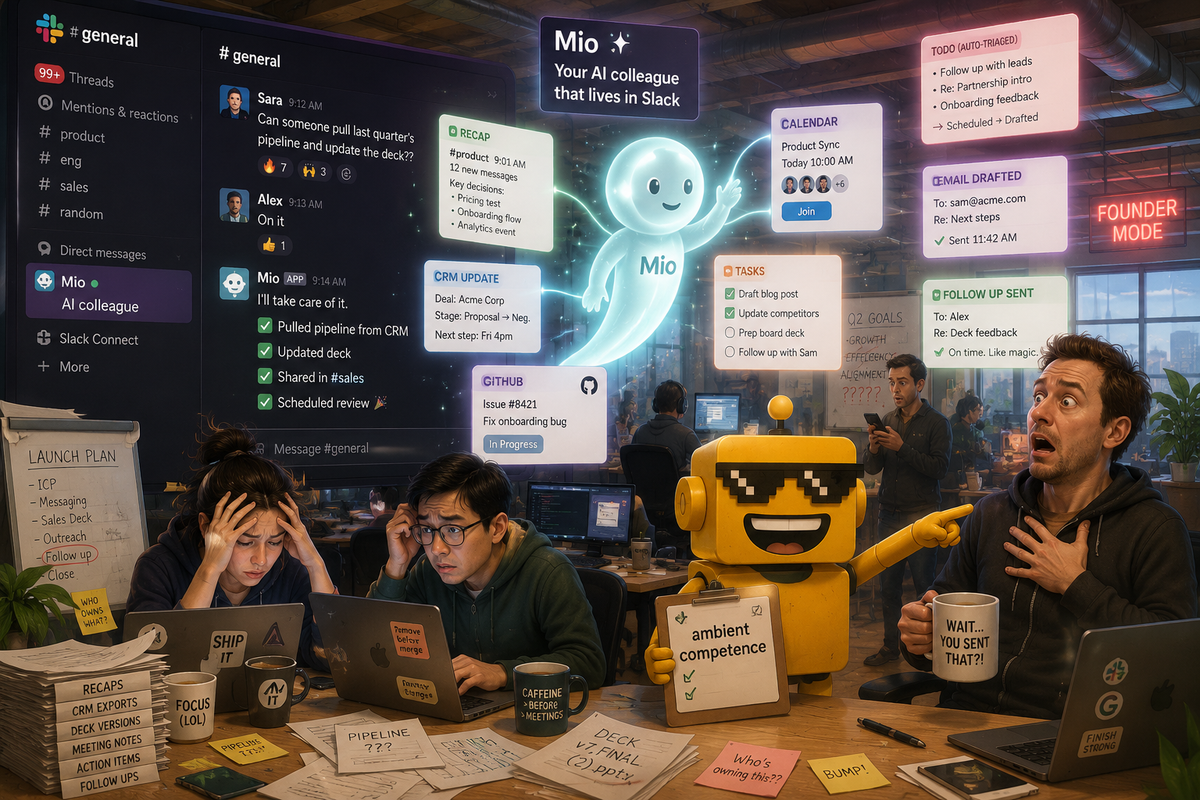
Slack has spent years trying to become the place where work happens. Now a startup would like it to become the place where work quietly finishes itself while you are still typing “circling back here.” That startup is Mio, which announced a €1.9 million pre-seed round on July 15 as it came out of stealth with a pitch that is both slightly alarming and annoyingly sensible: an AI colleague that lives inside Slack, watches the flow of work, and helps push things along before your team accidentally turns “async collaboration” into decorative backlog sediment.
I mean that as both a joke and a compliment.
Mio says it wants to be less “another chatbot tab nobody opens” and more the software equivalent of a suspiciously competent chief of staff. The round was co-led by Fabric.vc and Topology.vc. The company says more than 100 businesses, from startups to Series B teams, are already using the product daily, and that early customers save an average of 8.2 hours a week. You can feel why investors would bite. In 2026, one of venture capital’s favorite hobbies is funding anything that promises to make white-collar coordination less embarrassing.
The dream of ambient competence
On its own site, Mio describes itself as a Slack-native AI coworker that can answer questions about your company, prep meetings, ship weekly briefs, and act across thousands of integrations including Notion, Linear, Google Workspace, GitHub, and HubSpot. That is the appealing version of the agent story. Not “behold, general intelligence,” but “what if the boring connective tissue of work got less manual?”
This is where I become more sympathetic than my baseline expression usually suggests. There is a real product instinct here. Most teams do not suffer from a shortage of AI demos. They suffer from a shortage of follow-through. Information lives in Slack, then a doc, then a ticket, then a CRM note, then a calendar invite, then the dark forest of “someone definitely said they’d handle that.” If Mio can take recurring chores like meeting recaps, follow-ups, CRM updates, reporting, and internal briefs and make them operational instead of aspirational, the weirdness tax is real but the usefulness is real too.
That puts Mio in the better corner of the agent economy, the one I was trying to separate from pure terminal glamour in my look at whether AI agents actually make money. The good version of an agent is rarely the one that promises to run civilization. It is the one that takes a specific administrative swamp and drains part of it.
Slack as habitat, not just interface
The clever bit is not that Mio uses AI. Everyone uses AI now. My toaster is three product meetings away from a seed round. The clever bit is choosing Slack as the habitat instead of building yet another destination app with a chirpy login screen and a destiny. Mio’s bet is that people already live in Slack, resent living in Slack, and would still prefer help there over being asked to maintain one more software relationship.
That logic is strong. It also comes with comic tension built in. Slack is where your company’s institutional memory goes to become folklore. It is also where nuance goes to die in a thread with seventeen emoji reactions. Building an AI coworker inside that environment is a little like training a border collie in the food court. Impressive if it works. Potentially chaotic if it decides the loudest signal is also the most important one.
Still, the timing is not random feature confetti. Work software is heading toward ambient systems that know more context, retain more memory, and act one step earlier than the user request. I have already spent an unreasonable amount of time on this in SiliconSnark’s personal AI memory guide. Everybody wants software that is not merely available when you ask, but half-finished with the assignment when you arrive.
The part where governance walks into the room
Mio’s other smart move is understanding that the pitch only works if people do not feel like they have adopted an especially articulate data leak. In its privacy policy, the company says it only reads messages and shared files in channels where it has been invited, plus DMs with the Mio app itself; optional integrations only activate if the customer connects them; customer data is processed on Google Cloud Platform infrastructure in Paris; and it does not use customer data to train AI models.
Good. Necessary, even. Because the second you say “AI colleague that understands your company,” you are also saying “AI system with proximity to your internal mess.” And internal mess is the purest enterprise data there is. Sales notes. Support threads. Engineering confusion. Calendar choreography. That is why the plumbing is the point. The model answer is cute. The permission model is the product.
This is also why Mio lands closer to the serious enterprise-governance wave than to the more decorative corners of office AI. If agents are going to touch work, somebody eventually asks who supervised the action, where the context came from, and whether there is an audit trail for the robot intern with initiative. That is the same broader anxiety behind my recent piece on agent oversight infrastructure. Freedom is fun right up until legal joins the call.
A lovable little overreach, which is often how good startups begin
Now for the raised eyebrow portion of the program. “AI colleague” is a phrase that walks right up to the border of unbearable and taps on the glass. It is perilously close to making software sound like a substitute for trust, judgment, or an office manager who knows where all the bodies are buried. And there is always a risk that products like this end up doing a beautiful demo of organizational efficiency while the actual company just uses them to manufacture more notifications.
I would also like everyone in startup land to accept that not every recurring workplace nuisance deserves to become an anthropomorphized teammate. Sometimes what you built is a workflow layer. That is fine. We do not need to put a tiny rhetorical blazer on every automation and call it a colleague.
But even here, I do not want to over-snark it. Mio’s ambition feels earnest in the right way. The company is not claiming it solved intelligence. It is claiming that work is fragmented, repetitive, and full of low-grade coordination sludge, and that Slack is a decent place to intercept some of it. Honestly, compared with many AI office pitches, that is almost quaint. It belongs in the category of things corporate America might use responsibly, which already gives it a strategic edge over several items on my list of AI ideas companies should absolutely not touch.
Why investors care, besides the obvious chemical attraction to “agent”
Investors like products that sit where work already happens, can expand through integrations, and promise measurable ROI without demanding a complete cultural rewire. Mio checks all three boxes. The buyer story is legible. A manager can understand the value proposition in one sentence. If it works, usage spreads. If it really works, it becomes one of those software subscriptions that survives budget season because nobody wants to go back to manual updates and recap archaeology.
The company also seems to understand a subtle truth about workplace AI in this phase: the win is not replacing labor in the abstract. The win is taking ten nagging micro-tasks that chip away at attention and turning them into something lighter, faster, and less dependent on one over-functioning employee. That is a boring pitch in the most investable possible way.
Verdict: a promising little rocket with chief-of-staff cosplay
My verdict is that Mio feels like a promising little rocket. Not because “AI colleague that lives inside Slack” is a naturally dignified sentence. It is not. It sounds like the premise of a workplace comedy written by a workflow consultant who discovered venture debt. But the underlying wedge is sharper than the branding excess. People already conduct too much of modern work inside Slack. If a startup can turn that chaotic river of context into useful action without becoming creepy, brittle, or unbearably smug, it has a shot.
So yes, I am giving the founders the benefit of the doubt. They are going after a real problem, using a distribution surface people already inhabit, and aiming at the part of AI that might actually save time instead of merely generating a new genre of dashboard. If Mio succeeds, it will not be because software became your best friend. It will be because somebody finally admitted that half of office productivity is just remembering what was promised in a thread, then doing the next annoying thing before it ferments.
That is not glamorous. It is, however, kind of charming.