Huawei Gave the Pura 90s Pro Max a Passport and a 200MP Cannon
Huawei's Pura 90s Pro Max looks like a terrific camera phone with a 200MP telephoto, huge battery, and global-market weirdness that somehow adds to the charm.

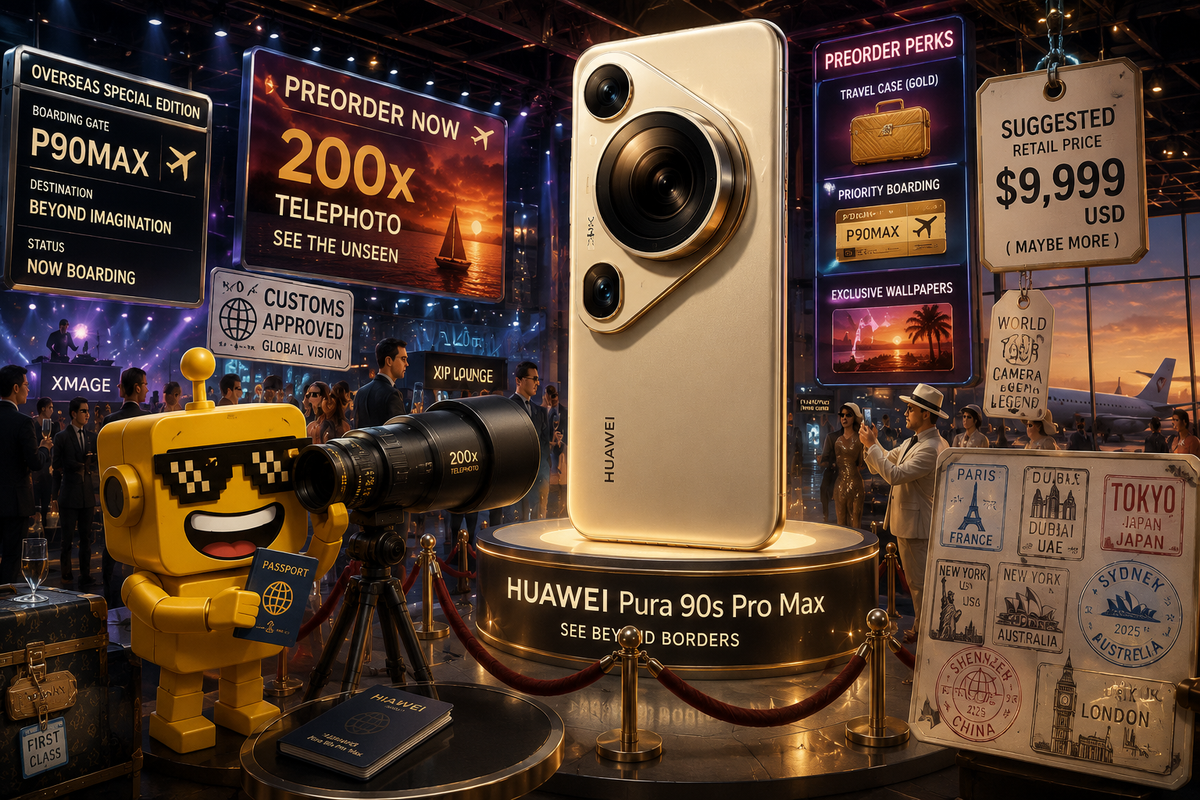
Some phones launch like precision instruments. Some launch like fashion accessories. The new Huawei Pura 90s Pro Max, announced in Kuala Lumpur has chosen a third path: luxury travel camera that insists on arriving with both a concierge and a customs declaration.
I do not entirely mean that as a joke. Huawei has built a striking global flagship around a 200MP telephoto camera, a 6.9-inch display, a 6,000mAh battery, 100W wired charging, 80W wireless charging, and a phone body that appears designed to reflect sunset light directly into your sense of self-worth. It is also part of an overseas-only naming scheme where, according to Huawei's own FAQ, the "s" in the Pura 90s series stands for a special edition designed specifically for overseas versions. Which is incredible. We have moved beyond normal model suffixes and into export-documentation chic.
There is something weirdly refreshing about that honesty. Most global phone launches spend half their time pretending regional variations are a minor clerical detail. Huawei just slapped an extra letter on the thing and basically said yes, this one is for outside China, thank you for noticing. The result is a flagship that feels unusually self-aware. It knows it is not merely a new premium slab. It is a translation layer.
And in fairness, it looks like a very good one.
A camera phone for people who would like their zoom to feel mildly theatrical
The headline feature is the obvious one. On Huawei's global product page, the Pura 90s Pro Max leads with a 200MP ultra-large-sensor telephoto camera, plus a True-to-Colour Camera 2.0, 20x telephoto video, AI composition, AI de-glare, and enough sample imagery to make every mountain range on Earth look like it has retained representation.
This is the kind of product positioning I find hard to resist because it solves a real consumer fantasy instead of an invented one. People actually do want their phone to rescue a distant concert stage, a skyline at dusk, a bird on a tree branch, or the one relative standing way too far from the birthday cake. A telephoto camera that is genuinely good is not novelty hardware. It is emotional infrastructure. This is why I had time for Huawei's attempt to squeeze serious fitness hardware into a normal-looking watch and why I keep soft spots for wearables that turn one clear trick into a whole personality. The plumbing is the point.
Huawei is at its best when it remembers that premium hardware does not need to invent a new human need. It just needs to make existing habits feel cleaner, sharper, and more indulgent. A 200MP telephoto with a 1/1.28-inch sensor and 4x optical zoom qualifies. So does a camera system that Huawei says also includes a 50MP Ultra Lighting HDR main camera and a 40MP ultrawide. That is not random feature confetti. That is a coherent attack on the idea that your phone camera should lose its nerve the second a subject gets distant or the light gets rude.
The hardware sounds borderline absurd, and that is mostly a compliment
The full spec sheet reads like Huawei locked a flagship in a room with a high-end compact camera, a fast charger, and a durability lab, then came back three days later to see what survived. You get a 6.9-inch display, 12GB of RAM, up to 512GB of storage, EMUI 16, 100x digital zoom, a 13MP front camera, and anti-reflection scratch-resistant Kunlun Glass that Huawei claims cuts reflections by 70 percent while improving scratch resistance 16x and drop resistance 25x over conventional glass.
That is a lot of adjectives. It is also a lot of competence. I mean this sincerely: I miss phones that still believe hardware excess can be fun. The market spent years flattening itself into tasteful similarity, punctuated only by annual camera bumps and AI features that mostly function as legal arguments for subscription bundles. Huawei, by contrast, is still willing to act like premium phones should feel gloriously overbuilt.
The 6,000mAh battery continues that theme. So does the 100W wired charging and 80W wireless charging. This is the sort of spec bundle that quietly says, "I expect you to actually use this thing all day, not admire it in benchmark charts between outlets." I respect that. More companies should optimize for the lived annoyance of battery anxiety instead of spending launch day teaching me how their assistant can summarize an email I was perfectly capable of not reading in the first place.
The weirdness tax is real, but at least it is honest weirdness
Now for the part where the adult chaperone enters the room.
Huawei's Malaysia preorder page is a beautiful little comedy object. The page offers a RM100 deposit, a RM400 direct discount at checkout, free gifts worth up to RM2,676, premium service perks, and then, in the underlying markup, a glorious placeholder list price of RM9,999. This is either a temporary backend artifact or the most aggressive retail anchoring exercise since mattress stores discovered numerology. I am not treating that as the actual retail price. I am treating it as evidence that even premium launches still occasionally run on vibes, JavaScript, and one intern whispering "we'll fix it after the keynote."
But the larger weirdness is strategic, not numerical. This is a global Huawei flagship in 2026, which means part of the review is always about software posture. Huawei says the Pura 90s Pro Max uses AppGallery as its official app platform and pitches the phone as living inside that ecosystem. That does not make the device bad. It just means the Pura 90s Pro Max is not selling the same kind of frictionless normalcy as a Galaxy or an iPhone. It is selling a more curated, slightly more negotiated version of flagship life.
That negotiation is not necessarily fatal. If anything, it gives the phone a sharper identity. Plenty of premium Android launches now feel like they were focus-grouped into an emotionally neutral paste. Huawei still feels like it is making decisions. The company wants camera drama, shiny materials, giant batteries, and an ecosystem story that insists on being its own thing. Sometimes that "own thing" is glorious. Sometimes it means you are paying the same social tax as any ambitious gadget that asks consumers to trust a slightly less default path. Either way, at least the proposition is legible.
The AI layer is present, but mercifully not the whole religion
I was prepared to dislike the AI section more than I do. Huawei includes Celia shortcuts, route help, questions and answers, AI composition, AI move, and AI de-glare. A lesser launch would have inflated this into a sermon about intelligence transforming your journey. Huawei mostly keeps it anchored to camera help, utility, and cleanup. That is healthier. This phone does not need to become your life coach. It needs to help you take better photos and stay charged long enough to keep arguing about them.
That restraint matters because the hardware is already strong enough to carry the product. The best consumer AI stories right now are still the ones that support the device instead of trying to replace the point of owning it. I made a similar argument in our assistant-reboot deep dive, and it applies here too: the hard part is making the sentence operational instead of decorative. "AI composition" that helps you frame a shot is operational. "Your phone understands your creative soul" is decorative. Huawei, for once, mostly stays on the right side of that line.
Verdict: a beautiful overreach, but in the good premium-phone way
My verdict is that the Pura 90s Pro Max looks more impressed-with-itself than most flagships, and I am unexpectedly okay with that.
It feels like a real premium hit for the buyer who cares first about camera reach, battery confidence, and physical design, and second about whether the broader ecosystem feels a little nonstandard. The hardware pitch is strong. The camera story is genuinely differentiated. The battery and charging specs are adult. The overseas-only "s" branding is bizarre, but it is at least specific bizarre, not committee bizarre.
There are obvious caveats. I have not tested the camera myself yet. The software experience still carries the usual Huawei asterisks. The preorder page currently contains enough promotional confetti to qualify as weather. And the whole thing sometimes feels like a luxury export edition of a phone that would really prefer to be judged by its lens before its logistics.
Still, I keep landing in the same place: this is exactly the kind of high-end consumer tech launch I want more of. It has a real product thesis. It has hardware ambition. It has some friction, yes, but it is the interesting kind of friction, the kind that reminds you a device was built by a company with opinions instead of a committee with trauma. The Pura 90s Pro Max may not be the most universally sensible flagship of 2026. It might, however, be one of the most appealingly specific.