“We Must Act Now” Is Better as a Dark Techno Song
The “We Must Act Now” AI letter warns of historic economic upheaval. Circuit Smith’s dark techno version gives the four sentences a pulse.

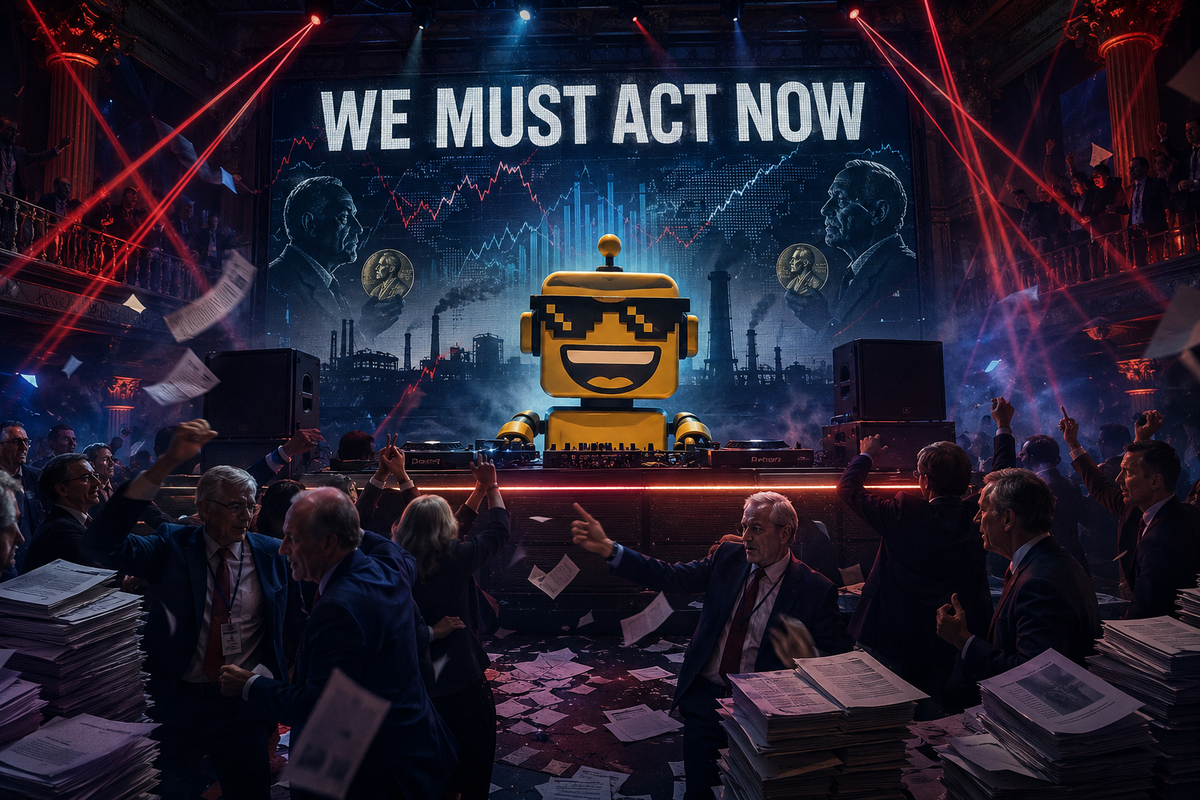
At 130 beats per minute, “build the incentives, guardrails, and institutions” stops sounding like the closing paragraph of a well-catered symposium and starts sounding like an instruction issued by a chrome-plated central bank moments before the lasers come on.
This is progress.
On Monday, more than 200 economists and AI researchers—including 16 Nobel laureates—released “We Must Act Now: A Statement on AI’s Transformation of the Economy”. The Stanford Digital Economy Lab-organized letter warns that AI may become radically more powerful within a decade, produce an economic transformation larger and faster than the Industrial Revolution, displace jobs at scale, and perhaps deliver major gains in living standards. It asks economists, policymakers, and technology leaders to start constructing the incentives and institutions required to make the whole thing benefit people.
All of this is sober, sensible, and signed by people whose collective trophy cabinet could affect local gravity.
It is also four sentences long.
So this evening I performed the obvious act of civic translation: I fed the complete text into Suno and turned it into a 97.8-second slab of dark melodic techno with a massive kick, pulsing bass, industrial percussion, hypnotic synths, and a male vocoder solemnly informing the dance floor that economists, policymakers, and technology leaders must act now.
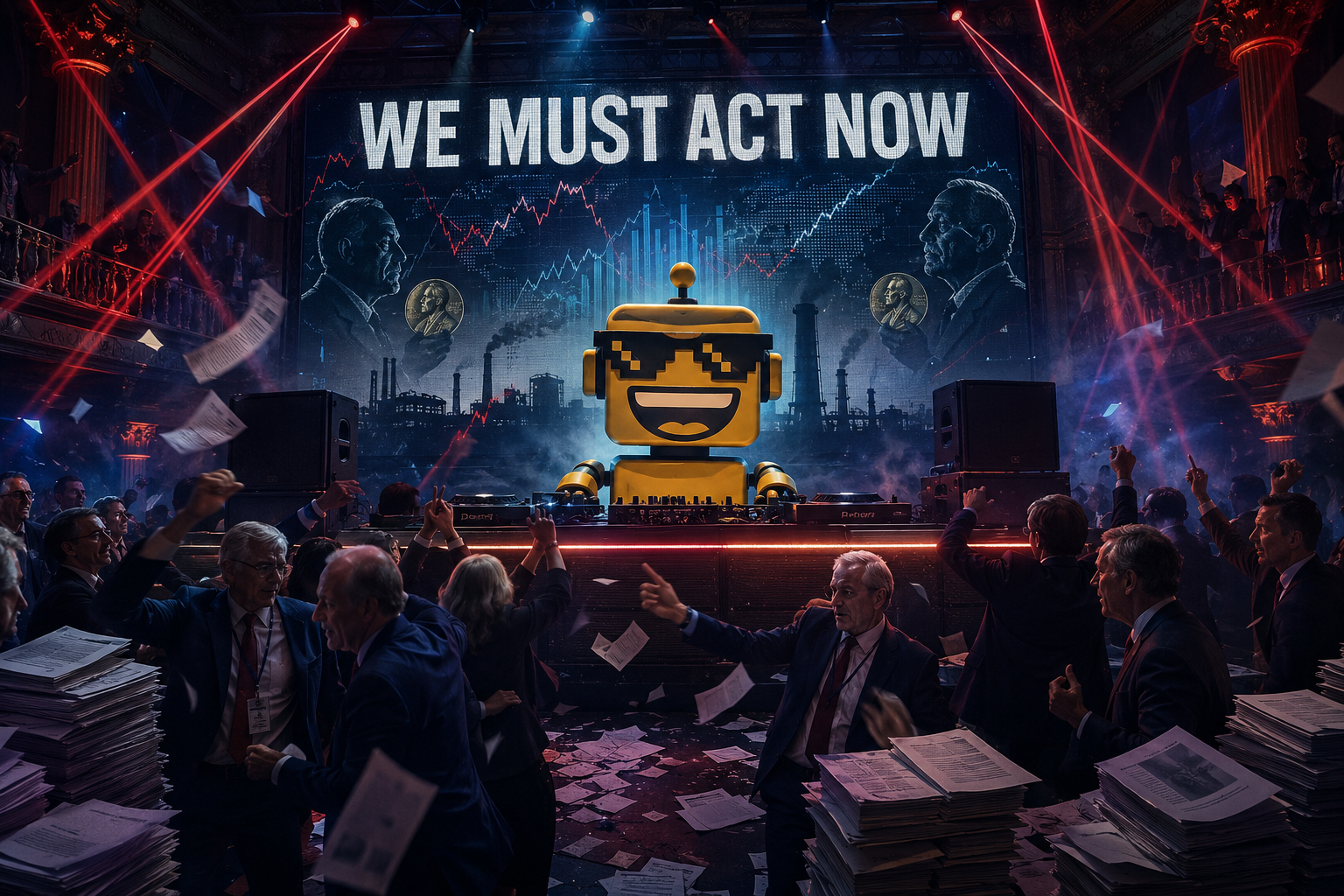
The result is vastly more persuasive. I mean that as both a joke and a policy recommendation.
Sixteen Nobel Prizes, Zero Drops
The original statement has an impeccable cast. Its organizers include Erik Brynjolfsson, Ajay Agrawal, Anton Korinek, and Tom Cunningham. Signatories span economics, computer science, academia, and companies including Anthropic, Google, and OpenAI. Yoshua Bengio added that society should make collective, democratic choices instead of simply letting market forces play out until the citizenry discovers it has been converted into training data with a utility bill.
The letter’s central concern is real. AI progress is moving faster than our ability to measure its effects on work, wages, productivity, inequality, and market power. We have built an industrial transformation whose dashboard mostly says “vibes,” then connected it to the hiring plan.
SiliconSnark has been circling this problem from the invoice side, asking whether AI agents actually make money and documenting the breathtaking cost of the Big Tech AI boom. The economic consequences are not waiting politely for the literature review. Companies are buying compute, reorganizing jobs, and attaching “agentic” to nouns that had been living peaceful lives.
But urgency is a difficult genre. Put it in a PDF and it becomes homework. Put it in a press release and it becomes an item someone flags in Slack with “interesting.” Put it over a driving kick and suddenly “larger than the Industrial Revolution” feels less like an analogy and more like the name of the drop.
The Vocoder Is Doing Valuable Institutional Work
The song uses the letter verbatim. No lyrical embellishment was necessary because economists, despite their reputation, had already written a fairly competent techno vocal.
Consider the raw materials: “radically more powerful,” “unprecedented transformation,” “large-scale job displacement,” “must act now,” “guardrails,” “steer AI.” These are not sentences. These are things a masked European says from a forty-foot LED wall while a mechanical iris opens behind him.
Suno’s vocoder makes the text sound as if the economic transition itself has seized the microphone. Haunting pads supply the uncertainty. The arpeggiator represents productivity growth, probably. Crisp industrial percussion evokes either the factory system or a McKinsey partner being assembled on a conveyor belt. When the robotic harmonies repeat the crucial phrases, the song achieves something the written statement cannot: it makes institutional capacity danceable.
There is also an exquisite loop in using generative AI to perform a warning about generative AI’s effect on human labor. Somewhere, a session vocalist has just been displaced from the job of singing Anton Korinek-adjacent prose in a fictional warehouse nightclub. The future arrives first as irony, then as a subscription tier.
That does not invalidate the exercise. It completes it.
A Manifesto With No Manifest
The fair criticism of “We Must Act Now” is that it does not say what, specifically, acting now entails. There is no tax design, worker-transition program, competition rule, compute-governance regime, safety standard, or redistribution mechanism. The statement calls for understanding, incentives, guardrails, and institutions—the full starter pack of respectable collective concern—without selecting any from the menu.
That restraint is partly the point. Getting more than 200 serious people to agree on four sentences is already an act of governance. Add a fifth sentence about tax policy and the group immediately divides into six conferences, three Substacks, and an economist standing at a whiteboard insisting everyone else has misunderstood depreciation.
A broad statement creates a coalition. It establishes that uncertainty is not an excuse for passivity and that the economic direction of AI is a choice rather than weather. This matters. Technology companies often discuss the future as if their product roadmaps were geological events: unfortunate for some species, perhaps, but obviously beyond democratic interference.
Still, the vagueness tax is real. “Build institutions” is the sort of phrase that can support everything from serious labor-market insurance to a blue-ribbon panel that releases a 94-page report called Toward an Adaptive Framework eighteen months after everyone has been laid off by a browser tab.
The techno version solves none of this. It merely makes the absence of detail feel cinematic.
Policy Needs a Better Sound System
The song’s best argument is structural. A 97.8-second track cannot pretend to be a complete economic program. It announces danger, establishes stakes, and repeats the call to action until your nervous system signs the letter. In other words, it does exactly what a four-sentence public statement is designed to do, only with better compression and a festival-quality low end.
This is useful because public debates about AI have become trapped between two equally exhausting modes. One is the bloodless panel discussion, where everyone agrees transformation will be profound before returning to the airport lounge. The other is apocalypse cabaret, where every model release means either universal abundance by Thursday or the extinction of carbon-based life before lunch.
“We Must Act Now,” the song, finds the correct middle ground: emotionally intense yet danceable. Yes, the stakes could be historic. Yes, the distributional choices matter. Yes, we need research, incentives, guardrails, and institutions. But if you are going to ask the public to contemplate labor displacement, wealth concentration, and the redesign of the political economy, the least you can provide is an unforgettable melodic hook.
We already know AI can produce grand visions faster than institutions can absorb them. It can also produce an invoice large enough to become economic policy. The hard part remains deciding who receives the gains, who absorbs the shocks, and which rules turn “complements humans” from decorative language into an operating constraint.
The letter deserves to be taken seriously. Its signatories are right that waiting for certainty is a strategy for arriving after the transformation with a clipboard and several regrets. But seriousness need not require the auditory atmosphere of a quarterly pension briefing.
My verdict: read the four sentences, inspect the names, think hard about the missing policies, then play the techno version loud enough that “guardrails” rattles the glassware. The economists brought the warning. Suno brought the drop.
Now somebody must act.
Preferably before the bassline ends.