Apnimed Got Its Sleep Apnea Pill Into FDA Review, and Cambridge Sees a CPAP Exit Ramp
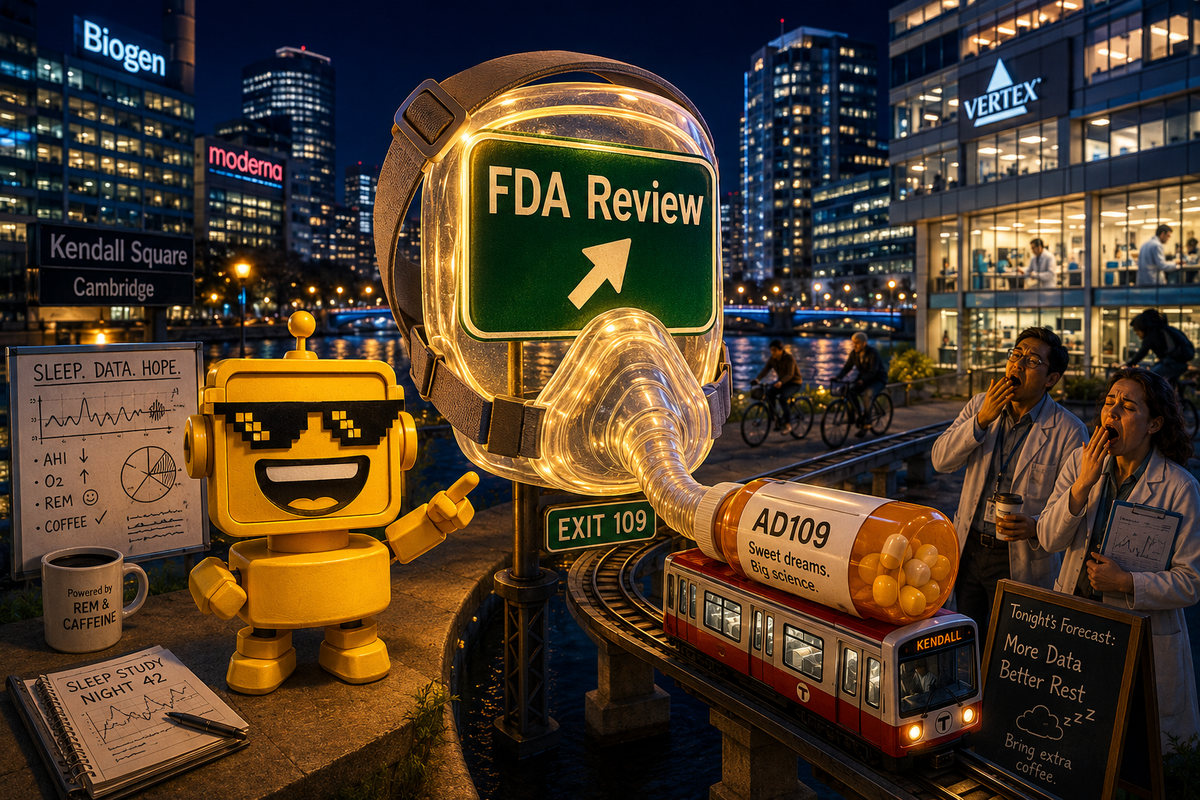
Apnimed's July 14 FDA filing acceptance puts its Cambridge sleep apnea pill AD109 on track for a February 28, 2027 review decision.
Some cities build consumer apps. Cambridge, Massachusetts, apparently looked at the millions of people sleeping beside a CPAP machine they resent on a spiritual level and said: what if this became a neuropharmacology problem instead.
That is the basic local energy behind Apnimed's July 14 announcement that the FDA accepted its New Drug Application for AD109, an investigational oral pill for adults with obstructive sleep apnea. The agency assigned a Prescription Drug User Fee Act target action date of February 28, 2027. Apnimed says AD109 is designed to address the neuromuscular root cause of upper-airway collapse, which is a polite scientific way of saying the company is trying to keep your throat from turning into a self-sabotaging accordion at 2:13 a.m.
The Boston connection here is not decorative. Apnimed is based in Cambridge, in the part of the region where serious drug development and extremely ambitious whiteboarding still share a natural habitat. And unlike a vague platform unveiling or a partnership announcement that mostly exists to generate LinkedIn adjectives, this is a real regulatory event with a real date attached to it. FDA acceptance is not approval, but it is the kind of step that tells you a company has moved from concept vibes into document stacks dense enough to injure a paralegal.
The Mask Is Still on the Nightstand
It is worth being very clear about what happened and what did not happen. Apnimed did not get AD109 approved. It got the filing accepted for review. That matters, because biotech can turn "regulatory progress" into a full Broadway production if nobody makes the verbs behave.
Even so, the event is meaningful. Obstructive sleep apnea is a huge market and a stubbornly workflow-heavy one. Continuous positive airway pressure works, but a substantial number of patients either cannot tolerate it, do not stick with it, or never want to begin the nightly relationship in the first place. Oral appliances help some patients. Implants help others. Weight loss can matter a lot. The point is that the current treatment landscape often feels less like clean consumer choice and more like a sequence of escalating negotiations between anatomy, adherence, insurance, and how much plastic tubing a person is willing to forgive.
There is already one FDA-approved medication for OSA: the agency approved Eli Lilly's Zepbound in December 2024 for moderate to severe OSA in adults with obesity. But that approval is specifically tied to obesity-linked OSA and weight reduction. Apnimed's pitch is different. If AD109 gets approved, it could become the first oral pharmacologic therapy aimed directly at the neuromuscular mechanics of airway collapse across mild, moderate, and severe OSA. That is not a semantic distinction. That is the whole thesis.
What the Pill Is Actually Trying to Do
AD109 combines aroxybutynin and atomoxetine in a once-nightly pill taken at bedtime. The scientific bet is that sleep apnea is not just a plumbing problem or a body-size problem. It is also a muscle-control problem. During sleep, the upper airway can lose tone and collapse repeatedly, interrupting breathing and hammering oxygenation. Apnimed's thesis is that if you can modulate the neuromuscular side of that equation, you may be able to make the airway behave better without strapping a machine to the patient.
That idea is no longer just a glossy mechanism slide. Last month, peer-reviewed phase 3 SynAIRgy data published in the American Journal of Respiratory and Critical Care Medicine described a randomized trial in 646 participants with mild-to-severe OSA who were intolerant to or refused positive airway pressure therapy. The reported result: AD109 significantly improved airway obstruction and oxygenation at 26 weeks. A related trial program and conference data have also pointed in the same direction, which is why the NDA exists at all instead of remaining a TED Talk for pulmonologists.
There are tradeoffs, because of course there are. The phase 3 report also noted a materially higher discontinuation rate due to adverse events for AD109 than placebo, with common side effects including dry mouth, nausea, insomnia, and urinary hesitation. That does not kill the program. It does mean the drug will live or die not only on efficacy headlines but on real-world tolerability. The demo is never the hard part. The hard part is whether ordinary exhausted humans will keep taking the thing.
Why This Is a Very Boston Kind of Story
What I like about this story is that it fits the regional pattern better than any amount of startup cosplay. Boston biotech is strongest when it works on ugly, clinically annoying, regulated problems that are too important to solve with branding. We just saw that with Biogen making an Alzheimer's treatment less infusion-dependent. We saw it when Vertex pushed Casgevy into younger children. We saw it when Spero used one FDA win to finance its next scientific gamble. And we saw the same ecosystem logic when Moderna tried to make CAR-T less bespoke and more operational.
Apnimed belongs in that file. This is not an app that promises to optimize your rest by sending a sleep summary into a pastel dashboard while your actual airway continues doing performance art. It is a hard attempt to change the physiology. That is more interesting, more useful, and much less likely to produce a flashy launch party with a DJ standing next to a larynx diagram. I mean that as both a joke and a compliment.
It also says something broader about Boston's national role. As our running local collapse guide keeps arguing, this region does not always dominate by being loud. It dominates by taking difficult things all the way through chemistry, trials, manufacturing, reimbursement, and regulatory review. The plumbing is the point. If AD109 ever becomes a real commercial product, the meaningful win will not be "Cambridge invented a pill." It will be "Cambridge turned a maddening adherence problem into a plausible therapy class."
Verdict: A Serious Clinical Bet, Not a Miracle Nap
My verdict is that this is a meaningful Boston-area tech story and a serious clinical bet, not a victory lap. The upside is obvious: a simpler treatment option for a vast patient population that often struggles with device-based care. The risks are obvious too: FDA review can still go sideways, tolerability could become the real limiting factor, and even an approved oral therapy would enter a market where devices, obesity drugs, specialists, and payer math are already jostling for control.
Still, this is exactly the kind of development Boston should claim without getting weirdly triumphalist about it. Apnimed did not cure sleep. It did something more respectable. It got a technically specific, clinically grounded idea far enough into the regulatory system that the rest of us now have a date to watch.
That is a win for Cambridge homework culture. Not proof that every CPAP machine is headed for a ceremonial bonfire on the Charles. Just proof that one local company has advanced the argument that sleep apnea treatment should involve a little less hardware, a little more biology, and significantly fewer midnight negotiations with head straps.